Quick Answer
How can UK-based NRIs manage elderly parents living alone in India?
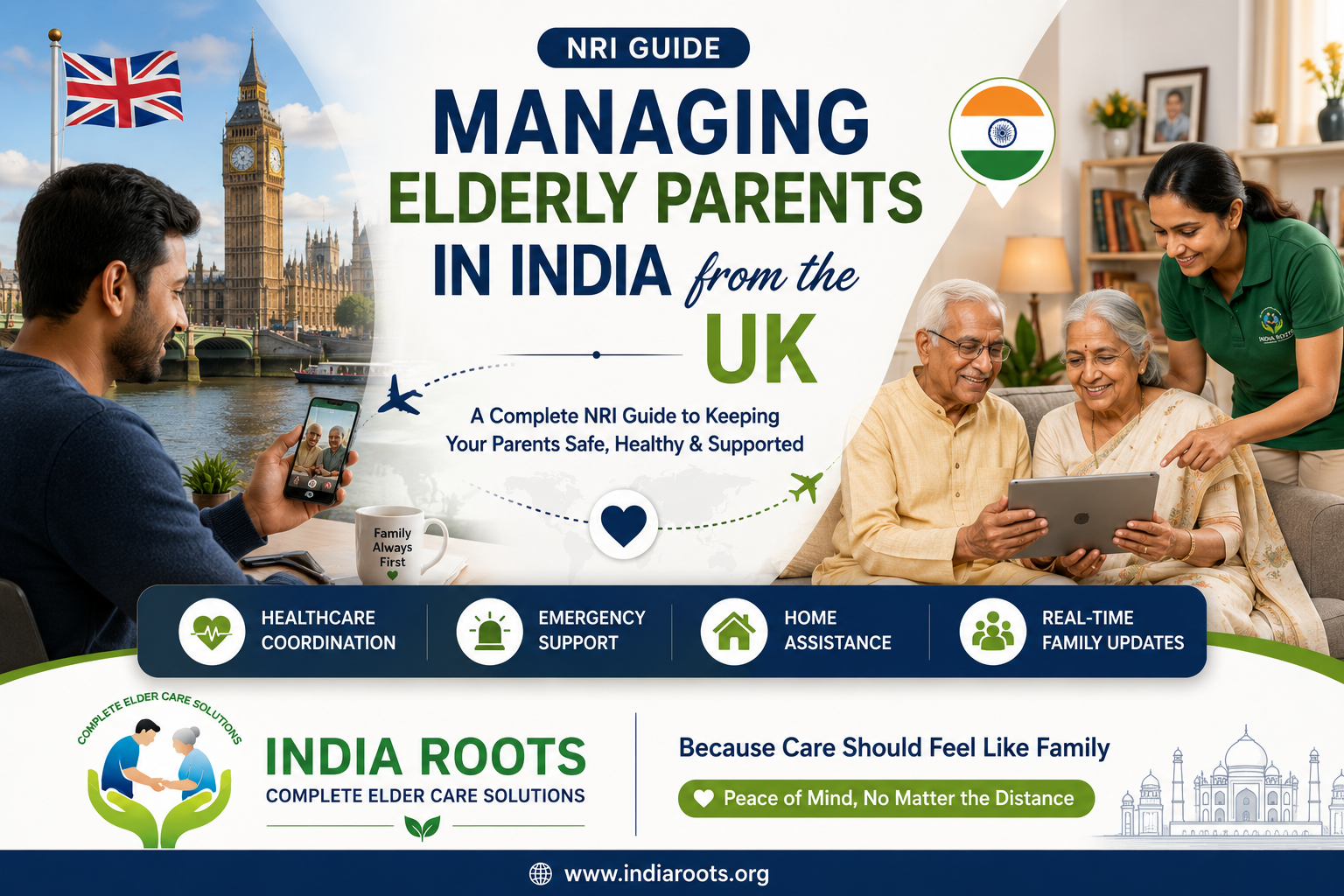
UK-based NRIs can manage elderly parents in India through a combination of regular video calls, professional on-ground elder care services, advance legal arrangements such as Power of Attorney, digital financial tools for remote bill payment, and emergency response planning. The most effective approach combines all of these — with a trusted on-ground partner like IndiaRoots handling the physical presence that cannot be provided from Leicester, Southall, Birmingham, or anywhere else in the UK. IndiaRoots provides regular home visits, medical coordination, documentation support, and emergency response across Delhi NCR, Punjab, Haryana, Chandigarh, and surrounding regions. Contact us at info@indiaroots.org or WhatsApp +91 93508 98003.
The UK-India Distance Problem — Why It Is Different
Managing elderly parents in India from the UK carries a specific weight that is worth naming before anything else.
You are approximately 6,700 kilometres away. The time difference is between four and a half and five and a half hours depending on the season — close enough that a crisis in India reaches you during your working day rather than the middle of the night, but far enough that the earliest you can arrive after booking an emergency flight is eighteen to twenty-four hours. A return ticket in peak season from Heathrow or Gatwick to Delhi, Chandigarh, or Amritsar runs to several hundred pounds at short notice. The cost, the visa situation for travel, the leave arrangements — all of it makes spontaneous travel genuinely difficult.
Unlike the Canada-India connection, where the Punjabi diaspora is geographically concentrated and culturally cohesive around a specific set of cities, the UK’s Indian diaspora is more diverse — Punjabi families primarily from the Chandigarh tricity, Ludhiana, Jalandhar, and Amritsar; Gujarati families with roots in Gujarat and parts of Maharashtra; families from Haryana, Rajasthan, UP, and beyond. The cities where elderly parents live back in India vary widely, and the specific challenges — documentation in Punjab versus property matters in Gujarat versus medical coordination in Delhi NCR — are different in their detail, even if the emotional architecture is the same.
What is universal is this: the phone call is not enough. It has never been enough. And as parents age past 70, past 75, past 80, the gap between what a phone call can reassure and what is actually happening on the ground widens in ways that are impossible to fully close from the UK.
This guide is for UK-based NRIs who are trying to close that gap as responsibly as they can.
Who This Guide Is For
This guide is written for you if:
You live in the UK — in Leicester, Southall, Birmingham, Manchester, London, Leeds, Glasgow, or anywhere else — and one or both of your parents live alone in India.
Your parents are over 65. They may be managing well day-to-day, or they may be beginning to struggle in ways they do not fully disclose to you. They live in their own home — in Chandigarh, in Mohali, in Delhi, in Gurugram, in Ludhiana, in Amritsar, in Haryana, or elsewhere — and they have built their lives there.
You are involved and caring. You call regularly. You send money home. You visit when you can — but visits are expensive, leave is limited, and the gap between trips is stretching longer than you would like.
You are beginning to worry in a specific way. Not about a crisis — yet — but about the slow accumulation of small things that could become a crisis. The medication nobody is tracking. The document nobody has updated. The home repair that never got done. The loneliness that your parent minimises every time you ask.
If this describes your situation, this guide is for you.
The Five Biggest Challenges UK-Based NRIs Face
Over years of working with NRI families, IndiaRoots has identified the challenges that come up most consistently for UK-based families with elderly parents in India. They are worth naming clearly, because understanding the problem is the first step toward solving it.
Challenge 1 — You cannot verify what you are being told
Your parent tells you they are fine. They are managing. The neighbours are helpful. Everything is under control.
You have no way to know whether this is true. Not because your parent is dishonest — they almost certainly believe it themselves — but because elderly people consistently underreport difficulty to children abroad. They do not want to worry you. They do not want to appear dependent. They have internalised, across decades, the belief that being a burden is a form of failure.
The result is that most UK NRI families are operating on incomplete and overly optimistic information about their parent’s real situation.
Challenge 2 — The time zone makes real-time response difficult
At four to five and a half hours ahead, India is not an impossible time zone to manage from the UK. But it does mean that a crisis happening in India at 9pm IST reaches you at 4:30pm UK time — mid-afternoon, potentially in a meeting, potentially with children to collect from school. And by the time you have absorbed the information, made calls, and tried to coordinate anything, another two or three hours have passed.
In a genuine emergency, those hours matter.
Challenge 3 — Documentation always falls behind
Aadhaar updates. Bank nominations. Power of Attorney. Jeevan Pramaan (pension life certificate). PAN-Aadhaar linking. Will registration. Property mutation.
These tasks require physical presence at government offices and banks in India. They cannot be done remotely. For UK-based NRIs, the only options are either to fly to India specifically to complete them, to persuade an already-stretched elderly parent to do it alone, or to leave them undone — which most families end up doing until a crisis makes them urgent.
Challenge 4 — Medical coordination is structurally broken
Your parent has a doctor’s appointment in Chandigarh or Delhi or Ludhiana. Someone needs to take them. Someone needs to sit in the appointment, understand what the doctor says, note the prescription, purchase the medication, and explain the dosage instructions. Someone needs to follow up on the test results.
From the UK, you can do none of this directly. You can call your parent after the appointment and hope the account they give you is accurate and complete. It often is not — not through any fault, but because elderly patients frequently forget or misunderstand what doctors say, particularly in busy Indian clinical settings where appointments are brief.
Challenge 5 — Emergencies have no plan
If your parent falls in the middle of the night in Mohali, what happens? If they are taken to hospital, who accompanies them? Who speaks to the doctors? Who calls you? Who makes decisions before you can be reached?
Most UK NRI families, if they are honest, do not have a clear answer to these questions. There is a vague plan involving neighbours, or a relative who lives forty minutes away, or a hope that the situation will somehow be managed. This vagueness is not irresponsible — it reflects the genuine difficulty of planning for emergencies across such a distance. But it is a gap that needs closing before the gap becomes a crisis.
Managing Health and Medical Care from the UK
Health management is the most urgent practical concern for most UK NRI families. Here is a realistic breakdown of what needs to be in place.
Know your parent’s complete medical picture
This sounds obvious but is rarely done thoroughly. As a starting point, ensure you have:
- A complete list of all medications your parent takes, including dosages, timing, and the prescribing doctor’s name and contact
- The names and direct contact numbers of all treating doctors — their general physician, any specialists, and the nearest hospital they would use
- A record of all known health conditions, recent investigations, and test results
- Information about any allergies, particularly to medications
Keep this information updated. If your parent has a hospital visit and a prescription changes, the list changes. Establishing the habit of getting this information after every medical interaction is one of the most useful things you can do from the UK.
Establish a medical escort arrangement
Someone needs to be physically capable of taking your parent to medical appointments, staying through the consultation, and reporting back to you accurately. This is not a task that neighbours can reliably perform — it requires commitment, consistency, and the ability to communicate medical information clearly.
IndiaRoots provides medical escort as a core service across all the cities where elderly parents of UK NRI families typically live — Chandigarh, Mohali, Panchkula, Delhi, Gurugram, Noida, Ludhiana, Amritsar, and Haryana. Our associates accompany your parent, note what the doctor says, collect prescriptions, and report to you in detail.
Medication monitoring
The most common medical problem IndiaRoots identifies in elderly clients is not a dramatic health event — it is quiet medication non-compliance. A tablet skipped because the blister pack was confusing. A medication discontinued because it seemed to be causing side effects and nobody was around to suggest a doctor’s review instead. A prescription not filled because the chemist required the original and the original was mislaid.
Regular in-person visits allow IndiaRoots associates to verify medication compliance in a way that a phone call never can.
Chronic condition management
If your parent has diabetes, hypertension, cardiac conditions, thyroid disorders, or any other chronic condition requiring ongoing management — quarterly check-ups are not enough. The lifestyle factors between check-ups matter: what they are eating, how much they are moving, whether they are sleeping adequately, whether stress levels are elevated. These are things that a phone call cannot assess and an annual India visit cannot meaningfully monitor.
Mental health — the invisible challenge
Depression, anxiety, and early cognitive decline are significantly under-detected in elderly Indians living alone. The cultural context makes it less likely that a parent will self-report psychological difficulty. The clinical infrastructure for geriatric mental health in most Indian cities is limited. And from the UK, the signs — social withdrawal, changes in sleep or appetite, flattened affect, subtle memory lapses — are essentially invisible.
IndiaRoots care associates are trained to observe and report these signs. We have flagged early depression and early cognitive changes in clients whose families in the UK had no idea anything was amiss. Early detection changes outcomes dramatically.
Documentation and Legal Affairs — What Needs to Be in Order
Documentation is the area where UK NRI families most consistently fall behind — and where the consequences of falling behind can be most practically damaging.
Here is a checklist of what should be in order for any elderly parent living alone in India.
Power of Attorney
A Power of Attorney (POA) allows a designated person in India — a trusted family member, a lawyer, or an organisation like IndiaRoots — to act on your parent’s behalf for specific purposes: property matters, banking, government liaison, or broader general authority. For UK NRI families, a POA is not optional. It is the legal foundation that allows anything else to happen when you cannot be there.
A POA must be registered in India to be legally valid for most purposes. It can be executed at the Indian High Commission in the UK under certain circumstances, or your parent can execute it in India with appropriate legal assistance. IndiaRoots coordinates the POA process for families who need it.
Read our detailed guide: Power of Attorney for Elderly Parents in India
Aadhaar card
Aadhaar is the foundational identity document for virtually every government service in India. It must be up to date — correct address, functional biometrics, linked to your parent’s bank account and PAN card. An outdated or improperly linked Aadhaar card blocks pension access, banking services, and a growing range of government benefits.
The biometric update process requires physical attendance at a UIDAI-authorised centre. For elderly parents with diminished fingerprint quality — which is common — the iris scan alternative must be used. IndiaRoots accompanies clients to Aadhaar centres and manages the complete process.
Read our detailed guide: How to Update Aadhaar for Elderly Parents in India
Bank nomination
If your parent’s bank accounts do not have updated nominations — naming the correct beneficiary — accessing those funds after their death becomes an extremely lengthy legal process. This is a straightforward update that requires a bank visit and a simple form. It is also one of the most commonly undone tasks for elderly parents living alone.
Read our detailed guide: How to Update Bank Nomination for Elderly Parents in India
Jeevan Pramaan — the annual life certificate
If your parent receives a government pension, they are required to submit a Jeevan Pramaan — a digital life certificate confirming they are alive — once a year, typically in November. Failure to submit results in pension suspension. The process requires biometric authentication at a bank, post office, or CSC centre.
IndiaRoots manages Jeevan Pramaan submissions for all enrolled clients. We track the deadline and ensure submission without the family having to chase it.
Will and property documentation
A registered will is not mandatory in India but provides enormous legal clarity and significantly reduces the risk of family disputes or administrative complications after death. Property mutation records, title deeds, and related documentation should all be in order and accessible.
For UK NRI families who have not addressed property documentation, IndiaRoots can assist with liaison at the relevant Tehsildar office or property registration authority.
Read our detailed guide: NRI Property Documentation in India Without Travelling
NRI documentation assistance — the complete picture
For a comprehensive overview of all documentation tasks UK NRI families need to address, read: NRI Documentation Assistance in India
The Time Zone Reality — UK to India
The UK to India time difference sits at four and a half hours (GMT) to five and a half hours (BST during British Summer Time). This is meaningful in practice.
When your parent wakes at 6am IST and takes their morning medication, it is 1:30am in the UK. If they need to ask you something, they wait. If they are unwell, they may not call at all rather than wake you.
When you finish work at 6pm UK time, it is 10:30 or 11:30pm in India. Your parent is likely asleep. The productive window for communication — where both parties are alert and available — is relatively narrow.
This time zone dynamic reinforces the “I am managing” pattern. Your parent does not want to call during your working hours. They do not want to call when you are likely sleeping. The calls happen at convenient times, which are inherently the times when everything seems most under control.
IndiaRoots bridges this gap by being physically present in India during India’s waking hours — when your parent is actually going about their day, taking their medication, receiving a delivery, dealing with a plumber, or sitting alone in the late afternoon. We observe what is happening in real time and report back to you at whatever time is convenient for you in the UK.
We are also reachable by WhatsApp at +91 93508 98003 for urgent communication across the time zone — including for families who receive an update late in the UK evening and want to speak to someone immediately.
Financial Management from the UK
Managing your parent’s finances from the UK is more tractable than it was a decade ago — but still requires active systems and oversight.
Regular money transfers
Most UK NRI families send regular money to parents in India through bank transfers, services like Wise, Remitly, or Western Union, or through NRE/NRO account arrangements. Establish a reliable, regular transfer schedule and ensure your parent has sufficient buffer in their account to cover unexpected expenses.
Bill payments
Electricity, water, gas, property tax, society maintenance — many of these can now be paid online in India. However, for elderly parents who are not digitally confident, or for bills that still require physical payment, IndiaRoots manages bill payment logistics on the ground, ensuring no deadline is missed.
Pension and savings
If your parent receives a pension — government, EPS, or otherwise — ensure the account is active, the nomination is updated, and the Jeevan Pramaan is submitted annually. For PPF accounts, FD renewals, or other savings instruments, IndiaRoots accompanies parents to banks and post offices to manage the administrative requirements.
Protecting against fraud
Online and telephone fraud targeting elderly people in India has increased significantly. The specific patterns are worth knowing: fake bank officials requesting OTPs, lottery scam calls, KYC verification fraud, and WhatsApp-based impersonation. IndiaRoots is trained to recognise and report these patterns and to educate elderly clients about how to respond.
For a detailed guide to financial fraud targeting elderly parents, read: Online Fraud Targeting Elderly in India — How to Protect Your Parents (coming soon)
Emergency Preparedness — What to Do When Something Goes Wrong
Every UK NRI family with elderly parents in India needs an emergency plan. Not a vague intention — an actual plan with specific names, numbers, and protocols written down and accessible.
The emergency contact structure
Your emergency contact structure should include at minimum:
- The direct mobile number of your parent’s treating physician
- The number of the nearest hospital emergency department your parent would use
- The number of at least one trusted neighbour who can physically reach your parent within fifteen minutes
- The number of any nearby family member — even if not in the same city, someone reachable within two to three hours
- The number of your IndiaRoots care associate and the IndiaRoots emergency line: +91 93508 98003
The IndiaRoots emergency protocol
For all IndiaRoots-enrolled clients in India, we maintain an emergency response protocol that operates beyond standard visit hours. In an urgent situation:
- The nearest IndiaRoots associate reaches your parent as quickly as possible
- We coordinate with the appropriate hospital — Fortis, Max, AIIMS, PGIMER, or whichever facility is appropriate for the location and situation
- Your parent is not left alone in a medical situation
- You are notified immediately, with updates as the situation develops
For UK families, this protocol means that when a crisis happens in India, someone is already on the ground and moving — before you have had time to absorb the news, book a flight, or arrange emergency leave.
What to do in the immediate aftermath of a crisis
If you receive a call informing you of a parent’s medical emergency in India:
First: call IndiaRoots (+91 93508 98003) if we are not already managing the situation — we can be on the ground faster than you can arrange anything else from the UK.
Second: contact the treating hospital and identify the attending doctor. Ask for a direct number.
Third: if you have a Power of Attorney in place, confirm to the hospital and any legal parties that it is valid and that decisions can be made by the named holder.
Fourth: assess whether to travel immediately or to manage remotely with IndiaRoots on the ground. For a hospitalisation with someone on the ground coordinating, you may not need to come immediately. We will be honest with you about when physical family presence is needed.
Home and Daily Life — Keeping Things Running
The unglamorous reality of supporting elderly parents from abroad is that most of what matters is not dramatic. It is the daily rhythm of life — meals, medications, errands, repairs, social engagement — staying intact and functioning.
Domestic help management
Many elderly parents in India rely on domestic help — a cook, a cleaner, a driver. Managing this domestic help from the UK is genuinely difficult: verifying reliability, dealing with absences, finding replacements, ensuring fair treatment. IndiaRoots can supervise and manage domestic help arrangements on behalf of families, including conducting background checks where needed and handling any staffing changes.
Home maintenance
Plumbing, electrical repairs, gas cylinder logistics, inverter servicing, pest control, minor structural repairs — these are constant in any Indian home. For elderly parents managing alone, they represent a stream of stressful decisions and logistical challenges. IndiaRoots maintains vetted relationships with reliable contractors across all service cities and supervises all repair work, ensuring quality and fair pricing.
Grocery and household supplies
For parents in cities with reliable app-based delivery infrastructure — Delhi, Chandigarh, Gurugram, Noida — IndiaRoots can help set up and manage grocery delivery accounts so that essential supplies arrive at the door. For parents in cities or areas where this infrastructure is less reliable, our associates handle grocery errands as part of regular visit schedules.
Safety adaptations
As parents age, home safety becomes more important. Anti-slip mats in bathrooms, grab bars near toilets and stairs, adequate lighting throughout the home, functional door locks, a working emergency contact list on the wall. IndiaRoots conducts home safety assessments and coordinates the implementation of any adaptations identified.
The Emotional Dimension — Your Parent’s Wellbeing and Yours
Your parent’s emotional reality
Loneliness among elderly people living alone in India is a genuine health risk that is significantly underacknowledged. An elderly parent in Leicester-connected Punjab or Birmingham-connected Gujarat who has outlived their spouse, seen their friends dwindle, and watched their children build lives in the UK is carrying a social and emotional weight that weekly phone calls — however loving — cannot adequately address.
The cultural context makes this harder to see. Indian elderly people — particularly of that generation — are not likely to say “I am lonely” or “I am depressed.” They are more likely to say everything is fine, God is great, they do not need anything. The feelings are expressed, if at all, in oblique ways: unusual quietness on the phone, less interest in news that would normally engage them, comments about how nice it was when the family was all together.
IndiaRoots companionship visits provide regular, meaningful human contact. Not a transaction, not a check-in — a genuine relationship with a consistent person who shows up, sits down, and is genuinely present. For many of our elderly clients, this relationship becomes one of the most important in their week.
Your emotional reality
The guilt that UK NRI families carry about parents in India is real and rarely spoken about openly. It sits in the background of every phone call, every visit home, every missed birthday. It intensifies when something goes wrong — and compounds with the practical helplessness of being thousands of kilometres away.
IndiaRoots does not resolve the distance. But it significantly reduces the uncertainty that makes the guilt unbearable. When you know that someone reliable is visiting your parent, reporting back honestly, and handling what needs to be handled — the quality of your worry changes. It becomes less frantic, less helpless, less consuming.
Many UK families who engage IndiaRoots tell us that what they notice most immediately is not a practical change — it is a shift in how they feel when they put the phone down after talking to their parent. For the first time in years, they actually believe that things are okay.
When a Phone Call Is No Longer Enough
There is a specific moment in most NRI families’ experience when the phone call stops being sufficient. It is not always a dramatic crisis. Often it is something quieter — a detail noticed during a visit that your parent had not mentioned, a document discovered to be missing, a health indicator that had been quietly declining for months without anyone catching it.
The signs that it is time to move from phone-call management to on-ground support:
- Your parent is 75 or older and living alone, even if they seem healthy
- There has been any fall, hospitalisation, or significant health event in the past twelve months
- You are aware of any cognitive changes — forgetfulness, confusion, repetition — however mild
- Your parent has a chronic condition requiring ongoing management
- Critical documents — Aadhaar, bank nomination, POA, will — are not in order
- You do not have a clear emergency plan with specific names and numbers
- You feel, on balance, more anxious about your parent than you feel reassured
Any one of these is a sufficient reason to begin a conversation with IndiaRoots. All of them together constitute a situation that needs addressing without delay.
How IndiaRoots Supports UK-Based NRI Families
IndiaRoots is an on-ground elder care organisation with teams operating across Delhi NCR, Punjab, Haryana, Chandigarh, and surrounding regions — exactly the cities where the parents of most UK NRI families live.
Our services for UK-based families include:
Regular welfare check visits — in-person visits to your parent’s home, on a schedule you choose, with a structured report after every visit.
Companionship — meaningful, consistent human presence that addresses the loneliness your parent is unlikely to admit to.
Medical escort and coordination — scheduling appointments, arranging transport, accompanying your parent, noting the doctor’s instructions, collecting medications, reporting to you in detail.
Documentation support — Aadhaar updates, bank nomination, Jeevan Pramaan, POA coordination, property documentation, PAN-Aadhaar linking, and any other government or banking task your parent needs.
Home maintenance supervision — vetted contractors, supervised repairs, household supply management, home safety assessment.
Emergency response — on-ground activation in any urgent situation, hospital coordination, immediate family notification.
Financial errand support — bill payments, bank errands, pension management, fraud monitoring.
How to get started:
The first step is a free consultation call. We speak with you about your parent’s situation — their health, their location, their specific needs, your concerns — and explain exactly how IndiaRoots would support your family.
📧 Email: info@indiaroots.org
📞 WhatsApp: +91 93508 98003
🌐 indiaroots.org
We are familiar with UK time zones and can schedule calls at times that work for you in the UK — evenings, weekends, or during your lunch break.
UK NRI Community — City-by-City Context
The UK’s Indian diaspora is one of the most established in the world, with communities that have been present for three to four generations in some cities. Understanding the specific community context helps explain why the parent-care challenge has the particular shape it does for UK NRI families.
Leicester
Leicester has one of the largest Gujarati communities outside of India, with deep roots going back to the 1960s and 1970s migrations — including the significant wave from East Africa. Many Leicester families have elderly parents or grandparents in Gujarat, but also in the Punjab and Haryana regions. The community is well-organised and has existing networks of mutual support — but these networks do not extend to on-ground care management in India.
Southall, West London
Southall has been the heart of the Punjabi community in the UK for decades. Families here typically have parents in Punjab — Ludhiana, Jalandhar, Amritsar, Patiala — or in the Chandigarh tricity. The emotional and cultural connection to Punjab is extremely strong in Southall, and the guilt about parents left behind is correspondingly acute. IndiaRoots serves all of these Punjab cities comprehensively.
Birmingham
Birmingham has large communities from both Punjab and Gujarat, as well as significant populations from Haryana, UP, and other states. The diversity of origin means a diversity of parent locations in India — from Chandigarh to Ahmedabad to Gurugram. IndiaRoots covers Delhi NCR, Punjab, and Haryana, which accounts for a significant proportion of Birmingham NRI families’ parent locations.
Manchester
Manchester’s Indian community includes significant Gujarati and Punjabi populations, with families whose parents live across Northwest India. IndiaRoots’ coverage of the Chandigarh tricity and Punjab cities is directly relevant to many Manchester NRI families.
London — broader
London’s Indian population is the largest in the UK and represents the full diversity of India’s geography and culture. Families across East London, North London, and the outer boroughs have parents across India — and IndiaRoots’ service geography in North India means we are relevant to a very large proportion of them.
Scotland — Glasgow and Edinburgh
Scotland’s Indian community is smaller but growing, with Punjabi families particularly in Glasgow. The community’s cultural ties to Punjab are strong, and IndiaRoots serves the Punjab cities — Ludhiana, Amritsar, Jalandhar — that are most relevant to Scottish Punjabi families.
Case Studies — UK Families, Indian Parents
Case Study 1 — The Pension Crisis That Almost Wasn’t, Leicester to Chandigarh
Mr. Hardev Bains, 78, lives alone in Sector 15, Chandigarh. His son Gurpreet is in Leicester, running a business. In November 2024, Hardev missed the Jeevan Pramaan deadline for his government pension. His pension was suspended in December. He did not tell Gurpreet for three weeks — managing on his savings and not wanting to create worry.
When Gurpreet found out, he was distressed both by the pension suspension and by the realisation that his father had been concealing it. He contacted IndiaRoots. Our Chandigarh team accompanied Hardev to the relevant bank, completed the delayed Jeevan Pramaan submission, and liaised with the pension authority to reinstate the pension — a process that took eleven days from IndiaRoots’ engagement.
IndiaRoots now manages Hardev’s Jeevan Pramaan submission annually, tracking the deadline and ensuring it never lapses. Gurpreet receives confirmation the moment it is done.
Case Study 2 — The Medication That Changed Everything, Southall to Ludhiana
Mrs. Kamla Sharma, 74, lives in Ludhiana. Her daughter Priya is in Southall. Priya had been calling her mother every day — good calls, by all accounts. Her mother was cheerful, engaged, seemed to be managing well.
During an IndiaRoots welfare check visit in March 2025, the care associate noticed that Kamla’s insulin for her Type 2 diabetes had not been refrigerated correctly — she had been keeping it in a cupboard rather than the refrigerator, not fully understanding the storage requirement. The insulin had been compromised for an unknown period. Her blood sugar readings, which she self-monitored with a glucometer, had been persistently elevated but within a range she considered normal.
IndiaRoots flagged this to Priya and coordinated with Kamla’s doctor. The insulin was replaced, storage protocols were established clearly, and Kamla’s blood sugar stabilised over the following three weeks.
Priya told us: “She seemed absolutely fine on every call. I had no idea.”
Case Study 3 — The Property Dispute Avoided, Birmingham to Amritsar
Mr. Balvinder Singh, 80, lives in Amritsar. His three children are split between Birmingham and Canada. Balvinder’s wife passed away in 2023, leaving a property situation that was legally unclear — a jointly owned property with no updated mutation and no registered will.
His daughter Navneet, in Birmingham, realised the extent of the problem only when she visited India in early 2024. She contacted IndiaRoots to assist with the documentation process. Our team in Punjab liaised with a local advocate, accompanied Balvinder to the relevant property office, and managed the mutation process. A will was also drafted and registered with legal assistance IndiaRoots coordinated.
Navneet reflected: “If we had left it another year or two, it would have been a legal nightmare for all three of us.”
Comparison — Managing Alone vs. With IndiaRoots
Ready to Talk? — Start Here
If you are based in the UK and your parents are in India, IndiaRoots can provide the on-ground support that makes the distance manageable.
The first conversation is free. We speak with you about your parent’s specific situation — their location, their health, their daily needs, your concerns — and explain exactly what IndiaRoots would do. No scripts, no pressure. Just a practical discussion about how we can help.
We are comfortable with UK time zones and can arrange calls at evenings, weekends, or any time that suits you.
📧 Email: info@indiaroots.org
📞 WhatsApp: +91 93508 98003
🌐 indiaroots.org
Frequently Asked Questions
I am based in the UK and my parents live in Punjab — does IndiaRoots cover their area?
IndiaRoots covers Punjab comprehensively, including Ludhiana, Amritsar, Jalandhar, Patiala, Mohali, and the broader Chandigarh tricity region. If you are unsure about specific coverage for your parent’s address, call or WhatsApp us at +91 93508 98003 and we will confirm immediately.
My parents live in Delhi — do you serve Delhi NCR?
Yes. IndiaRoots serves Delhi NCR including South Delhi, West Delhi, Gurugram, Noida, Greater Noida, Faridabad, and Ghaziabad. Delhi NCR is one of our primary service regions.
What is the time zone situation for communicating with IndiaRoots from the UK?
India is four and a half hours ahead of UK GMT and five and a half hours ahead during British Summer Time. IndiaRoots is accessible via WhatsApp (+91 93508 98003) throughout India’s business and evening hours, which covers most of the UK working day. For scheduled calls, we can arrange times that work for you — including early India morning calls which fall in the UK late evening.
Can IndiaRoots help set up a Power of Attorney for my parents in India?
Yes. IndiaRoots assists UK NRI families with the Power of Attorney process for parents in India — including identifying the appropriate legal professional, guiding your parent through the execution and registration, and managing the documentation. Read our detailed guide: Power of Attorney for Elderly Parents in India
How does IndiaRoots report back to UK families after visits?
After every visit, families receive a structured update in their preferred format — WhatsApp message, voice note, or written report. The update covers health and mood, medication status, home condition, any documentation or errand updates, and anything that needs the family’s attention. The format is agreed upon at the start and can be adapted to your preference.
My mother is resistant to outside help — how does IndiaRoots manage this?
This is the most common concern we hear from UK families. IndiaRoots approaches resistant clients gradually and without pressure. We typically begin with a low-key introductory visit framed as a friendly check-in, and allow the relationship to develop at your parent’s pace. Most clients who were initially resistant become genuinely comfortable — and often fond — of their IndiaRoots associate within the first few weeks.
What is the difference between IndiaRoots and a home nursing agency?
IndiaRoots is not a nursing agency. We provide comprehensive life support — companionship, errands, documentation, home management, medical escort, emergency coordination, and reporting to the family. For parents who additionally need medical nursing, IndiaRoots can coordinate with verified nursing providers while continuing to manage the broader support picture. The two services address different needs and are often complementary.
Can IndiaRoots handle my parent’s Jeevan Pramaan submission each year?
Yes. IndiaRoots tracks the Jeevan Pramaan deadline for all enrolled clients and accompanies them to the appropriate submission location — bank, post office, or CSC centre — to ensure it is completed before the deadline. We confirm submission to the family as soon as it is done.
What happens in a genuine emergency — a fall, a hospitalisation?
IndiaRoots activates its emergency response protocol: the nearest associate reaches your parent, we coordinate with the appropriate hospital, your parent is not left alone, and you are contacted immediately. For UK families, this means having someone on the ground responding before you have even had time to process the news and think about what to do. We update you at every stage and tell you honestly if and when your physical presence is needed.
How does IndiaRoots protect my parent from financial fraud?
IndiaRoots care associates are trained to recognise the specific patterns of fraud targeting elderly people in India — fake bank officials, KYC fraud, OTP requests, WhatsApp impersonation, lottery calls. We educate clients about how to respond to suspicious contacts, flag any patterns observed during visits, and notify the family immediately if anything concerning comes to our attention.
Is there a minimum engagement period with IndiaRoots?
IndiaRoots works on both short-term and long-term bases. There is no rigid minimum commitment — care plans are structured to fit your parent’s situation and your family’s needs. Many families begin with a trial period and extend to ongoing care as the relationship develops.
How much does IndiaRoots cost for UK-based families?
Pricing is fully customised based on visit frequency, service scope, and your parent’s specific location and requirements. Everything is discussed transparently in the initial free consultation. Email info@indiaroots.org or WhatsApp +91 93508 98003 to begin the conversation.
Conclusion
There is no perfect solution to the problem of being in the UK while your parents are in India. The distance is real. The time zone gap is real. The emotional weight of it — the guilt, the worry, the helplessness — is real and legitimate.
What IndiaRoots offers is not a perfect solution. It is a meaningful, practical, and proven reduction of the gap between the care you want to provide and the care that is actually possible from thousands of kilometres away.
From Leicester to Ludhiana. From Southall to Chandigarh. From Birmingham to Delhi. From Manchester to Mohali.
We are already there. We just need to meet your parent.
📧 info@indiaroots.org
📞 +91 93508 98003
🌐 indiaroots.org