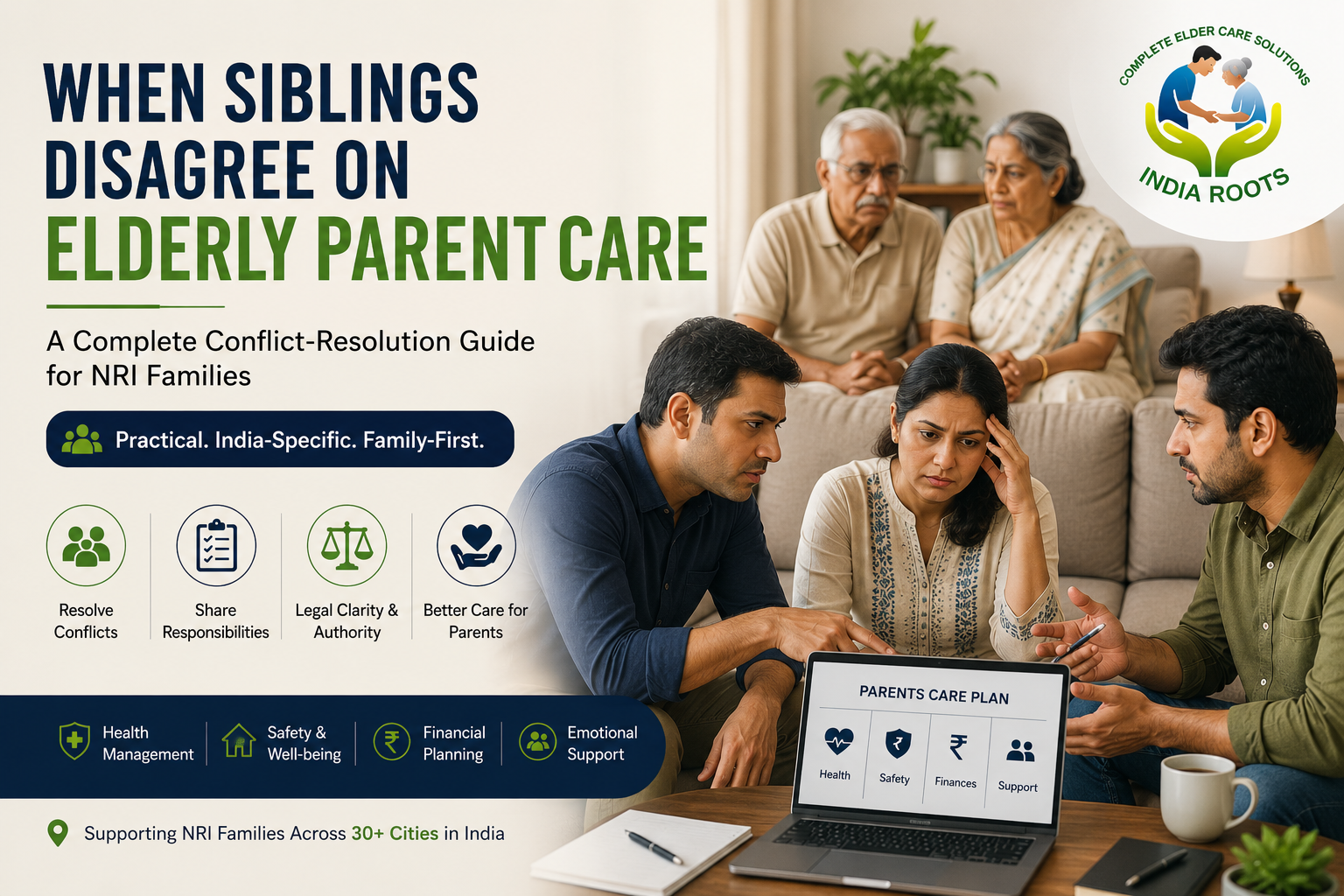
Every NRI family has the same group chat. It starts as “Mom & Papa Updates” and, six months in, becomes the place where three adult children who love the same two parents stop being able to agree on almost anything.
One sibling wants a full-time attendant. Another says a stranger in the house feels like giving up on the family. The one in Gurgaon feels like they’re the only one who actually shows up. The one in New Jersey feels like their monthly transfer never gets acknowledged as “real” help. And your parents — the two people this is actually about — are stuck listening to their children argue about them instead of talking to them.
If that sounds familiar, the problem isn’t your family. It’s that nobody gave you a structure. Here’s one.
The Numbers Behind This Conversation
This isn’t a niche problem. Around 11% of Indians belonged to the 60+ age group as of 2025, and that share is projected to exceed 20% by mid-century — India’s 60+ population is set to grow from roughly 8% in 2010 to 19% by 2050, encompassing over 300 million people. The most dependent segment is growing fastest: India’s 80+ population alone is projected to grow by around 279% between 2022 and 2050.
At the same time, the global Indian diaspora numbers roughly 35 million people, and the NRI population specifically has grown by over 70% in the last decade. Families managing aging parents from another country aren’t a shrinking exception — they’re the new normal, and the numbers are moving faster than most families’ systems for handling it.
Why This Fight Is Almost Universal in Indian Families Specifically
Sibling conflict over eldercare isn’t unique to NRI families — but it plays out differently in Indian households than it does elsewhere, for reasons worth naming directly:
Joint family expectations don’t disappear just because siblings moved abroad. There’s often an unspoken assumption that one child — the eldest son, or whoever lives in India — inherits primary responsibility for parents, sometimes tied directly to inheritance and property. Left unexamined, this becomes resentment on both sides.
Care and property get tangled together. Conversations about who cares for parents often happen in the same breath as conversations about who inherits the house — rarely said out loud, but shaping everything underneath.
Festivals and visits compress a year of guilt into two weeks. NRI siblings who see parents once a year often form judgments about care quality based on a short visit, while the sibling managing daily reality feels dismissed by someone who “just landed.”
“What will people say” is a real decision input, whether families admit it or not — especially around hiring outside help or placing a parent in any kind of managed care.
None of this makes Indian families more dysfunctional. It means a generic framework borrowed from Western eldercare content won’t fully work here.
The Real Reason These Fights Escalate So Fast
A fight about whether to hire a home nurse is almost never about the home nurse. It’s about who gets to be right about what your parents need, whose sacrifice counts as “enough,” and old sibling roles from childhood that were never renegotiated as adults.
Naming this out loud defuses more of the fight than any care plan will. Say it plainly: “I think we’re all scared, and that’s coming out as disagreeing about logistics.” It sounds simple. It works.
A Practical Framework: Six Steps
1. Get Your Parents’ Actual Answer — Not Each Sibling’s Guess
One video call, all siblings present, three direct questions to your parents: What help would actually make your day easier right now? What are you not willing to accept? Who do you trust to decide in an emergency? Write the answers down. Refer back to them whenever the group chat starts reinterpreting what “Mummy really wants.”
2. Split the Emotional Call From the Planning Call
The emotional call has no agenda. The planning call happens separately, with a fixed agenda covering logistics only. Most fights happen because these collapse into one 11 PM phone call where nobody can tell if they’re venting or deciding.
3. Put Names on Every Role — In Writing
| Common Conflict | Vague Approach (Fails) | Structured Approach (Works) |
|---|---|---|
| Hire a caregiver? | Everyone debates opinions | Professional assessment decides |
| Which hospital in an emergency | Whoever’s on the phone decides | Pre-agreed care plan + named contact |
| Who pays what | Argued after the bill arrives | Formula agreed in advance |
| Medication changes | Relayed sibling-to-sibling | Shared medical log, one source of truth |
| Final medical decision | Unclear, decided in the moment | Named decision-maker + documented backup |
4. Build a Cost-Sharing Formula Before You Need One
Pick one, in advance: equal split regardless of income, proportional to income, or effort-adjusted (the sibling providing hands-on care contributes less financially). Write it down and revisit it yearly — not mid-crisis.
5. Get a Neutral, Professional Assessment
When siblings can’t agree on how much care is needed, a geriatric care assessment replaces guesswork with facts. This single step resolves more disputes than any family conversation on its own.
6. Put Legal and Documentation Basics in Place Before a Crisis
This is the step most families skip — and often the one that matters most.
| Document / Planning Area | Why It Matters |
|---|---|
| Power of Attorney (POA) | A trusted family member in India can act on financial and legal matters on behalf of ageing parents. The authority granted depends entirely on the specific type of Power of Attorney executed and applicable Indian law. A POA does not automatically include medical decision-making authority. |
| Primary Hospital Contact | India does not have one universal medical directive system. Hospital procedures may differ, so families should nominate one primary contact for doctors and hospitals, and discuss appropriate authorization documents with a qualified lawyer and the parent’s physician before an emergency occurs. |
| Nominee vs. Legal Heir | A bank or investment nominee is not always the legal owner of an asset. Families should understand the distinction between nomination and inheritance to avoid confusion and disputes during estate settlement. |
| Joint Bank Account Access | Ensure the family member managing care in India has the necessary banking access or authorization so urgent medical expenses can be paid without delays caused by paperwork or overseas approvals. |
| Digital Storage of Important Documents | Securely store essential documents—including Aadhaar, PAN, medical records, insurance policies, prescriptions, and property papers—in a shared digital location accessible to more than one trusted family member. |
| Health Insurance Information | Keep policy details, cashless hospital networks, claim procedures, policy numbers, and emergency contacts readily available. Every sibling should know how claims are filed before a hospitalization creates unnecessary stress. |
Sorting this out in a calm moment prevents a second crisis from erupting on top of a medical one.
A Real Pattern We See
A common scenario IndiaRoots sees: three siblings — one in Toronto, one in Bangalore, one in Pune — disagreeing for months over whether their mother in Chandigarh needed live-in help after a fall. The sibling in Chandigarh felt outvoted by two siblings who weren’t seeing the daily reality; the siblings abroad felt shut out of a decision about their own mother. A professional home assessment gave the family an objective picture of her mobility and risk. Within a week, roles were assigned, a cost-sharing formula was agreed, and the family moved from arguing about opinions to executing a plan — with visibly fewer emergency hospital trips in the months that followed.
What Good Coordination Looks Like Day-to-Day
- A shared care log — updated by whoever is with your parents, so no one sibling is the sole filter of information
- A fixed update rhythm — daily, every other day, or weekly, agreed in advance
- Clear thresholds for group input — minor decisions handled by the primary contact alone; major decisions require the whole family
Free Resource: Family Care Planning Checklist
IndiaRoots offers a downloadable Family Care Planning Checklist covering: parent preferences, current medication list, emergency contacts, financial responsibilities and formula, legal documents on file, monthly expense tracker, and hospital/insurance details. Reach out below to get a copy.
How IndiaRoots Helps Families Get Past This
IndiaRoots works with NRI families across 30+ cities in India because this exact conflict — siblings who love their parents but can’t agree on how to care for them — is one of the most common reasons families reach out to us.
- An independent, professional assessment of your parents’ actual care needs, so the family works from facts, not competing guesses
- A single point of contact on the ground in India, so no one sibling becomes the informal, unpaid care manager for everyone else
- Structured updates shared with every sibling equally, wherever they live
- Support navigating documentation — including guidance on POA types and medical authorization — so your family isn’t figuring this out for the first time during a hospital emergency
We’re not here to tell your family what to decide. We’re here to give you a shared, trustworthy foundation so the decision gets made by facts and care — not by who argued longest.
Sibling disagreements are rarely a sign that your family doesn’t care. More often, they’re a sign that everyone cares deeply but lacks a shared process. When decisions are guided by your parents’ wishes, clear responsibilities, and objective professional advice, conflict becomes collaboration. Your parents deserve coordinated care — not delayed decisions. And your family deserves a system that makes that possible.
Get Support Today
Call: +91-93508 98003
Email: info@indiaroots.org
Serving NRI families across 30+ cities in India.
Frequently Asked Questions
Why do siblings fight so much about elderly parent care in Indian families specifically?
Indian families often carry unspoken assumptions linking eldercare responsibility to inheritance, birth order, or proximity — assumptions never explicitly agreed on as adults. Combined with infrequent NRI visits and cultural sensitivity around outside help, these disputes tend to be more layered than a simple logistics disagreement.
How should NRI siblings split eldercare costs fairly with siblings in India?
Pick one formula in advance: equal split, income-proportional split, or effort-adjusted split where the hands-on caregiver contributes less financially. Agree on it before a crisis forces the conversation, not during one.
What legal documents should NRI families set up before a parent care emergency?
A Power of Attorney appropriate to the intended scope, a clearly nominated primary contact for hospitals (discussed in advance with a lawyer and doctor, since India has no single universal medical directive system), and confirmed digital and physical access to essential documents for whoever is on the ground.
Should siblings hire a professional care coordinator or handle everything themselves?
When siblings disagree about how much care is genuinely needed, an independent professional assessment is usually the fastest way to end the deadlock, replacing competing opinions with an objective recommendation.
How can NRI siblings contribute if they can’t be physically present in India?
Beyond financial support: managing medical records and insurance paperwork remotely, vetting care providers, coordinating communication, and holding a share of legal or financial responsibility so it doesn’t all fall on one person.
What is the single most effective tool for reducing sibling conflict over parent care?
Written role clarity. Most conflict comes from vague, shared responsibility where everyone assumes someone else is handling something.
What if one sibling simply refuses to help?
Name it directly rather than working around it silently. Define what “help” can look like beyond money or physical presence — coordination, paperwork, research — and give that sibling a specific, low-friction role. If they still decline, document the agreed division of labor among the remaining siblings so it doesn’t quietly become one person’s unpaid job.
Can elderly parents legally choose one child to make decisions for them?
Yes, through a Power of Attorney or by naming a specific nominee on financial accounts, though the legal scope depends on the document type. Parents can express a preference for a primary decision-maker, but it’s worth formalizing that choice in writing rather than leaving it as a verbal understanding among siblings.
Should aging parents move abroad or stay in India?
This depends on the parents’ own preference, health needs, social support system, and visa/residency realities — there’s no universal right answer. It’s best decided after the parents’ own wishes are documented (Step 1) and a professional assessment clarifies their actual care needs (Step 5).
How often should siblings review the care plan?
At minimum, quarterly, or immediately after any significant health change. A plan built for a stable situation stops working the moment mobility, cognition, or living arrangements shift.
Is mediation helpful in family care disputes?
Yes, particularly when disagreements have become personal rather than logistical. A neutral third party — whether a family counselor or a professional care coordinator — can separate the emotional conversation from the practical one, which families in conflict often struggle to do on their own.