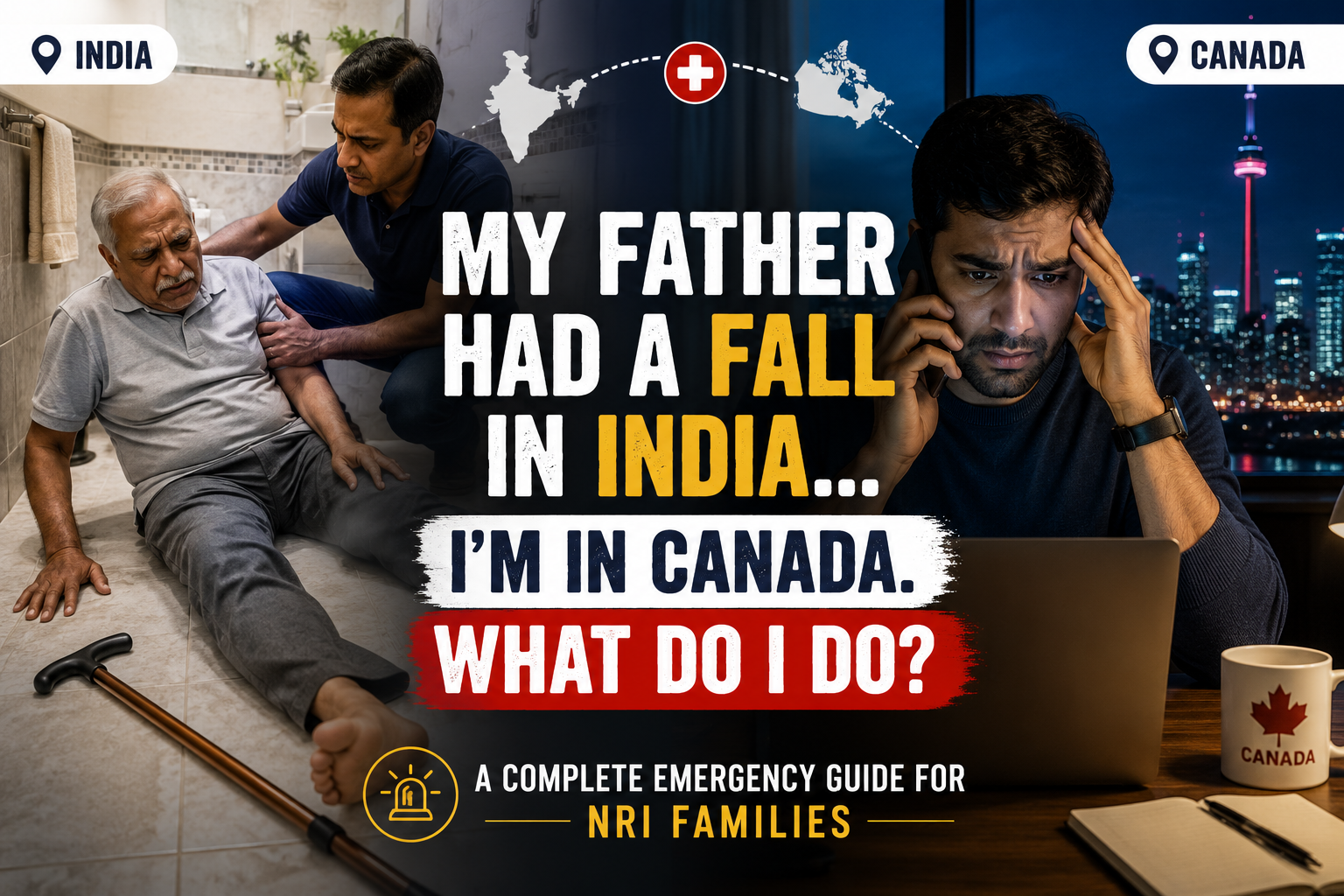
The 2 AM Phone Call Every NRI Family Fears
It is 2 AM in Toronto. Your phone rings. Your father has been rushed to a hospital in Chandigarh with a cardiac emergency. Doctors need immediate consent to proceed with surgery. Your mother is present but overwhelmed and unable to navigate the paperwork alone. The hospital administrator asks a simple, devastating question: who has the legal authority to act on your father’s behalf?
You are 11,000 kilometres away. You have no legal standing in India to sign documents, authorise treatment, or make decisions on his behalf. Every minute matters — and you are powerless.
This scenario plays out across India every week. And in nearly every case, the family did not have a Power of Attorney in place.
A Power of Attorney is not a complicated legal concept. It takes a few hours to prepare and a few thousand rupees to register. But for NRI families managing ageing parents in India from abroad, it may be the single most important legal step they ever take.
This guide covers everything you need to know — what a Power of Attorney is, which type suits your situation, how to create one from Canada, the USA, the UK, Australia, or the UAE, and how to avoid the most common and costly mistakes NRI families make.
What Is a Power of Attorney for Elderly Parents?
A Power of Attorney (POA) is a legal document through which one person — the Principal — authorises another person — the Agent or Attorney-in-Fact — to act on their behalf in legal, financial, medical, or personal matters.
For NRI families, a POA for elderly parents in India means that a trusted person — whether a local relative, family friend, or professional representative — can legally act on your parent’s behalf when you cannot be physically present.
A Power of Attorney Allows Someone To:
- Manage bank accounts and financial transactions
- Handle property sales, purchases, and maintenance
- Make medical decisions and consent to treatment
- Deal with insurance claims and renewals
- Complete pension and government documentation
- Represent your parents in legal and administrative proceedings
Who Needs It?
- NRI families with elderly parents living in India
- Elderly parents living alone in Chandigarh, Haryana, or anywhere in India
- Parents with existing or emerging health conditions
- Families managing property or assets remotely from abroad
Why Every NRI Family Should Have a Power of Attorney
Distance Creates Legal Problems
Managing the affairs of an elderly parent from another country is one of the most complex challenges an NRI family faces. Distance does not just create emotional strain — it creates legal and administrative paralysis.
Without a Power of Attorney, here is what you cannot do from abroad:
- Sign medical consent forms or authorise surgery on your parent’s behalf
- Execute property documents, complete a sale, or manage a purchase
- Access or operate a bank account on your parent’s behalf
- Collect pension disbursements if your parent cannot visit the bank in person
- File or pursue an insurance claim requiring physical submission
- Represent your parent before any government office, court, or administrative authority
Each of these situations requires someone physically present with the legal authority to act. A Power of Attorney creates that authority.
Real-Life Situations Where a POA Becomes Essential
Hospital Emergency: Your mother suffers a stroke in Panchkula. She is unconscious. The hospital requires next-of-kin consent before proceeding with an emergency procedure. If no local family member holds POA, the hospital may delay treatment while attempting to reach relatives abroad. A Medical POA or a General POA with healthcare provisions resolves this immediately.
Dementia Diagnosis: Your father is diagnosed with early-stage Alzheimer’s in Ambala. He is still mentally competent today, but that window will close. If a Durable POA is not created now, the family loses the legal ability to create one later — and must go through the courts instead.
Property Sale: Your parents decide to sell their Chandigarh flat and move to a smaller home. Without a registered POA, no one in India can sign the sale deed or appear before the Sub-Registrar on their behalf.
Pension Issues: Many government pension offices in Haryana and Punjab require annual life certificates or periodic in-person verification. If your parent cannot attend due to health conditions, a POA holder manages this on their behalf.
Banking Issues: Your father’s savings account is frozen due to inactivity. The bank requires in-person visits for KYC renewal. A POA holder attends in his place.
What Happens If You Don’t Have a POA?
This is the section most families never think about until it is too late.
Common Consequences of Not Having a POA:
- Treatment delays: Hospitals may delay non-emergency procedures while attempting to reach legally authorised family members
- Frozen bank accounts: Banks will not allow third-party access without legal authorisation
- Property transaction delays: Property sales stall when no authorised signatory is available
- Insurance claim issues: Claims requiring physical submission go unprocessed
- Court procedures: Families must apply for court-ordered guardianship, a process that takes months and costs significantly more than a POA
The Real Cost of Waiting Until a Crisis: Families who delay creating a POA until a crisis has already occurred typically face one of two outcomes: either the parent is still mentally competent and the process must be fast-tracked under stressful conditions, or the parent has already lost capacity — and a POA is no longer legally possible. In the second scenario, the family must pursue guardianship through a civil court, which involves legal fees, court delays, and ongoing judicial oversight.
The cost of creating a POA today is a fraction of the cost of not having one when it matters most.
Types of Power of Attorney in India
General Power of Attorney (GPA)
A General Power of Attorney grants the agent broad authority to act across multiple areas — banking, property, legal matters, medical decisions, and general administration — depending on how the document is drafted.
What It Covers: Financial transactions, property management, medical decisions, legal representation, government documentation, insurance, and pension matters — all within a single document.
Advantages: Comprehensive coverage across multiple domains. Reduces the need for separate documents for each task. Suitable for ongoing, long-term management of a parent’s affairs.
Risks: Broader authority carries a higher risk of misuse if the agent is not chosen carefully. An overly broad GPA with an unreliable agent can result in financial abuse or property disputes.
When It Makes Sense: When a trusted local person needs to handle a range of day-to-day matters over an extended period — particularly when parents are ageing and multiple areas of life require ongoing management.
Specific Power of Attorney (SPA)
A Specific Power of Attorney limits the agent’s authority to a single, clearly defined task or transaction.
What It Covers: One specific action — selling one property, managing one bank account, handling one insurance claim, or representing the principal in one court matter.
Examples:
- Selling a specific flat in Sector 22, Chandigarh
- Managing one savings account at Punjab National Bank
- Representing the principal in one ongoing property dispute
- Collecting one insurance claim settlement
Advantages: Lower risk. The agent’s authority expires once the specific task is complete. Easier to control and revoke.
When It Is Better Than GPA: For one-time transactions, particularly property sales, where you want strict limits on what the agent can do and do not want to grant ongoing authority.
Medical Power of Attorney
A Medical Power of Attorney specifically authorises the agent to make healthcare decisions on behalf of the principal.
Hospital Emergencies: Private hospitals in Chandigarh, Mohali, and Gurugram increasingly require legal documentation before allowing third parties to consent to major procedures. A Medical POA eliminates administrative delays during emergencies.
Surgery Consent: The POA should clearly specify whether the agent can consent to surgical procedures, including high-risk or emergency surgeries.
Healthcare Decisions: The document can also specify authority over decisions such as ICU admission, specialist referrals, choice of hospital, and end-of-life care preferences.
Durable Power of Attorney
A standard POA becomes void if the principal loses mental capacity. A Durable Power of Attorney includes specific language stating that the document remains valid even after the principal loses mental capacity.
Why It Matters for Dementia: This is critically important for families managing parents with early-stage dementia, Alzheimer’s disease, or those who have suffered strokes. Once mental capacity is significantly diminished, a standard POA can no longer be created or enforced.
What Happens If Mental Capacity Is Lost Without a Durable POA: The family has no legal recourse except court-ordered guardianship — a process that can take months, involves significant legal expense, and requires ongoing court supervision. Planning ahead with a Durable POA avoids this entirely.
General vs Specific Power of Attorney: Comparison
Who Should Be Appointed as Power of Attorney?
Qualities of the Right Person
Choosing the wrong agent is as dangerous as not having a POA at all. The agent you appoint will have real legal authority over your parent’s affairs. The person must be:
- Trustworthy: This is the non-negotiable quality. The agent will have access to bank accounts, property documents, and medical decisions.
- Locally available: An agent based in Chandigarh or the immediate surrounding area — Mohali, Panchkula, Zirakpur — can respond to emergencies quickly. An agent four hours away cannot.
- Financially responsible: The agent must handle money, property, and insurance matters with integrity.
- A capable communicator: The agent should keep the NRI family informed of every action, every development, and every decision made on the principal’s behalf.
Best Options
Adult child living locally in India: Often the most trusted option, particularly if they are in the same city as the parents.
Trusted relative: A sibling, niece, nephew, or cousin who is geographically close and has a good relationship with the parents.
Close family friend: Someone the parents know well, trust, and interact with regularly.
Lawyer: A practising advocate can serve as a professional agent, particularly for property and legal matters. Useful when family options are limited or when objectivity is important.
Elder care coordinator: A professional elder care organisation — such as IndiaRoots — can serve as a reliable, accountable, locally present agent for NRI families who do not have a suitable local family member available.
Can an NRI Child Hold POA?
Yes. An NRI child can be named as the Attorney-in-Fact. However, there is an important practical consideration: if you live abroad, you cannot physically appear at Indian government offices, banks, or hospitals. You can manage decisions made remotely — communicating with doctors, providing written instructions, coordinating with service providers — but you cannot sign physical documents in India.
For this reason, many NRI families appoint a trusted local person as the primary agent and name the NRI child as a secondary or co-agent for decisions that can be managed remotely.
Power of Attorney for Elderly Parents Living Alone
This is a situation that deserves specific attention. Elderly parents who live alone in Chandigarh or anywhere across Haryana face a higher risk profile — both medically and administratively. When something goes wrong, there is no immediate family member present to take action.
Why Seniors Living Alone Need a POA Earlier
When parents live alone, every medical event, banking issue, or property matter falls entirely on them to manage. If they are hospitalised even briefly, documents go unmanaged, bills go unpaid, and institutions go without the updates they require. A POA ensures someone can step in immediately.
Warning Signs Your Parents Should Create One Now
If two or more of these apply to your parent, creating a POA should be treated as urgent — not optional.
How to Create a Power of Attorney in India: Step-by-Step
Step 1 — Decide What Powers Are Needed
Before any drafting begins, clearly define the scope. Do you need someone to manage one specific property transaction? Handle all banking matters? Make medical decisions? Manage day-to-day affairs comprehensively? The answers determine whether you need a GPA or SPA, and what specific powers must be included.
Step 2 — Draft the Document
The POA must be drafted on stamp paper of the appropriate denomination, which varies by state and by the nature of the POA. In Chandigarh and across Haryana, consult a local advocate or the Sub-Registrar’s office to confirm current stamp duty requirements.
The document must include:
- Full names, addresses, and identification details of both the principal and the agent
- A clear and specific description of all powers being granted
- Any limitations or exclusions on those powers
- The duration of the POA — whether it is open-ended or limited to a specific time period
- The date and place of execution
Step 3 — Gather Required Documents
Step 4 — Sign Before Witnesses
The POA must be signed by the principal in the presence of two adult witnesses who are not named as agents or beneficiaries in the document. The agent may also be required to sign depending on the document type and state-specific requirements.
Step 5 — Register the POA
For property-related POAs, registration at the Sub-Registrar’s office is mandatory under the Registration Act, 1908. Both the principal and the agent — or their representatives — must appear before the Sub-Registrar. For non-property POAs, registration is not always legally required but is strongly recommended for legal enforceability and acceptance by banks, hospitals, and government offices.
Documents Required for Power of Attorney in India
For Parents (Principal)
- Aadhaar Card
- PAN Card
- Passport (if available)
- Address proof (utility bill, voter ID, or bank statement)
- Passport-size photographs
For NRI Children (Agent, if applicable)
- Valid Indian Passport
- OCI Card or PIO documentation
- Overseas address proof
- Visa or residency documentation
- Passport-size photographs
For Property Matters (Additional)
- Original title deed of the property
- Latest property tax receipt
- Encumbrance certificate
- Society NOC (if applicable for apartment properties)
For Medical Matters (Additional)
- Existing hospital registration records (helpful but not always mandatory)
- Any relevant medical history documentation the agent may need to present
How NRIs Can Create a Power of Attorney from Abroad
This is among the most-searched questions by NRI families — and the answer is practical and straightforward. You do not need to travel to India to create a POA.
If You Live in Canada
Draft the POA with guidance from an Indian lawyer or a legal firm familiar with Indian law. Sign the document before a Canadian Notary Public. Take the notarised document to the nearest Indian High Commission or Consulate for attestation. Courier the attested document to India. In India, pay the applicable stamp duty through adjudication at the collector’s office, then register at the Sub-Registrar’s office.
If You Live in the USA
The process is identical to Canada. Sign before a US Notary Public, then get the document attested at the nearest Indian Consulate or Embassy — New York, Washington DC, Chicago, Houston, San Francisco, Atlanta, or Seattle. Courier to India for adjudication and registration.
If You Live in the UK
Sign before a UK Notary Public. Attestation is done at the Indian High Commission in London or at the Indian Consulates in Birmingham or Edinburgh. Courier to India for the subsequent steps.
If You Live in Australia
Sign before an Australian Notary Public. Attestation at the Indian High Commission in Canberra or the Consulates in Melbourne or Sydney. Courier to India.
If You Live in the UAE
Sign before a UAE Notary Public. Attestation at the Indian Consulate in Dubai or the Indian Embassy in Abu Dhabi. Courier to India.
NRI Power of Attorney Process: Step-by-Step Checklist
| Step | Action | Where |
|---|---|---|
| 1 | Draft the Power of Attorney (POA) document | With Indian legal guidance |
| 2 | Sign before a Notary Public | In your country of residence |
| 3 | Obtain Embassy or Consulate attestation | Indian Embassy or Consulate in your country |
| 4 | Courier the attested POA document to India | To a trusted representative or family member in India |
| 5 | Pay applicable stamp duty (adjudication) | Collector’s Office / Revenue Authority in India |
| 6 | Register the POA document | Sub-Registrar’s Office in the relevant district in India |
The full process typically takes two to four weeks end-to-end, depending on your location and the efficiency of the Sub-Registrar’s office.
Is Registration Mandatory in India?
Property POA
Yes — mandatory. Any POA that authorises the sale, purchase, mortgage, or transfer of immovable property must be registered at the Sub-Registrar’s office under the Registration Act, 1908. An unregistered property POA is legally invalid for property transactions.
Banking POA
Not legally mandatory, but strongly recommended. Most banks — particularly nationalised banks operating in Chandigarh and across Haryana — prefer or insist on a registered POA before allowing a third party to operate an account. Always verify with the specific bank before proceeding.
Medical POA
Generally not mandatory, but strongly advised. A registered Medical POA is far less likely to be challenged by hospital administration during an emergency. Registration adds legal weight and credibility.
Government Documentation POA
Varies by matter. For pension-related matters, many government offices across Punjab and Haryana require a registered POA. For others, a notarised document may suffice. Confirm requirements with the specific office in advance.
Power of Attorney for Medical Emergencies
For NRI families, medical emergencies represent the highest-risk scenarios — events that can occur without warning and require immediate legal authority to manage.
Stroke
A stroke can leave a parent unconscious, partially incapacitated, or unable to communicate. Hospitals require next-of-kin or legally authorised consent before major interventions. A Medical POA ensures the designated agent can provide that consent immediately — without delays that could affect outcomes.
Heart Attack
Cardiac emergencies require rapid decisions. When your parent is admitted to a hospital in Chandigarh or Mohali and is unable to sign consent forms, the POA holder steps in instantly. Without POA, hospitals may delay procedures while attempting to reach distant relatives.
Surgery Consent
Elective and emergency surgeries both require signed consent from the patient or an authorised representative. A POA with specific surgical consent authority allows the agent to sign on your parent’s behalf.
Hospital Admission
Admission to private hospitals often involves significant paperwork — financial guarantees, treatment authorisations, identity verification. A POA holder manages all of this without requiring the patient to be conscious or present.
Can a POA Sign Hospital Documents?
Yes, provided the POA explicitly includes medical and healthcare authority. Many hospitals in Chandigarh and across Haryana accept a registered POA with medical provisions as legal authorisation for an agent to sign admission documents, consent forms, and treatment authorisations.
Power of Attorney for Property Matters
Property is frequently the most valuable asset elderly parents own, and it is one of the most administratively complex areas to manage from abroad.
Selling Property: A registered Specific POA allows the agent to appear before the Sub-Registrar, sign the sale deed, and complete the transaction on your parent’s behalf. Without a registered POA, the principal must appear in person.
Managing Rental Income: If your parents own rental property in Chandigarh or anywhere in Haryana, a POA holder can collect rent, renew lease agreements, handle maintenance disputes, and manage tenant relationships.
Property Maintenance: Municipal tax payments, society maintenance dues, utility management, and repair authorisations can all be managed by the POA holder.
NRI Property Management: NRI families who own property in India but cannot manage it locally rely on POA to delegate full property management to a trusted local representative.
Power of Attorney for Banking and Financial Matters
Bank Accounts
A POA with banking authority allows the agent to operate the principal’s savings accounts, current accounts, and fixed deposits. This includes deposits, withdrawals, transfers, and account maintenance.
Pension Collection
Government pension offices across Punjab and Haryana require periodic in-person verification or submission of life certificates. A POA holder manages these visits and requirements when the pensioner cannot attend in person.
Insurance Claims
Health insurance claims, life insurance maturity claims, and general insurance claims all require documentation, submission, and follow-up. A POA holder manages the entire claims process on the principal’s behalf.
Fixed Deposits
Renewal, premature withdrawal, or restructuring of fixed deposits can be authorised through a properly drafted POA with banking provisions.
Tax Matters
Filing income tax returns, responding to tax notices, and managing tax-related documentation can all be delegated to a POA holder — including a chartered accountant if specific financial authority is granted.
What Happens If Elderly Parents Develop Dementia?
This is one of the highest-value planning decisions an NRI family can make — and the one most frequently delayed until it is too late.
Can Someone With Dementia Sign a POA?
This depends on the stage of the condition. Indian law requires the principal to be of sound mind at the time of signing. A person in the early stages of dementia, who retains sufficient understanding of what they are signing and its consequences, may still be legally competent to execute a POA. However, as the condition progresses and mental capacity diminishes, the legal window closes.
A medical assessment confirming mental competence at the time of signing is strongly advisable when dementia has been diagnosed — even at an early stage. This protects the POA from future legal challenge.
What Happens If Capacity Is Lost?
If a parent with dementia has not created a POA while competent, and later loses mental capacity entirely, the family cannot create a POA after the fact. At this point, the only legal recourse is to apply to a court for guardianship — or for the appointment of a manager under the Mental Health Care Act, 2017.
POA vs Guardianship for Dementia Patients
The message is unambiguous: if your parent has received a dementia diagnosis or is showing early signs of cognitive decline, creating a Durable POA must be treated as an immediate priority.
Court-Appointed Guardianship Process
When no POA exists and mental capacity has been lost, a family member must file a petition in the appropriate civil court requesting appointment as guardian or manager. The court may appoint a medical examiner, require evidence of incapacity, and impose ongoing reporting obligations. This process typically takes several months to complete, during which time the parent’s affairs — banking, medical decisions, property — may be in a state of legal limbo.
Power of Attorney vs Guardianship
Power of Attorney vs Will
These two documents are frequently confused, but they serve entirely different purposes and are both essential for NRI families with elderly parents in India.
An NRI family ideally has both documents in place. The POA manages day-to-day and emergency matters while the parent is alive. The Will ensures that the parent’s assets are distributed according to their wishes after death. Neither document substitutes for the other.
Common Mistakes NRI Families Make
Waiting Too Long
This is the most common and most damaging mistake. Families assume they will create a POA when the situation becomes urgent. But if your parent is already hospitalised, incapacitated, or in the early stages of cognitive decline when you decide to act, the process becomes significantly more complicated — or legally impossible. Create the POA while your parents are healthy.
Choosing the Wrong Agent
Convenience is not the right criterion. Appointing the nearest available relative without assessing trustworthiness, financial integrity, and local availability leads to the most common cases of POA misuse. The agent must meet all the criteria outlined above — not merely be the most accessible option.
Giving Unlimited Authority
A General POA that grants unlimited authority over all financial and property matters is dangerous unless the agent is someone of unquestionable integrity. Draft the document with only the powers that are genuinely required. Include explicit limitations on what the agent cannot do.
Not Registering Property POAs
Families sometimes create an unregistered POA to save stamp duty and registration fees. When a property transaction is later required, the unregistered document is found legally invalid, causing significant delays and requiring the entire process to begin again.
Not Updating Documents
A POA created ten years ago may name an agent who has since emigrated, passed away, or had a serious falling-out with the family. Review POA documents every two to three years and update them as circumstances change.
Can a Power of Attorney Be Cancelled?
Yes. A principal can revoke a POA at any time, provided they remain mentally competent to do so.
Revocation Process
- Draft a Revocation Deed clearly identifying the original POA being cancelled — including the date, registration number, and Sub-Registrar’s office where it was registered
- Execute the Revocation Deed on appropriate stamp paper before two witnesses
- Register the Revocation Deed at the same Sub-Registrar’s office where the original POA was registered
- Formally notify the agent in writing that their authority has been revoked
- Notify all third parties who were relying on the original POA — banks, hospitals, property registries, government offices
When Should It Be Revoked?
- When the purpose for which it was created has been fully completed
- When the family’s trust in the agent has broken down
- When the agent has relocated and is no longer locally available
- When the principal recovers from an illness and is able to manage their own affairs
- When the principal’s circumstances change significantly — change of residence, new financial arrangements, family changes
Frequently Asked Questions
Can I make a Power of Attorney online in India? The document can be drafted online with the assistance of a lawyer. However, execution — signing before witnesses — and registration must be done physically. As of 2026, there is no fully online POA registration process available in India.
Can I get a POA from Canada? Yes. Draft the document with Indian legal guidance, sign before a Canadian Notary Public, get it attested at the Indian High Commission or nearest Consulate, and courier it to India for adjudication and registration. The process typically takes two to four weeks.
How much does a POA cost in India? Costs vary by state and type. Stamp duty for a General POA typically ranges from a few hundred to a few thousand rupees depending on the state and powers granted. Registration fees vary by Sub-Registrar’s office. Legal drafting fees depend on the complexity of the document and the lawyer engaged. For Chandigarh and Haryana, consult a local advocate for current applicable rates.
Is registration mandatory? For property-related POAs, yes — mandatory by law. For banking and medical POAs, registration is not legally required in most cases but is strongly recommended for practical acceptance by institutions.
Can siblings jointly hold POA? Yes. A POA can name multiple agents. The document should specify whether agents must act jointly — meaning all must agree before any action — or severally — meaning any one agent can act independently. Specify this clearly in the document.
Can a POA sell property? Yes, provided the POA explicitly grants property sale authority for the specific property in question and is registered at the Sub-Registrar’s office. An unregistered POA cannot be used to complete a property sale in India.
Can a POA operate bank accounts? Yes, if the document includes specific banking authority. The bank will require a copy of the registered POA and may ask for additional KYC documentation before allowing third-party account operation.
Can a POA make medical decisions? Yes, if the document includes medical and healthcare authority. A Medical POA or a General POA with healthcare provisions allows the agent to consent to treatment, surgery, and related decisions on behalf of the principal.
What happens if the POA holder dies? The POA becomes automatically void. A new POA must be created and a new agent appointed. To avoid this gap in coverage, name a successor or alternate agent in the original document.
Does a POA expire? A POA remains valid until it is revoked by the principal, until the task it was created for is completed (in the case of a Specific POA), or until the principal dies. A POA can also be drafted with a specific expiry date if desired.
Does a POA end after death? Yes. A Power of Attorney is automatically extinguished on the death of the principal. After death, authority to manage assets passes to the executor named in the Will, or through applicable succession laws if no Will exists.
How long does registration take? At most Sub-Registrar offices in Chandigarh and across Haryana, registration is typically completed within one to three working days when all documents are in order. In some offices, same-day registration is possible.
How IndiaRoots Supports NRI Families Beyond the Legal Paperwork
A Power of Attorney creates the legal authority. What NRI families truly need alongside that authority is a trusted, accountable, on-the-ground presence that can exercise it in real time — in a hospital corridor at midnight, at a bank branch on a Tuesday morning, or at a government office when a pension document needs renewal.
IndiaRoots is a Chandigarh-based elder care service working exclusively with NRI families who have elderly parents living in Chandigarh, Mohali, Panchkula, and across Haryana.
Emergency Response: Our team is based locally and available to respond to medical and personal emergencies. When combined with a properly executed POA, this provides NRI families with a complete emergency response capability — legal authority and physical presence, together.
Medical Coordination: We accompany elderly parents to hospital appointments, specialist consultations, and diagnostics. We coordinate directly with doctors and ensure that NRI families receive timely, accurate updates on their parent’s condition and treatment.
Hospital Assistance: From admission to discharge, we manage paperwork, handle communication with hospital administration, assist with insurance claim submission, and ensure your parents are never navigating the system alone.
Documentation Support: Pension renewals, bank KYC updates, government identity documentation, insurance renewals, and routine administrative matters — we manage the ongoing documentation burden so your parents do not have to manage it alone.
Family Updates: We provide regular structured updates to NRI families — weekly check-in reports, visit summaries, and immediate alerts whenever there is a change in your parent’s condition or situation.
Local Representation: For families whose POA agent is a professional representative rather than a family member, IndiaRoots can serve as that representative — providing accountable, documented, professional management of your parent’s day-to-day affairs.
A Power of Attorney gives you the legal authority to act. IndiaRoots gives you the trusted presence on the ground to exercise that authority when it matters most.
To discuss how we can support your family, call us at +91 93508 98003 or write to info@indiaroots.org.
The Best Time to Create a Power of Attorney Is Before You Need It
A Power of Attorney is not about giving up control. It is about ensuring that when an emergency happens — and in the life of every ageing parent, some form of crisis eventually does — there is someone trusted who can act immediately, without delay, without confusion, and without a frantic international phone call at 2 AM achieving nothing.
For NRI families managing ageing parents in Chandigarh, Mohali, Panchkula, and across Haryana, a properly executed Power of Attorney is often the single most important legal step you can take today.
It costs less than one international flight. It takes a few weeks to execute properly. And it can be the difference between a managed emergency and a legal catastrophe that takes months and significant expense to resolve.
If you have been putting this off, there is no better time than right now.
To speak with our team about elder care support for your family in Chandigarh or Haryana, call IndiaRoots at +91 93508 98003 or email info@indiaroots.org.