Living abroad does not eliminate responsibilities in India.
For millions of NRI families across Canada, the UK, Australia, the UAE, and the United States, the list of pending tasks back home is rarely short. A property whose mutation records have not been updated since a parent passed away. A bank account flagged for KYC non-compliance. An Aadhaar card with an address that changed a decade ago. A pension life certificate that needs to be submitted before the month ends. A government office that has been called three times and has still not responded.
These are not extraordinary problems. They are the ordinary, persistent administrative responsibilities that come with having roots in India while building a life somewhere else. And they are genuinely difficult to manage from thousands of kilometres away — not because the tasks themselves are complicated, but because they require a physical presence, a local relationship, and the kind of patient, persistent follow-up that cannot be done effectively over a phone call from another time zone.
The challenge is not knowing what needs to be done. Most NRI families know exactly what needs to be done. The challenge is finding someone trustworthy to actually do it — someone who will show up, follow through, communicate clearly, and not disappear after the first round of paperwork.
This is precisely what IndiaRoots was built to provide.
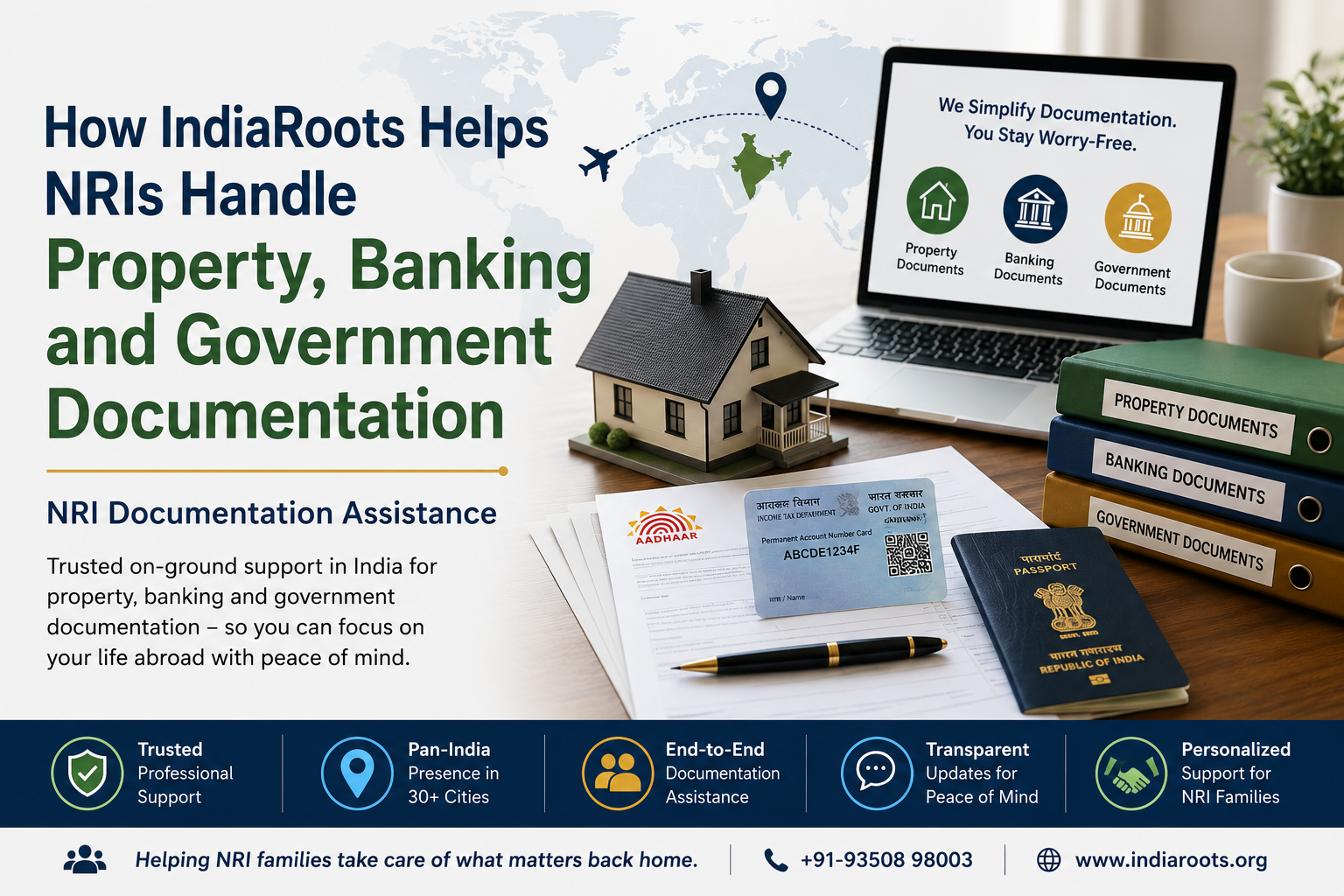
This guide explains how IndiaRoots supports NRI families with property documentation, banking paperwork, government liaison, Aadhaar and PAN updates, pension documentation, and on-ground coordination across India — so that important responsibilities are managed properly without requiring unnecessary travel or the stress of managing everything remotely on your own.
What Is NRI Documentation Assistance?
NRI documentation assistance helps overseas Indians manage property records, banking paperwork, Aadhaar updates, pension documentation, government processes, and local administrative tasks in India without needing to travel frequently.
In practical terms, it is a professional on-ground coordination service — a trusted local presence that handles the tasks requiring physical follow-through, local relationships, and persistent engagement with Indian administrative systems. It is not a legal service or a financial advisory. It is the missing piece between knowing what needs to be done and having someone reliable to actually do it.
The core activities that fall under NRI documentation assistance include:
Document collection and organisation. Identifying which documents are available, which are missing, which are outdated, and which need to be obtained from government authorities or financial institutions.
Verification and review. Confirming that property records, bank records, and government documents reflect accurate and current information, and identifying discrepancies that need to be resolved.
Liaison with authorities. Communicating with municipal offices, revenue departments, bank branches, post offices, and government portals on behalf of the family.
Appointment coordination. Booking appointments where required, accompanying elderly parents to offices and branches, and managing the logistics of each visit so it is completed correctly and efficiently in as few trips as possible.
Follow-up and status tracking. Monitoring the progress of submitted applications, following up with relevant offices when responses are delayed, and communicating updates to the family overseas.
Family communication. Providing regular, structured updates so that NRI families always know what has been completed, what is in progress, and what requires their input or authorisation.
Why Documentation Challenges Are Common for NRIs
The Reality of Managing Affairs From Abroad
Indian administrative processes have modernised significantly over the past decade. Many services are now available online, and digital access to government portals has reduced some friction that previously required physical visits. But the hardest tasks — the ones that have been pending for months or years — are precisely the ones that cannot be resolved through a portal.
A mutation that requires a personal appearance at the tehsildar’s office. A bank branch that updates a signature specimen only if the account holder is present. A government office that accepts applications online but processes them only after a follow-up visit. An elderly parent who can navigate none of this independently and has no family member nearby to assist.
The structural challenges NRI families consistently face include:
Time zone differences that limit real-time coordination. A family in Vancouver is twelve and a half hours behind India. A family in London is four and a half hours behind. Calling a government office, following up with a bank, or coordinating a document submission in real time is difficult when working hours barely overlap.
The absence of local representation. Most Indian administrative processes assume the responsible person can appear in person when required. Without a trusted local representative, tasks requiring physical presence simply do not get done. As documented in [Common Documentation Problems Faced by Seniors Living Alone in India], this gap creates a backlog that compounds over time.
Elderly parents who cannot manage processes independently. For NRI families with ageing parents living in India, the documentation burden often falls on parents who are in their seventies or eighties — managing complex paperwork alone, without reliable digital access, and frequently without any support network nearby.
Difficulty tracking document status. Without someone physically checking on the progress of an application, it is genuinely difficult to know whether a submission has been received, processed, or rejected — or simply lost in a system that has not been updated.
Outdated records compounding over time. A property record that was not updated five years ago is harder to correct today than it was then. A bank nomination not refreshed after a spouse passed away three years ago is now a significantly more complex problem. Documentation challenges do not resolve themselves — they accumulate.
The Three Major Areas Where NRIs Need Help
Almost all NRI documentation needs fall into one of three categories: property documentation, banking documentation, and government documentation. In many cases, all three are relevant simultaneously — a family dealing with a parent’s estate, for example, may face property transfer, bank nomination claims, and Aadhaar or pension-related issues at the same time.
IndiaRoots provides coordinated support across all three areas through a single point of contact, so families are not managing multiple service providers for tasks that are closely connected.
How IndiaRoots Helps With Property Documentatio
Property is typically the most significant asset elderly parents hold in India — and property documentation is consistently among the most complex and time-sensitive challenges NRI families face. Families who want a comprehensive understanding of this area can also read our dedicated guide [How NRIs Can Manage Property Documents in India Without Travelling].
Property Tax Verification and Payment
Property tax records are maintained at the municipal or local body level. Many elderly parents are unaware of outstanding dues, changes in tax calculation, or new requirements introduced by municipal authorities. Unpaid property tax can accrue penalties and, in some cases, affect the legal status of a future property transaction.
IndiaRoots assists families by verifying current property tax status, identifying any outstanding dues, and coordinating payment on the family’s behalf — with receipts shared digitally as important documentation for any future property transaction.
Mutation Record Updates
Mutation — the process of updating ownership records in the revenue department following a sale, inheritance, or gift — is one of the most commonly delayed documentation tasks for NRI families. When a parent passes away and a property transfers to children, mutation in the new owner’s name is a legal requirement that many families defer until it becomes urgently necessary.
Outdated mutation records can complicate future property sales, create legal ambiguity around ownership, and generate complications with property tax assessment. IndiaRoots coordinates mutation applications, follows up with revenue department offices, and ensures ownership records are updated correctly.
Encumbrance Certificate Procurement
An Encumbrance Certificate (EC) confirms whether a property is free of legal dues, mortgages, or litigation — an essential document for property sales, loans, and legal processes. Obtaining one requires an application to the Sub-Registrar’s office and physical follow-up in most states. IndiaRoots manages EC applications, collects the certificate when ready, and shares it with the family overseas.
Property Record Reviews
Many NRI families are uncertain what documentation currently exists for a property — what is on record, what is missing, or what discrepancies may exist between different records. IndiaRoots conducts property record reviews, comparing existing documents against revenue and municipal records, and identifying gaps or inconsistencies that should be addressed before they become more serious.
Liaison With Municipal and Revenue Authorities
Many property documentation tasks require direct engagement with municipal offices, tehsildar offices, revenue departments, or Sub-Registrar offices — involving in-person visits, application submissions, status follow-ups, and navigating bureaucratic delays that require persistence and local familiarity. IndiaRoots manages this liaison process end to end, eliminating the need for NRI families to attempt these interactions remotely.
Common Property Problems IndiaRoots Helps Resolve
- Property still registered in the name of a deceased parent with no mutation initiated
- Missing original sale deed or a gap in the chain of title documents
- Outdated property tax records with incorrect owner name or address
- Ownership discrepancies between municipal records and revenue records
- Encumbrance or lien on property that the family was unaware of
- Property tax dues accumulated over multiple years without the family’s knowledge
How IndiaRoots Helps With Banking Documentation
Banking documentation is a recurring need for NRI families with elderly parents in India. Accounts accumulate over a lifetime, and maintaining them in compliance with current banking requirements — while ensuring they are structured correctly for eventual settlement — requires active management.
Aadhaar and PAN Updates for Banking
Most Indian banks require current Aadhaar and PAN details on file as part of KYC compliance. When an elderly parent’s Aadhaar address is outdated or their PAN records contain an error, the bank account can be flagged, frozen, or placed in limited-operation status. IndiaRoots assists families with updating these records so that banking operations remain uninterrupted.
Bank KYC Compliance
KYC compliance deadlines are a recurring issue for elderly account holders not actively monitoring their banking records. When a bank issues a KYC update requirement and no action is taken, the account may be restricted. IndiaRoots identifies pending KYC requirements and assists with completing the necessary documentation and branch submission before restrictions are imposed.
Nomination Updates
Outdated or missing bank nominations are one of the most consistently discovered problems when IndiaRoots reviews elderly parents’ banking records. A missing or outdated nomination can create significant legal and administrative complications for the family following the account holder’s death — a topic covered in full in our guide [How to Update Bank Nomination for Elderly Parents in India].
IndiaRoots coordinates nomination reviews, prepares the required documentation, accompanies elderly parents to branch visits where necessary, and obtains nomination acknowledgements that are shared with the overseas family.
Joint Account Documentation
When one holder of a joint bank account passes away, the surviving account holder needs to update the account records — removing the deceased holder and potentially restructuring the account. This process involves a death certificate, KYC documents, and in some cases a new account mandate. IndiaRoots assists families with managing this transition.
Pension Verification Support
Many elderly parents receive pension payments into their bank accounts — whether government pensions, ex-serviceman pensions, or employer pensions. Pension continuity requires annual life certificates (Jeevan Pramaan), which must be submitted each November. IndiaRoots coordinates life certificate submissions for elderly parents, ensuring pension payments are not disrupted.
Branch Visit Coordination
For elderly parents who cannot manage bank branch visits independently, IndiaRoots provides coordination and escort support — confirming appointment details, preparing all required documents, accompanying the parent to the branch, and ensuring the visit achieves its intended purpose in a single trip.
Common Banking Problems IndiaRoots Helps Resolve
- Bank accounts frozen or restricted due to KYC non-compliance
- Nomination records listing a deceased family member
- Signature mismatch flagged by the bank preventing transaction processing
- Address change required following relocation of the account holder
- Pension payments stopped due to missed life certificate submission
- Joint account restructuring following the death of one account holder
How IndiaRoots Helps With Government Documentation
Government documentation tasks are often the most time-consuming and frustrating for NRI families — involving processes that are partially digitised, inconsistently administered, and frequently requiring follow-up visits that elderly parents cannot easily manage alone.
Aadhaar Updates
Aadhaar is the foundational identity document for elderly parents in India, required for virtually every administrative process — banking, healthcare, government benefits, property transactions, and more. When an elderly parent’s Aadhaar contains an outdated address, an incorrect name, or an unregistered mobile number, it creates downstream complications across all other documentation.
The update process, as explained in our complete guide [How to Update Aadhaar for Elderly Parents in India], requires a visit to an Aadhaar Seva Kendra or authorised enrolment centre, biometric verification, and in some cases supporting documents for the change requested. IndiaRoots identifies which Aadhaar fields require updating, prepares the supporting documentation, books the appointment, accompanies the elderly parent, and confirms the update has been successfully processed.
PAN Corrections
PAN cards issued many years ago frequently contain name discrepancies — a middle name dropped, a spelling variation, or a name that does not match the format used on other identity documents. These discrepancies can create complications with banking, income tax filings, and property transactions. IndiaRoots assists families with PAN correction applications and follow-up with the Income Tax Department.
Pension Documentation
Government pension processes involve periodic documentation requirements beyond the annual life certificate — including address updates with the pension disbursing authority, nominee updates for pension accounts, and documentation required when a pension is transferred following a pensioner’s change of address or bank. IndiaRoots supports families with the full range of pension documentation needs, coordinating with relevant authorities and keeping the family informed of outcomes.
Life Certificate Assistance
The annual Jeevan Pramaan life certificate submission, required each November for pension continuity, is a specific and time-bound requirement that many elderly parents struggle to complete independently. IndiaRoots provides dedicated life certificate assistance — coordinating submission through Aadhaar-based digital life certificates, bank-based submission, or post office submission depending on what is most accessible for the parent.
Government Office Coordination
Many government tasks — from applying for a domicile certificate to updating records with a municipal authority — require visits to offices that operate on limited hours, have long queues, and may require multiple visits before a task is completed. IndiaRoots manages these visits through local coordinators who understand the specific requirements of each office and each process.
Utility and Local Authority Documentation
IndiaRoots also assists with utility-related documentation — updating electricity connection records, water connection names, and local authority registrations following a property transfer or the death of an account holder. These tasks are frequently overlooked but can create complications when not addressed promptly.
Documentation Challenges Faced by Elderly Parents
Understanding the specific obstacles elderly parents face when managing documentation independently helps NRI families appreciate why remote management alone is rarely sufficient.
Mobility Limitations
Travelling to a government office, bank branch, or Aadhaar centre involves physical demands that many elderly parents — particularly those in their seventies and eighties — find increasingly difficult. Long distances, crowded public spaces, extended waiting periods, and multi-storey buildings without adequate facilities are real barriers for parents with joint problems, reduced mobility, or recovery from illness.
Complex and Frequently Changing Government Procedures
Administrative procedures in India change more frequently than most families realise. A process that worked a certain way two years ago may now require different forms, different documents, or a different sequence of steps. Elderly parents who attempt to navigate these processes based on past experience often encounter unexpected requirements that result in rejected applications or wasted visits.
Long Queues and Multiple Visits
A single administrative task often requires more than one visit — a first visit to submit an application, a second to follow up, and sometimes a third to collect the outcome. For elderly parents managing this independently, even a straightforward task can stretch across weeks and involve significant physical effort.
Digital Access Difficulties
Many government services now have online components — portals for applications, status tracking, and appointment booking. Elderly parents who are not comfortable with smartphones or computers cannot access these independently, making tasks that could theoretically be initiated online into full in-person visits by default.
Missing or Disorganised Records
Many elderly parents hold decades of accumulated documents — property papers, insurance policies, bank statements, identity documents — that are not organised in any systematic way. When a specific document is needed for an administrative process, locating it can be a significant challenge in itself. As highlighted in [Common Documentation Problems Faced by Seniors Living Alone in India], disorganised records are among the most common issues IndiaRoots encounters when beginning a new family engagement.
NRI Documentation Task Comparison
| Documentation Task | Managing Alone From Abroad | With IndiaRoots |
|---|---|---|
| Property Tax Verification | Multiple unanswered calls and online attempts | Verified locally with confirmation and receipts shared |
| Mutation Updates | Requires in-person visits to revenue office | Authority liaison managed with status updates provided |
| Aadhaar Updates | Difficult to coordinate appointment for elderly parent | Appointment booked, parent accompanied, update confirmed |
| Bank KYC Compliance | Risk of account restriction if deadline missed | Proactively identified and completed before deadline |
| Nomination Update | Requires branch visit parent cannot manage alone | Escort arranged, documents prepared, acknowledgement obtained |
| Government Documentation | Time-consuming with no reliable local contact | End-to-end coordination by liaison team |
| Pension Life Certificate | Annual submission that parent may miss | Coordinated each year as part of ongoing support |
| Documentation Tracking | Limited visibility, status unknown | Regular structured updates with documents shared digitally |
| Family Communication | Fragmented, dependent on parent’s recall | Centralised reporting to overseas family |
| Emergency Documentation | Reactive and delayed by distance | Rapid local response with immediate family notification |
Why NRI Families Choose IndiaRoots
A Single Point of Contact for Multiple Needs
Rather than identifying and managing separate service providers for property documentation, banking liaison, Aadhaar updates, and government coordination, NRI families working with IndiaRoots have a single point of contact who manages all these needs through one coordinated support team. This eliminates the fragmentation and communication gaps that arise when multiple providers are involved in related tasks.
Family Updates and Transparency
IndiaRoots provides regular, structured updates to overseas families — confirming what has been completed, what is in progress, what is pending, and what requires the family’s input. Families are never left wondering whether something has been done or waiting for news that does not arrive.
On-Ground Presence Across India
With coordinators operating across more than 30 cities in India, IndiaRoots can provide reliable on-ground support whether a family’s elderly parents are in Chandigarh, Delhi, Mumbai, Haryana, Bengaluru, Pune, or elsewhere. This national presence means that support is available wherever it is needed — not only in major metros.
Support Designed Specifically for NRI Families
IndiaRoots was built specifically for the NRI family situation — an overseas family with elderly parents in India who need practical, trustworthy local support. The communication model, the service structure, and the documentation approach are all designed around the specific challenges of distance, time zones, and the need for trusted local representation.
Assistance That Goes Beyond Traditional Elder Care
While IndiaRoots provides elder care support — welfare checks, emergency response, medical coordination — the documentation and liaison services extend significantly beyond what traditional elder care agencies offer. IndiaRoots bridges the gap between personal care and administrative support, recognising that for NRI families, both are equally essential. Families wanting to understand this broader service model can read [What Makes IndiaRoots Different from Traditional Elder Care Services in India].
Real-Life Example: Supporting an NRI Family in Canada
A family based in Toronto had been aware for some time that several administrative tasks related to their elderly parents needed attention. Their father was 79 and their mother was 74. The family visited India once a year but had been unable to complete the pending items during those visits, partly due to the time required and partly because they did not know exactly where to start.
When they contacted IndiaRoots, an initial documentation review identified three separate issues requiring attention.
Their mother’s Aadhaar card still reflected an address from a property the family had sold eight years earlier. This had created complications with a recent banking KYC requirement, because the address on the Aadhaar did not match the address registered with the bank.
Their father’s bank accounts — two savings accounts and a fixed deposit — all listed the same nominee: a brother who had passed away two years earlier. None of the accounts had an updated nomination.
A property held in the father’s name had a property tax discrepancy: the municipal records showed the property categorised under a different usage type than the actual residential use, resulting in an inflated tax demand that had gone uncontested for three years.
IndiaRoots coordinated all three issues through a single support engagement. The Aadhaar address update was completed first, as it was a prerequisite for the banking KYC. Once the updated Aadhaar was in hand, the KYC was submitted to the bank branch. During the same branch visit, nomination forms for all three accounts were completed and acknowledgements obtained. The property tax discrepancy was raised with the municipal authority, the correct categorisation was documented, and a revised tax demand was issued — recovering three years of overcharged amounts.
The family in Toronto received updates at each stage. By the end of the engagement, they had digital copies of the updated Aadhaar, the KYC confirmation, all three nomination acknowledgements, and the revised property tax records — organised into a single shared folder.
What had been pending for years was resolved in weeks.
NRI Documentation Review Checklist
Use this checklist to identify which documentation tasks may require attention for elderly parents living independently in India.
☐ Aadhaar card updated with current address and registered mobile number
☐ PAN details verified and name consistent with other identity documents
☐ Bank KYC status confirmed and compliant across all active accounts
☐ Nomination records reviewed and updated for all bank accounts and fixed deposits
☐ Property tax records current and dues cleared for all held properties
☐ Mutation records verified and reflecting the correct current ownership
☐ Encumbrance Certificate reviewed where a property transaction is anticipated
☐ Pension documentation current including updated address and nominee records
☐ Annual Jeevan Pramaan life certificate submission status confirmed
☐ Utility and local authority records updated following any change of address or ownership
☐ Emergency contact documentation accessible locally and shared with overseas family
☐ Power of Attorney arranged where authorisation for a local representative is required
Families who identify multiple unchecked items on this list are encouraged to contact IndiaRoots for a documentation review. Addressing these items now, while elderly parents are well and the administrative process can be managed without urgency, is significantly easier than resolving them during a crisis.
Services Commonly Requested by NRI Families
NRI families approach IndiaRoots with a wide range of documentation and liaison needs. The most frequently requested services include:
Documentation Review and Audit
A comprehensive review of an elderly parent’s property, banking, and identity documents — identifying what is current, what is outdated, and what is missing.
Property Support
Mutation updates, property tax verification and payment, encumbrance certificate procurement, property record correction, and liaison with municipal and revenue authorities.
Banking Assistance
KYC compliance, nomination updates, joint account restructuring, pension verification support, and bank branch coordination for elderly parents.
Aadhaar Updates
Address corrections, mobile number registration, name corrections, and biometric updates for elderly parents who cannot manage the process independently.
Pension Documentation
Life certificate submission, address updates with pension disbursing authorities, and nominee updates for pension accounts.
Government Liaison
Coordination with government offices for PAN corrections, utility record updates, municipal documentation, and local authority liaison.
Emergency Documentation Support
Rapid documentation assistance when a family is dealing with a sudden hospitalisation, a death in the family, or an urgent administrative requirement that cannot wait.
Family Coordination and Communication
Structured updates, document sharing, and coordination between the local support team and the overseas family — ensuring the family is always informed and never left uncertain about what has been done.
Frequently Asked Questions
Can IndiaRoots handle property documentation without the NRI travelling to India?
Yes. IndiaRoots manages property documentation tasks — including property tax verification, mutation coordination, encumbrance certificate procurement, and liaison with municipal and revenue authorities — through local coordinators acting on behalf of the family. In most cases, the NRI family member does not need to travel to India for these tasks, though some processes may require a Power of Attorney to authorise a local representative to act formally. Our guide [Power of Attorney for Elderly Parents in India: Complete NRI Guide (2026)] explains this process in full.
Can IndiaRoots assist elderly parents directly?
Yes. IndiaRoots works directly with elderly parents — accompanying them to appointments, assisting with form completion, coordinating transport for branch or office visits, and providing the patient, practical support that makes administrative processes manageable for older adults. All outcomes and updates are communicated to the overseas family.
Do you help with bank KYC and nomination updates?
Yes. Banking documentation — including KYC compliance, nomination updates, address changes, signature mismatch resolution, and joint account restructuring — is one of the most frequently requested areas of support. IndiaRoots coordinates the entire process including document preparation, branch visit escort, and acknowledgement collection.
Can IndiaRoots coordinate government office visits on behalf of elderly parents?
Yes. IndiaRoots’ local coordinators manage government office visits for a range of tasks including Aadhaar updates, PAN corrections, pension documentation, and municipal authority liaison. The coordinator accompanies the parent where required, manages the submission process, follows up on application status, and communicates outcomes to the overseas family.
Which cities does IndiaRoots serve?
IndiaRoots currently operates across more than 30 cities in India, including major metros and Tier 2 cities. Families whose parents live outside currently served areas are encouraged to contact IndiaRoots to discuss whether support can be arranged. Coverage is expanding regularly.
Can IndiaRoots help with Aadhaar and PAN corrections?
Yes. Aadhaar updates — including address corrections, name corrections, and mobile number registration — are among the most frequently completed tasks. PAN correction assistance is also available. Both processes are coordinated through appointment booking, document preparation, and supervised submission.
How do families receive updates on the progress of tasks?
NRI families receive structured updates through their preferred communication channel — WhatsApp, email, or phone — at each stage of a task. Updates confirm what has been completed, what is currently in progress, what is pending further action, and where the family’s input or authorisation is required. Document copies are shared digitally so that the family always has access to completed work.
How IndiaRoots Supports Families Across India
IndiaRoots operates through a network of local coordinators and documentation specialists across more than 30 cities in India. This on-ground presence is what makes the service genuinely effective — not a call centre managing paperwork remotely, but trained local professionals who can appear in person, build relationships with local offices, and follow through on tasks that require physical presence.
Each family is assigned a dedicated point of contact who manages communication between the local support team and the overseas family. This person is responsible for understanding the family’s situation, coordinating the right support for each task, and ensuring the family always has a clear picture of what is happening and what comes next.
Beyond documentation, IndiaRoots provides the full range of elder care support — welfare checks, emergency response, and medical coordination — recognising that for most NRI families, the documentation needs and the personal care needs of elderly parents are closely connected. A parent whose paperwork is in order, whose accounts are accessible, and whose records are current is a parent who is better protected in every dimension.
Need Help Managing Documentation for Elderly Parents in India?
Whether it is a property record update, Aadhaar correction, pension paperwork, bank nomination review, or government liaison support, IndiaRoots provides trusted on-ground assistance across 30+ cities in India.
📞 Call or WhatsApp: +91 93508 98003
📧 Email: info@indiaroots.org
Conclusion
For most NRI families, the problem is not a lack of intention. It is a lack of a trusted local presence — someone who will actually show up, follow through, and come back again if the first visit does not resolve the issue.
Property records outdated for years. Bank accounts whose nominations have not been reviewed since they were opened. Aadhaar cards that still list an address from a previous decade. Government processes that require multiple visits an elderly parent cannot manage alone. These are not insurmountable problems. They are solvable — with the right local support, the right documentation, and a coordinator who understands the system and takes responsibility for seeing things through.
IndiaRoots exists to be that local presence for NRI families across India. Whether the need is property documentation, banking liaison, government coordination, or all three simultaneously, our team manages the process from start to finish — keeping the overseas family informed throughout and ensuring that important responsibilities do not remain unresolved.
Reach out to our team at +91 93508 98003 or write to info@indiaroots.org. We are here to help.