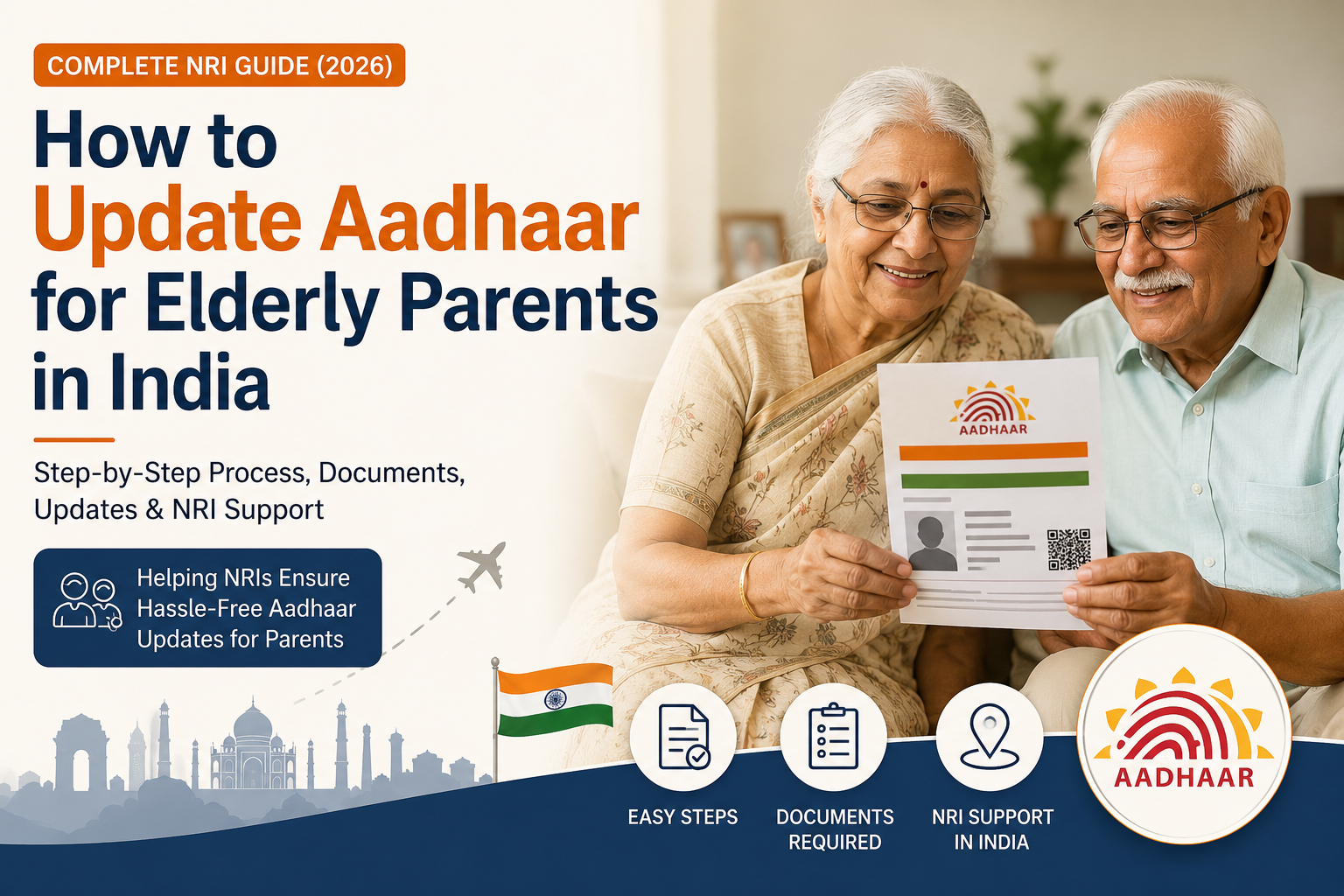
For millions of senior citizens across India, Aadhaar is not just a card — it is the gateway to banking, healthcare, pensions, and government benefits. A single outdated detail can trigger a chain of disruptions: a pension payment blocked, a health insurance claim rejected, a hospital admission delayed. Yet updating Aadhaar is precisely the kind of task that aging parents struggle to manage on their own, and that NRI children find nearly impossible to coordinate from thousands of kilometres away.
This guide walks you through everything you need to know about updating Aadhaar for elderly parents in India in 2026 — the common updates required, the documents needed, the step-by-step process, the pitfalls to avoid, and how professional on-ground support can make the entire process manageable without anyone needing to book a flight.
Related Reading:
Power of Attorney for Elderly Parents in India: Complete NRI Guide (2026)
How NRIs Can Manage Property Documents in India Without Travelling (2026 Guide)
Can NRIs Help Their Elderly Parents Update Aadhaar?
Yes — and more effectively than most families realise.
While Aadhaar updates ultimately require a physical visit to an Aadhaar Seva Kendra for most changes (particularly biometric and mobile number updates), NRI families can handle almost everything else remotely: reviewing existing Aadhaar details, organising and verifying documents, booking appointments online, and arranging trusted local support to escort their parents to the centre.
Common updates NRI families coordinate for their elderly parents include address changes after relocation, mobile number updates due to inactive SIM cards, name spelling corrections, date of birth corrections, and biometric refresh due to age-related fingerprint changes.
Featured Snippet
Can elderly parents update Aadhaar without visiting a centre?
No. For mobile number updates and biometric updates, the Aadhaar holder must visit an Aadhaar Seva Kendra in person. However, NRI family members can coordinate document preparation, appointment booking, transportation, and on-ground assistance remotely — so even if your parent needs to be physically present, they do not have to manage the process alone.
Signs Your Parent’s Aadhaar Needs Immediate Attention
Do not wait for a crisis to discover there is a problem. These warning signs indicate your parent’s Aadhaar record needs attention now:
OTPs are no longer being received on the registered mobile number. This is one of the most common and disruptive issues, as OTP-based authentication is now required for banking portals, insurance claims, and government service logins.
Bank KYC repeatedly fails or triggers repeated requests for re-verification. This typically indicates an address or name mismatch between Aadhaar and bank records.
Pension payments are delayed or held pending verification. Government disbursement systems are increasingly Aadhaar-linked, and an outdated record can interrupt payment cycles.
Fingerprint authentication frequently fails at banking kiosks, hospital check-in terminals, or government service centres. Age-related fingerprint degradation is common and addressable through a biometric update.
The Aadhaar address no longer matches your parent’s current residence. This creates KYC mismatches across banking, insurance, and government services simultaneously.
The name on Aadhaar differs from the name on PAN card or passport. Even a minor spelling variation can block financial transactions and document verification processes.
If any of these apply to your parent, act before the problem compounds.
Aadhaar Update Quick Reference
| Aadhaar Update Type | Centre Visit Required? | Typical Processing Time |
|---|---|---|
| Address Update | Usually Yes | 5–10 Working Days |
| Mobile Number Update | Yes (Mandatory) | 5–10 Working Days |
| Name Correction | Yes / Online (Case Dependent) | 5–10 Working Days |
| Date of Birth Correction | Yes | 7–15 Working Days |
| Biometric Update | Yes (Mandatory) | 5–10 Working Days |
Why Keeping Aadhaar Updated Is Critical for Senior Citizens
Aadhaar is not a one-time document. It is a living identity record, and for senior citizens it touches nearly every important aspect of daily life.
Banking and KYC Compliance
Banks routinely require Aadhaar-based KYC verification to maintain active accounts, process fixed deposits, and release pension credits. An outdated address or a mobile number that no longer receives OTPs can freeze access to funds at precisely the moment your parent needs them most.
Healthcare and Insurance
Government health schemes such as Ayushman Bharat and most private health insurance policies now require Aadhaar-linked verification at the point of claim. A mismatch between Aadhaar details and policy records can delay or outright reject reimbursements during medical emergencies.
Government Benefits and Subsidies
Senior citizen railway concessions, LPG subsidies, state-level pension schemes, and welfare transfers are all linked to Aadhaar. An inactive or mismatched record means benefits either do not reach your parent or require exhausting bureaucratic correction later.
Emergency Situations
In hospital admissions, financial transactions, and identity verification situations, an elderly parent who cannot complete Aadhaar-based authentication faces immediate practical barriers. Biometric failures — increasingly common as fingerprints wear with age — can make routine tasks unexpectedly complicated.
Common Aadhaar Updates Required by Elderly Parents
Understanding which update your parent actually needs is the essential first step, because different corrections involve different documents and different procedures.
Address Change
This is the most frequent update required. Elderly parents who have moved after retirement, relocated from a family home, shifted to live with a sibling, or moved into a care facility often have an Aadhaar address that no longer matches where they actually live. An outdated address creates problems with bank KYC, ration card linking, and local service registrations.
Mobile Number Update
This is arguably the most urgent update for seniors. Many elderly parents are using Aadhaar records linked to a mobile number that has since become inactive, been transferred to a different family member, or simply changed. Without a functioning registered mobile number, OTP-based authentication fails entirely, blocking access to banking portals, insurance portals, and online government services.
Name Corrections
Spelling inconsistencies between Aadhaar, PAN, passport, and bank records are extremely common among older generations. Even a minor variation — “Ramesh” versus “Ramesh Kumar,” or a surname spelled differently — can create document mismatches that complicate financial and legal transactions.
Date of Birth Corrections
Elderly parents from earlier generations often have inconsistent date of birth records across documents, sometimes reflecting school records, sometimes hospital records, and sometimes estimates. Correcting the date of birth on Aadhaar to align with the passport or PAN card prevents recurring complications.
Biometric Updates
As people age, fingerprints naturally become less distinct, making biometric authentication increasingly unreliable. If your parent’s fingerprints consistently fail to authenticate at banking kiosks, hospital check-ins, or government service centres, a biometric update at an Aadhaar Seva Kendra may be the most practical long-term solution.
Documents Required for Aadhaar Updates
| Update Type | Commonly Accepted Documents |
|---|---|
| Address Update | Utility Bill, Bank Statement, Passport, Rental Agreement |
| Name Correction | Passport, PAN Card, Voter ID, Marriage Certificate |
| Date of Birth Correction | Birth Certificate, Passport, School Leaving Certificate |
| Mobile Number Update | Aadhaar Holder Must Be Physically Present; No Additional Document Required |
| Biometric Update | Aadhaar Card and Any Valid Photo Identity Proof |
All documents must be original and valid at the time of submission. Photocopies should be carried as well, as the centre may retain a copy.
Step-by-Step Process to Update Aadhaar for Elderly Parents
Step 1: Review the Existing Aadhaar Record
Before anything else, obtain a fresh copy of your parent’s Aadhaar from the UIDAI website or the mAadhaar app. Review every field — name, date of birth, address, registered mobile number — and note every discrepancy against their other documents. This review tells you exactly which updates are needed and which documents to gather.
Step 2: Gather Supporting Documents
Based on the updates identified, create a document checklist and gather all originals. If you are coordinating from abroad, ask a trusted family member, neighbour, or professional support service to collect and verify the physical documents. Ensure nothing has expired and that spellings match across documents where possible.
Step 3: Book an Aadhaar Seva Kendra Appointment
Appointments can be booked online through the UIDAI portal at appointments.uidai.gov.in. Locate the nearest Aadhaar Seva Kendra to your parent’s current address — not necessarily the one closest to their Aadhaar-registered address. Schedule a slot that accounts for your parent’s health, mobility, and any need for accompaniment.
Step 4: Visit the Aadhaar Centre
On the appointment day, your parent should carry all original documents, photocopies, and the appointment confirmation. At the centre, the operator will verify documents, enter the required corrections into the system, and capture biometrics if the update requires it. Ensure your parent is accompanied by a trusted person who can assist with communication and mobility.
Step 5: Collect the URN and Track Progress
After submission, the system generates an Update Request Number (URN). Save this number carefully. Updates are typically processed within 5 to 10 working days. Progress can be tracked online through the UIDAI portal using the URN. Once updated, download and verify the revised Aadhaar to confirm all changes are correctly reflected.
Challenges Elderly Parents Commonly Face
Even with thorough preparation, the Aadhaar update process presents real challenges for senior citizens — and understanding these challenges helps families prepare more effectively.
Travel and Mobility
Aadhaar Seva Kendras are not always conveniently located, and many elderly parents with mobility limitations, chronic illness, or post-surgery recovery cannot travel independently. Arranging appropriate transportation and a capable companion is not optional — it is essential.
Long Waiting Times
Even with an appointment, Aadhaar centres often involve significant waiting. Elderly parents with health conditions may find extended waiting periods physically taxing. Arriving with all documents in order, bringing water and any necessary medications, and choosing off-peak appointment slots can help manage this.
Biometric Authentication Failures
Age-related fingerprint degradation is a genuine and frustrating problem. Some seniors experience repeated authentication failures at the centre itself during the verification process. Centre operators are generally trained to handle this, but families should be prepared for the possibility of a return visit.
Missing or Incomplete Documentation
Documents accumulated over decades often go missing, expire, or contain inconsistencies. A careful document review before the visit — with enough lead time to arrange alternatives if something is missing — prevents the most common reason for rejected update requests.
Limited Digital Familiarity
Booking appointments, downloading Aadhaar copies, and tracking URN status online require a level of digital familiarity that many elderly parents simply do not have. This is where family coordination — or professional assistance — becomes genuinely valuable.
How NRI Families Can Streamline the Process
Distance need not mean helplessness. NRI families can take meaningful action from abroad to make Aadhaar updates far smoother for their parents.
Review Aadhaar records proactively. Do not wait for a bank to flag a KYC mismatch or for an OTP to fail during a medical emergency. Download your parent’s Aadhaar now, review every field, and identify any updates that may be needed before they become urgent.
Organise documents in advance. Maintain a shared digital folder with scanned copies of all identity documents — passport, PAN, voter ID, utility bills, bank statements. This makes it easy to verify what is available when an update is needed.
Book appointments yourself. The UIDAI appointment portal is accessible from anywhere. NRI family members can book Aadhaar appointments for their parents directly, removing one of the most friction-heavy steps.
Arrange local escort support. Whether through a trusted family member, a neighbour, or a professional elder care service, ensure your parent does not have to navigate the visit alone. Escort support is often the single most important practical arrangement.
Coordinate through professional on-ground services. For NRI families without reliable local support networks, professional services that specialise in elder care coordination can handle document collection, appointment scheduling, and escort assistance end to end — providing regular updates to families abroad throughout the process.
Aadhaar Update Checklist for Elderly Parents
Aadhaar Update Visit Checklist for Elderly Parents
Before heading to the Aadhaar Seva Kendra, make sure everything below is ready to avoid delays or repeat visits.
- ☐ Aadhaar Card (Original and Photocopy)
- ☐ Valid Address Proof (Original and Photocopy)
- ☐ Valid Identity Proof (Original and Photocopy)
- ☐ Passport-Size Photographs (Carry Two, Even If Not Immediately Required)
- ☐ Active Mobile Number for OTP Receipt
- ☐ Appointment Confirmation (Printed Copy or Mobile Screenshot)
- ☐ URN Tracking Information from Any Prior Pending Requests
- ☐ Transportation Arranged
- ☐ Companion or Escort Confirmed
- ☐ Any Medications Needed for the Duration of the Visit
Common Mistakes to Avoid
Waiting until something breaks. The most preventable Aadhaar problems are the ones families discover only when a bank account is frozen or a pension credit fails. A proactive review now costs nothing; an emergency correction during a health crisis costs significant stress and time.
Using outdated documents. Submitting an expired utility bill or a bank statement older than three months is the fastest way to have an update rejected. Always verify document validity before the visit.
Ignoring biometric authentication failures. If your parent regularly struggles with fingerprint authentication at banking kiosks or government offices, a biometric update is the right long-term solution. Continuing to work around repeated failures is neither practical nor sustainable.
Failing to update mobile numbers. An Aadhaar linked to an inactive or changed mobile number is an Aadhaar that cannot complete OTP-based authentication. In 2026, that limitation affects an increasingly large range of essential services.
Not verifying the update after completion. Always download a fresh copy of the updated Aadhaar once the URN shows completion, and verify every corrected field before closing the matter. Operator data entry errors, while infrequent, do occur.
How IndiaRoots Helps NRI Families with Aadhaar Updates
IndiaRoots provides end-to-end support for NRI families whose elderly parents need Aadhaar updates in Chandigarh, Haryana, and surrounding regions. Our services are designed specifically for families who need trusted, professional support on the ground in India.
Document Collection Assistance: Our team helps gather, organise, and verify all documents required for the specific update type, saving families the logistical challenge of coordinating paperwork remotely.
Appointment Coordination: We identify the most appropriate Aadhaar Seva Kendra, schedule appointments at suitable times, and confirm all details in advance.
Escort Support: Our trained staff accompany elderly parents to the Aadhaar centre, assist with documentation submission, communicate with centre staff, and ensure your parent’s comfort throughout the visit.
Transportation Assistance: We arrange appropriate transportation suited to your parent’s mobility needs, so travel to the centre is not an obstacle.
On-Ground Liaison Services: We handle all communication with Aadhaar centre staff on behalf of your parent, resolving any issues that arise during the visit.
Regular Progress Updates: NRI families receive consistent updates throughout the process — from document collection through appointment completion and URN tracking — so you are never left wondering what is happening.
Real-Life Example: Helping an Elderly Parent in Chandigarh Update Aadhaar While Their Son Was in Canada
Mr. Harpreet Singh’s 78-year-old mother in Chandigarh had been unable to complete KYC verification with her bank for months. Her Aadhaar was still registered to a mobile number that had been disconnected two years earlier, and her address on record reflected her previous home, not her current residence.
Harpreet, based in Toronto, had been trying to resolve the matter remotely for weeks. He contacted IndiaRoots for assistance.
Our team visited Mrs. Singh’s home, reviewed her existing Aadhaar record, and confirmed that two updates were needed: a mobile number update and an address change. We helped her gather the required address proof documents, booked an appointment at the nearest Aadhaar Seva Kendra, and accompanied her on the day of the visit.
Both updates were successfully submitted in a single visit. Harpreet received progress updates throughout, and within eight working days his mother’s revised Aadhaar was available for download — with the correct address and a functioning registered mobile number. Her bank KYC was completed shortly after.
He did not need to travel to India. His mother did not navigate the process alone.
Frequently Asked Questions
Can elderly parents update Aadhaar online?
Some demographic updates — name corrections, address changes — can be initiated through the UIDAI self-service portal if a valid mobile number is linked and OTP verification is possible. However, mobile number updates and biometric updates always require a physical visit to an Aadhaar Seva Kendra. Many elderly parents with outdated mobile numbers or authentication failures cannot use the online portal and must visit a centre in person.
Is biometric update mandatory for senior citizens?
No, it is not mandatory. However, if an elderly parent experiences repeated fingerprint authentication failures — at banking kiosks, hospital check-ins, or government service centres — a biometric update is highly advisable. Fingerprints become less distinct with age, and a refreshed biometric record significantly improves authentication reliability.
How often should Aadhaar biometrics be updated?
UIDAI recommends that children update biometrics at ages 5 and 15, when physical changes are significant. For senior citizens, there is no fixed mandatory schedule. The practical trigger is authentication failure — if your parent’s fingerprints consistently fail to authenticate, it is time for a biometric update.
Can NRIs update Aadhaar for their parents remotely?
NRIs can coordinate and prepare everything remotely — document review, appointment booking, arranging escort support — but the elderly parent must be physically present at the Aadhaar Seva Kendra for the actual submission and biometric capture. NRIs cannot submit Aadhaar updates on behalf of their parents without the parent being present.
What if fingerprints do not match at the centre?
Aadhaar centre operators are trained to handle biometric failures. Alternative authentication methods — iris scan or OTP-based verification — can often be used. In some cases, a senior citizen exception process may apply. Families should inform the centre in advance if biometric failure is anticipated.
How long does an Aadhaar update take?
Once a request is submitted at the Aadhaar Seva Kendra, processing typically takes 5 to 10 working days. Complex corrections, particularly date of birth changes, may take longer. The URN issued at submission can be used to track status online.
Can IndiaRoots help elderly parents visit Aadhaar centres?
Yes. IndiaRoots provides complete Aadhaar update support for elderly parents in Chandigarh, Haryana, and surrounding regions — including document assistance, appointment coordination, transportation, and escort support throughout the visit.
Conclusion
An updated Aadhaar is not a bureaucratic nicety — for elderly parents in India, it is the foundation on which banking, healthcare, pensions, and daily life depend. Small errors and outdated details accumulate quietly, then surface at exactly the wrong moment: during a medical emergency, during a financial transaction, during a pension disbursement cycle.
NRI families are not powerless. A proactive review of your parent’s Aadhaar today — checking every field, identifying any discrepancy, understanding what update may be needed — is the most practical step you can take right now. And when the update process needs to move forward, professional on-ground support means your parent does not have to manage it alone, and you do not have to book a flight.
Need help updating Aadhaar for your elderly parents?
IndiaRoots can coordinate appointments, document verification, transportation, and escort support — so your parents don’t have to navigate Aadhaar centres alone.
📞 +91-93508 98003
📧 info@indiaroots.org
Serving families in Chandigarh, Haryana, and surrounding regions.