You are in Toronto, Vancouver, or Sydney. Your elderly parents are in Pune, Chandigarh, or Chennai. And somewhere in a drawer, an almirah, or a dusty file cabinet, lie property documents that have not been reviewed in years.
This is the reality for millions of NRI families. According to the Ministry of External Affairs, India has over 35 million people of Indian origin living abroad. Many own inherited or self-purchased property in India, making property documentation one of the most common administrative challenges faced by NRI families.
Managing those obligations from abroad is genuinely hard. Registration offices work on Indian Standard Time. Municipal corporations require in-person visits. Revenue departments do not respond to emails from overseas phone numbers. And your parents, however capable, may not be in a position to navigate these processes on their own.
The good news is that in 2026, with the right systems and the right support, NRIs can manage property documentation in India without travelling. This guide covers everything you need to know — from the documents you should maintain to the red flags you cannot afford to ignore, to the professionals who can help you handle it all from wherever you are.
Can NRIs Manage Property Documents in India Without Travelling?
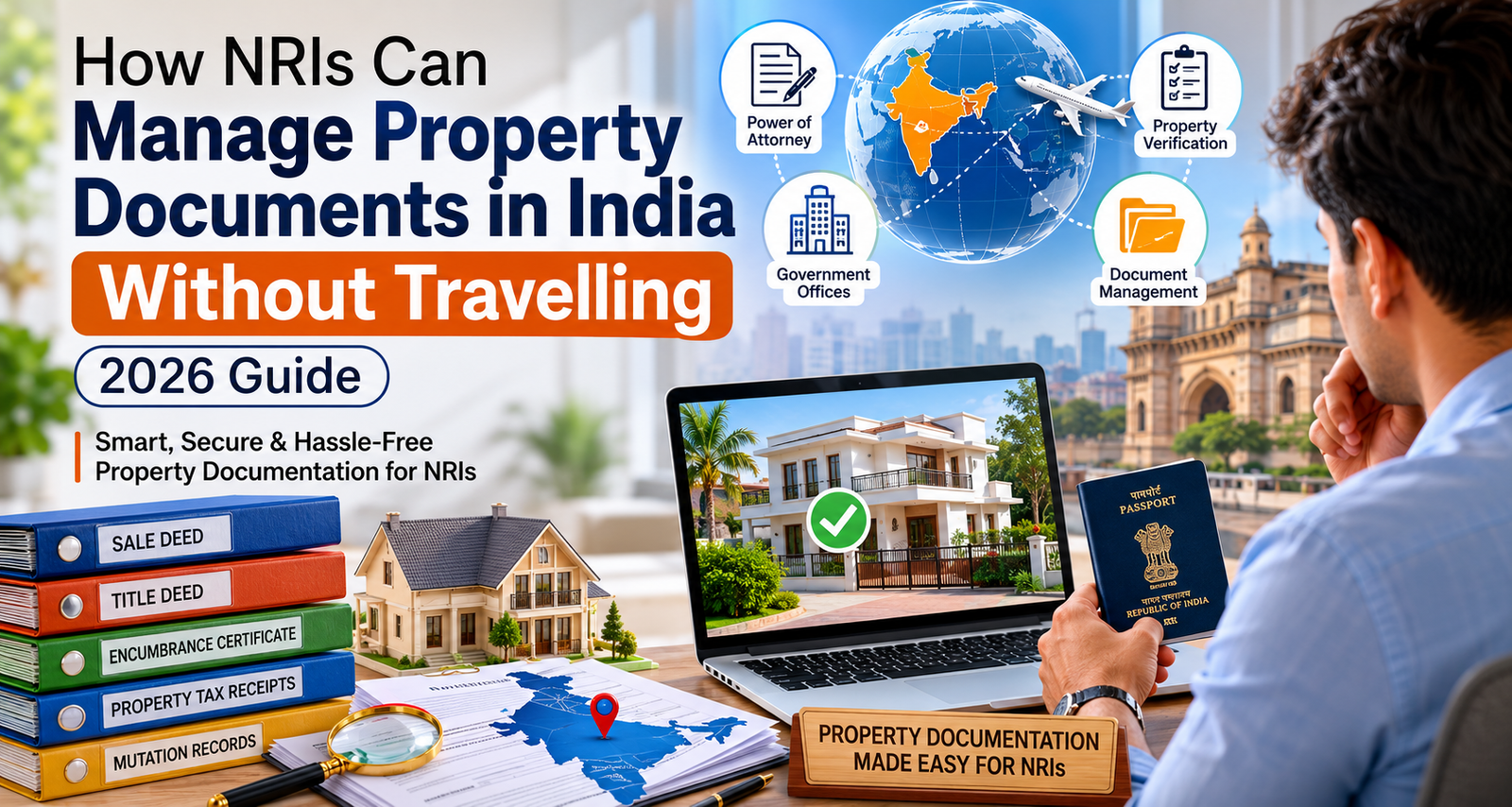
Yes. NRIs can manage property documentation in India remotely through a registered Power of Attorney, digital document management, annual documentation reviews, and professional on-ground liaison services. Most tasks — including mutation updates, property tax payments, encumbrance certificate procurement, and document verification — can be completed without travelling to India.
Need to appoint someone to act on your behalf? Read our guide: Power of Attorney for Elderly Parents in India: Complete NRI Guide (2026).
Understanding NRI Property Documentation
What Is Property Documentation?
Property documentation refers to the full set of legal, financial, and administrative records that establish ownership, usage rights, and compliance status of a property in India. For NRIs, keeping these records updated is both a legal requirement and a practical necessity.
The key documents every NRI property owner should be familiar with include:
Sale Deed: The primary legal document that records the transfer of property ownership from seller to buyer. It is executed at the time of purchase and registered with the Sub-Registrar’s office. This is the most important document in your property file.
Title Deed: Establishes the legal ownership history of the property. A clear title means the property has no disputed claims, encumbrances, or pending litigation. Before any property transaction, title verification is essential.
Encumbrance Certificate (EC): Issued by the Sub-Registrar’s office, the EC confirms that the property is free from any monetary or legal liabilities — such as mortgages, loans, or legal disputes — for a specified period. Banks require this document before approving home loans.
Property Tax Records: Municipal authorities maintain property tax records linked to each property. Keeping these up to date demonstrates compliance and prevents penalty accumulation. For NRI-owned properties where parents live, these records often go unchecked for years.
Mutation Records: Also called Khata or Patta in some states, mutation is the process by which the title of a property is transferred in the revenue or municipal records. When a property changes hands — through sale, inheritance, or gift — mutation must be updated accordingly.
Power of Attorney (POA): A legal document through which a property owner authorises another individual to act on their behalf for specified purposes — including signing documents, appearing before authorities, and completing registrations.
Society Documents: For apartment or housing society properties, documents such as the Share Certificate, Society NOC, and membership records are essential for resale, renovation approvals, and other transactions.
Utility Records: Electricity connection documents, water connection papers, and gas connection records in the name of the rightful owner serve as secondary proof of possession and ownership continuity.
Why Proper Documentation Matters
Neglecting property documentation is not a minor oversight — it can have serious legal and financial consequences.
Clear and updated documentation prevents legal disputes by establishing an unambiguous ownership record. It ensures that when a property needs to be sold, transferred, or inherited, there are no surprises in the form of contested claims or missing paperwork.
For NRI families specifically, proper documentation protects against fraud. Vacant or semi-occupied properties in India are vulnerable to encroachment and document tampering. Regular verification of records significantly reduces this risk.
If property is to be passed down to the next generation, updated mutation records and a clear inheritance trail make the legal process far smoother. Without these, legal heir disputes and court proceedings can stretch on for years.
Why NRI Property Documentation Becomes Difficult Without Local Support
Difficulty Accessing Government Offices
The primary challenge is physical access. Most property-related processes in India still require in-person visits to government offices — the Sub-Registrar’s office for registration, the municipal corporation for tax records, the revenue department for mutation updates. These offices operate on fixed hours, have long queues, and often require multiple visits before a task is completed. For an NRI living thousands of kilometres away, arranging these visits is either dependent on ageing parents or requires expensive international travel.
Missing or Incomplete Documents
Many NRI families discover, at the worst possible moment, that critical documents are missing. Lost title deeds, misplaced tax receipts, unavailable mutation records — these are common situations, especially for properties that have been in families for decades. Reconstructing these documents requires knowing which authority to approach, what supporting evidence to provide, and how to navigate an often slow bureaucratic process. Without someone on the ground to follow through, these efforts stall.
Delayed Property Transactions
When an NRI family decides to sell, rent, or transfer a property, documentation gaps cause significant delays. A missing encumbrance certificate delays the buyer’s bank approval. An outdated mutation record raises questions about ownership. Pending property tax holds up the registration. What should be a straightforward transaction stretches into months of frustration — buyers backing out, rental income lost, or legal timelines missed.
Coordinating From Different Time Zones
Even when an NRI is proactive, time zone differences make coordination genuinely difficult. A conversation that should take fifteen minutes requires scheduling across a twelve-hour gap. Follow-up calls to government offices have to happen during the NRI’s night hours. This results in communication delays, repeated follow-ups, and a general sense that nothing is moving. Many NRIs simply defer property matters indefinitely because the coordination burden feels too high.
Managing Property Documents: Alone vs. With Professional Support
| Task | Doing It Yourself From Abroad | With On-Ground Documentation Support |
|---|---|---|
| Property Tax Verification | Multiple follow-ups, no guaranteed closure | Managed locally with confirmed receipts |
| Mutation Updates | Complex coordination, slow responses | End-to-end assistance with authority follow-up |
| Encumbrance Certificate | Time-consuming, requires Sub-Registrar visits | Handled by liaison team on your behalf |
| Registration Coordination | Requires local oversight, high coordination burden | Structured support with appointment scheduling |
| Government Office Visits | Falls on elderly parents or unavailable relatives | Managed professionally, no family burden |
Essential Property Documents Every NRI Should Maintain
Maintaining a complete and updated property file is the foundation of stress-free property management from abroad. Here is a checklist of the documents every NRI property owner should have on record:
| Document | Purpose | Where to Obtain |
|---|---|---|
| Sale Deed | Primary ownership proof | Sub-Registrar’s Office |
| Title Deed | Ownership history and clarity | Sub-Registrar’s Office / Advocate |
| Encumbrance Certificate | Confirms property is liability-free | Sub-Registrar’s Office |
| Property Tax Receipts | Municipal tax compliance | Municipal Corporation / Online Portals |
| Mutation Certificate (Khata/Patta) | Revenue record ownership | Revenue Department / Municipal Body |
| Society NOC | Required for resale and renovation | Housing Society |
| Utility Bills | Secondary possession proof | Electricity / Water / Gas Provider |
| Power of Attorney | Authorises a representative to act | Notarised / Registered POA |
| Will / Legal Heir Certificate | Inheritance documentation | Civil Court / Estate Authorities |
| Occupancy Certificate | Confirms property is fit for occupation | Local Development Authority |
NRI Property Documentation Checklist
Use this checklist to audit your current property file:
Ensure you have the following documents organised, updated, and safely stored:
- ☐ Sale Deed
- ☐ Title Deed
- ☐ Encumbrance Certificate
- ☐ Property Tax Receipts (Last 3 Years Minimum)
- ☐ Mutation Certificate / Khata / Patta
- ☐ Society Share Certificate and NOC
- ☐ Utility Bills (Electricity, Water, Gas)
- ☐ Power of Attorney (If Applicable)
- ☐ Will / Legal Heir Certificate / Succession Certificate
- ☐ Occupancy Certificate
If any of these are missing or outdated, that is the starting point for your documentation review.
4 Practical Ways NRIs Can Manage Property Documentation in India Remotely
1. Appoint a Trusted Power of Attorney
A Power of Attorney is the single most important tool available to NRIs for managing property from abroad. It legally authorises a representative — a family member, lawyer, or professional service — to act on your behalf for specified property-related matters.
There are two types relevant to property management. A General POA grants broad authority across multiple actions, while a Special POA is limited to a specific transaction or task — such as completing a registration or collecting a particular document.
For property management purposes, a registered POA carries greater legal weight than a notarised-only POA, particularly for transactions involving immovable property. NRIs can execute a POA from abroad by signing before an Indian consulate or notary and having it registered in India.
It is important to appoint someone you trust completely, and to define the scope of the POA clearly to prevent misuse. IndiaRoots’ Documentation and Liaison Services can guide you through the entire POA process from abroad.
2. Digitise and Organise Property Records
Before outsourcing anything or appointing anyone, begin by digitising what you already have. Scan every property-related document — sale deeds, tax receipts, mutation records, society papers — and store them on a secure, password-protected cloud storage service.
Organise your documents into clearly labelled folders by property and document type. Share access with a trusted family member in India and, if applicable, your legal representative.
A complete digital archive ensures you are never scrambling for a document at a critical moment, and gives any professional you appoint the full context they need to assist you effectively.
3. Conduct Regular Property Documentation Reviews
Think of annual property documentation review the way you think of filing taxes — it is a scheduled obligation, not an optional activity.
Once a year, review the following: whether property tax has been paid for the current year, whether ownership records in municipal systems match the actual owner’s name, whether any legal notices have been issued against the property, and whether documents like the encumbrance certificate are current.
IndiaRoots’ Government and Legal Support services can conduct these annual reviews on your behalf, providing you with a structured status report and a recommended action list. Staying ahead of these matters prevents small administrative gaps from becoming expensive legal complications.
4. Use Professional Documentation Assistance Services
For NRIs whose parents are elderly, or for properties in cities where the family has no resident representative, professional documentation assistance services are the most practical solution.
These services handle the full cycle — collecting documents from government offices, verifying their accuracy and completeness, submitting applications on your behalf, and following up with authorities until the task is closed. You receive regular updates without having to manage the process yourself. This is precisely what IndiaRoots’ NRI Parent Care Services and documentation teams are structured to provide.
Property Documentation Tasks That Can Be Managed Remotely
With the right representative or professional service in place, the following tasks can be completed without the NRI travelling to India:
Property Tax Documentation: Annual payment of property tax, obtaining payment receipts, and resolving discrepancies in property tax records — including cases where the property is recorded in a deceased parent’s name — can be handled by a local representative with appropriate authorisation.
Mutation Assistance: Updating mutation records following a property purchase, inheritance, or transfer requires filing an application with the appropriate municipal or revenue authority. A professional service can manage this process end to end.
Encumbrance Certificate Procurement: Obtaining an EC for a specified period — required for property sales and refinancing — involves an application to the Sub-Registrar’s office. This can be done by an authorised representative.
Registration Coordination: While the property owner or their POA holder must be present at registration, the preparation, documentation, and scheduling can be managed remotely. A professional on the ground reduces the number of visits and eliminates avoidable delays.
Property Verification: Verifying the physical condition, occupancy status, and document accuracy of a property through site visits and records checks.
Society Documentation: Collecting share certificates, society NOCs, and maintenance receipts from housing societies — tasks that require local follow-up.
Utility Transfers: Transferring electricity, water, and gas connections into the correct owner’s name, especially important during inheritance or post-sale scenarios. IndiaRoots’ Financial and Bill Payment Support services can assist with this.
Legal Documentation Follow-Ups: Tracking the status of applications submitted to government authorities and following up until closure.
Red Flags NRIs Should Never Ignore
Even when you are managing property from a distance, certain warning signs require immediate attention. Do not defer action if you encounter any of the following:
Property documents cannot be located. If your elderly parents cannot find the original sale deed, title deed, or mutation records, begin the recovery process immediately rather than assuming the documents will turn up.
Missing original sale deed. This is a serious issue that requires a formal application for a certified copy to the Sub-Registrar’s office, along with supporting documentation. Do not delay — a missing sale deed creates vulnerability to fraud.
Property is still in a deceased parent’s name. This is among the most common documentation problems faced by NRI families. Until mutation and revenue records are updated to reflect the current legal heir or owner, property transactions — including sale, transfer, or mortgage — cannot proceed cleanly.
Multiple family members claiming ownership. Disputed inheritance claims involving multiple siblings or family branches require legal documentation — a registered Will, Succession Certificate, or Legal Heir Certificate — to establish a clear ownership trail before any transaction can proceed.
Unpaid property taxes. Accumulating property tax arrears attract penalties and can, over time, complicate ownership records. Check the municipal corporation’s online portal for your city to verify payment status.
Ownership records do not match. If the name in the municipal tax records or mutation records does not match the current legal owner, this needs to be corrected before any transaction is attempted.
Unknown occupants in the property. Vacant properties are vulnerable. Reports of unknown individuals occupying or claiming access to the property require immediate action.
Delayed registration processes. If a property sale or purchase is underway and registration is being delayed without clear reason, investigate.
Unauthorised property use. Reports that the property is being used for commercial purposes without consent, or that a tenant is subletting without permission, require prompt follow-up.
How IndiaRoots Helps NRIs Manage Property Documentation in India
IndiaRoots provides professional on-ground liaison and documentation support services specifically designed for NRI families with elderly parents in India. Our teams operate across 30+ cities, giving you a trusted local presence wherever your property is located.
Document Collection and Verification
We collect property documents directly from government offices, registries, and municipal bodies on your behalf. Every document we collect is verified for accuracy, completeness, and current validity before being reported to you.
Coordination with Local Authorities
Our teams have experience working with Sub-Registrar offices, municipal corporations, revenue departments, and housing societies across India. We handle the follow-ups so you do not have to navigate time zone gaps and unanswered phone calls.
Property Registration Support
We coordinate the preparation, documentation, and scheduling for property registrations, ensuring that everything is in order before the appointment date. This minimises delays and reduces the number of visits required.
Property Tax Assistance
We verify the property tax payment status for your property, facilitate annual payments, and assist in resolving discrepancies in tax records — including cases where the property is still recorded in a deceased parent’s name.
Power of Attorney Coordination
We guide NRI families through the process of executing a legally valid POA from abroad, ensuring it meets the requirements for the specific tasks it will be used for in India.
Regular Progress Updates for Families Abroad
You receive clear, written updates on every task — what has been done, what is pending, and what the next step is. You are never left wondering whether anything is moving.
On-Ground Liaison Services Across India
Whether your property is in Chandigarh, Delhi, Bangalore, Mumbai, Pune, or any of the other cities we serve, our teams provide the local presence that makes remote property management genuinely possible.
Ready to get your property documents in order without travelling to India?
📞 Call or WhatsApp: +91-93508 98003 📧 Email: info@indiaroots.org 🌐 Book a Free Consultation with IndiaRoots Documentation and Liaison Services
Case Example: Managing Property Documentation from Canada Without Visiting India
A family based in Calgary had elderly parents living in their ancestral home in Chandigarh. When the parents decided to transfer the property to their son, the family discovered that the mutation records were still in the grandfather’s name — the property had never been properly updated after his passing nearly a decade earlier.
Travelling to India was not immediately possible. The son’s work commitments and the cost of international travel made a short-notice trip impractical. His parents were not in a position to independently navigate the revenue department and the legal paperwork required.
IndiaRoots was engaged to handle the process on the family’s behalf. Our team in Chandigarh conducted a full document review, identified the exact steps required to update the mutation records and prepare the property for transfer, and managed all authority interactions over the following weeks. The family was kept updated at every stage via WhatsApp and email.
The matter was resolved without the son travelling to India. The property transfer proceeded on schedule, and the family now has a complete, updated documentation file held both digitally and in a secure location in Chandigarh.
Frequently Asked Questions
Can NRIs manage property documentation in India without visiting?
Yes, in most cases. Tasks such as property tax payments, mutation updates, encumbrance certificate procurement, society documentation, and utility transfers can all be completed through a registered Power of Attorney holder or a professional documentation assistance service. For transactions requiring physical presence at registration, a POA holder can attend on your behalf.
What property documents should NRIs keep updated?
At minimum: Sale Deed, Title Deed, Encumbrance Certificate, Mutation Certificate, Property Tax Receipts, Society NOC (if applicable), Utility connection documents, and any Will or Inheritance documents. All of these should be reviewed annually.
What documents are required to prove property ownership in India?
The primary documents required to establish property ownership in India are the registered Sale Deed, Title Deed, and Mutation Certificate (Khata or Patta). Supporting documents include property tax receipts, Encumbrance Certificate, and — for inherited property — a Will, Succession Certificate, or Legal Heir Certificate.
Is Power of Attorney necessary for property management?
It is not always legally mandatory, but it is practically essential for NRIs. Without a POA, every document collection, application submission, or authority interaction requires either your physical presence in India or an informal arrangement that carries legal risk. A registered POA provides a clean legal basis for your representative to act on your behalf.
Can an NRI sell property in India without visiting?
Yes. An NRI can sell property in India without being physically present by executing a registered Power of Attorney in favour of a trusted representative. The POA holder can sign the sale deed, appear at the Sub-Registrar’s office, and complete the registration process. The POA must be executed at the Indian consulate or notarised and apostilled in the country of residence before being registered in India.
How can NRIs obtain an Encumbrance Certificate?
An EC is issued by the Sub-Registrar’s office in the jurisdiction where the property is located. An application must be submitted along with property details and the period for which the EC is required. In many states, the process can be initiated online, but physical follow-up is often necessary. A local documentation service can handle this on your behalf.
How long does property mutation take in India?
Mutation timelines vary by state and municipality. In many cities, the process takes between 30 and 90 days from the date of application, provided all supporting documents are in order. Delays are common when documents are incomplete or when records need to be corrected — for example, when the property is still in a deceased person’s name. Professional follow-up with the relevant authority can significantly reduce the timeline.
What happens if property tax records are missing?
Missing property tax records can usually be reconstructed through the municipal corporation’s records. Most city corporations now have online portals where payment history can be retrieved using the property ID or owner details. If records are genuinely missing, a fresh assessment and registration may be required. A professional service familiar with the local municipal process can guide you through this.
Can property registration be completed remotely?
The execution of a sale deed requires the presence of the buyer, seller, or their authorised POA holders at the Sub-Registrar’s office. However, all the preparation — document collection, verification, drafting, and scheduling — can be managed remotely with proper support on the ground.
Is Power of Attorney valid for property transactions in India?
Yes. A registered Power of Attorney executed by an NRI abroad is legally valid for property transactions in India, provided it has been properly notarised, apostilled, and registered at the appropriate Sub-Registrar’s office in India. It is advisable to work with a legal professional to ensure the POA is drafted correctly for the specific transactions it will be used for.
How can NRIs verify property records online?
Many state governments in India now provide online portals for property record verification. For example, Karnataka has the Bhoomi portal, Maharashtra has MahaBhumi, and Delhi has the Delhi Land Records portal. NRIs can verify ownership records, mutation status, and property tax payment history through these platforms. However, for comprehensive verification — particularly for older properties or those with inheritance-related complexities — on-ground verification by a local professional is recommended.
How often should NRIs review property documents?
Once a year is the minimum recommended frequency. Additionally, any major event — the passing of a parent, a property sale, a change in tenancy, or a renovation — should trigger an immediate documentation review.
Can IndiaRoots assist with property paperwork for elderly parents?
Yes. IndiaRoots works directly with elderly parents in India on behalf of their NRI children abroad. Our teams accompany parents to appointments when needed, coordinate paperwork, and provide the kind of on-ground support that elderly individuals should not have to manage alone.
Conclusion
Property documentation may not feel urgent until the moment it becomes critical — and when that moment arrives, it is usually tied to a financial transaction, a legal dispute, or a family emergency that cannot wait.
For NRI families, the challenge is not a lack of intent. It is the practical difficulty of managing complex, location-dependent administrative tasks from thousands of kilometres away, often while also managing the welfare of elderly parents who have limited capacity to navigate these processes themselves.
The answer is not to keep deferring. It is to put systems in place — a current POA, a digitised document file, annual reviews, and professional support for the tasks that require someone on the ground.
IndiaRoots exists precisely for this purpose. With teams operating across 30+ cities in India, we provide NRI families with a trusted local presence for property documentation, coordination, and liaison — so you can manage what matters from wherever you are.
📞 Call or WhatsApp: +91-93508 98003 📧 Email: info@indiaroots.org
Book your free consultation today. Getting your property documents in order should not require a flight to India.
IndiaRoots — Trusted Elder Care and Liaison Services for NRI Families. Serving 30+ cities across India.