India’s elderly population is growing faster than at any point in its history. According to the United Nations Population Fund’s India Ageing Report, the number of elderly persons in India is projected to reach 347 million by 2050 — and a significant and growing proportion of that population lives independently, without a spouse or children nearby. For these seniors, daily life is often manageable. But beneath the surface of that independence lies a category of risk that families rarely think about until something goes wrong: documentation.
A pension payment that suddenly stops. A bank account that freezes because KYC has not been updated. A property dispute that surfaces because the title deed cannot be located. A hospital that cannot reach the family because there is no emergency contact file. These are not rare worst-case scenarios — they are the predictable consequences of documentation problems that accumulate quietly over years, invisible until they are not.
For NRI families with elderly parents living alone in India, documentation is the category of risk most likely to be underestimated and most likely to create a crisis at the worst possible moment. This guide covers the most common documentation problems seniors face, the warning signs that demand immediate attention, and the practical steps families can take — from anywhere in the world — to get ahead of the problem.
Related Reading:
How to Update Aadhaar for Elderly Parents in India (2026 Guide)
Power of Attorney for Elderly Parents in India: Complete NRI Guide (2026)
How NRI Families Can Support Parents Living Alone in Haryana (Complete Guide)
What Documentation Problems Do Seniors Living Alone Commonly Face?
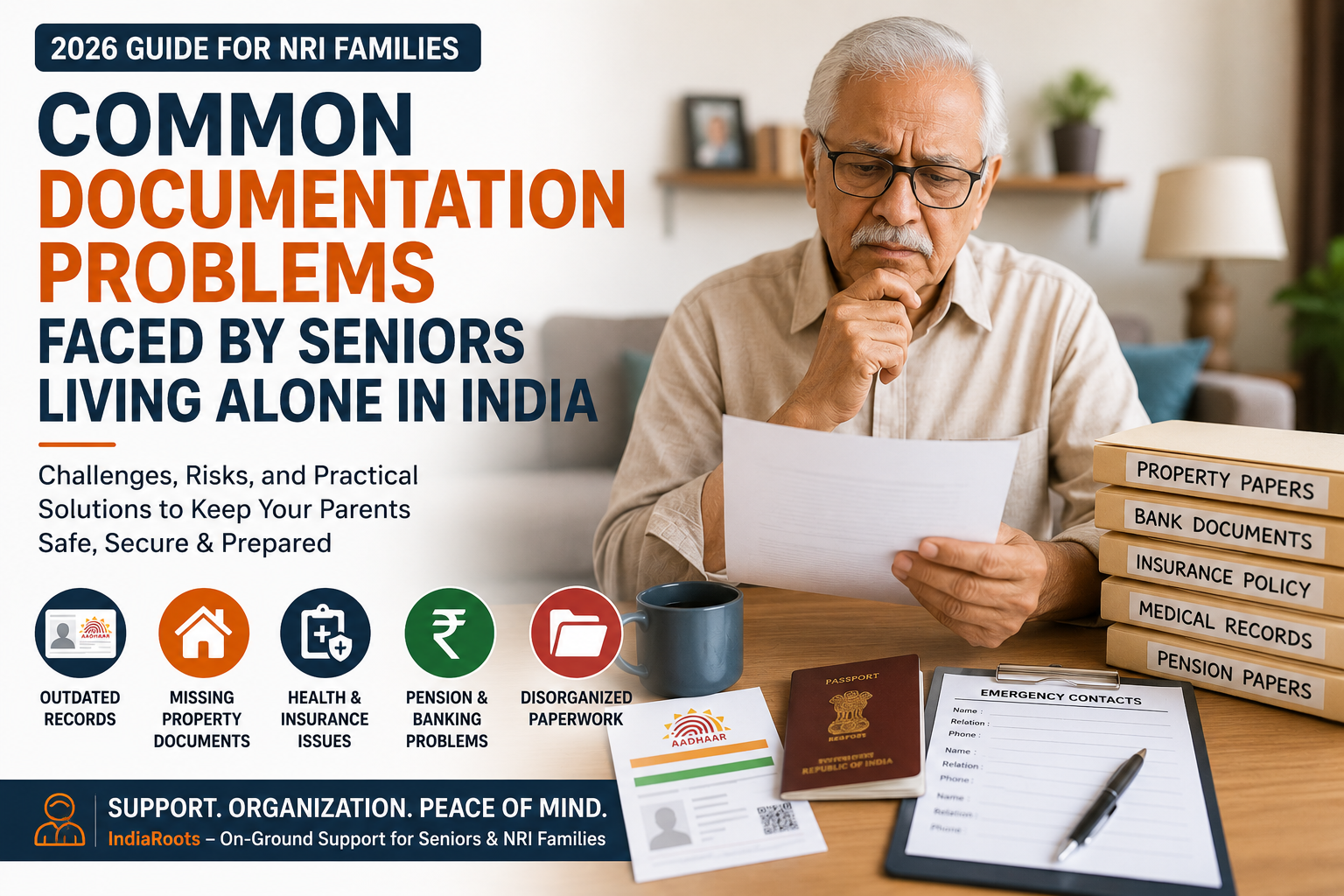
Seniors living alone in India commonly face documentation problems such as outdated Aadhaar records, missing property documents, expired insurance policies, incomplete medical records, pension verification failures, and difficulties managing government paperwork. These issues create significant complications during emergencies, financial transactions, healthcare situations, and legal processes — and they are far more common than most families realise until a specific trigger event forces the issue.
Quick Documentation Health Check
Use this quick checklist to assess whether important personal, financial, and legal documents are organised and up to date.
- ☐ Aadhaar updated within the last 3 years
- ☐ Active mobile number linked to Aadhaar
- ☐ Health insurance policy accessible and premiums up to date
- ☐ Property documents organised and easy to locate
- ☐ Emergency contact list available and current
- ☐ Will and Power of Attorney prepared, with storage location known to trusted family members
If any of these cannot be confirmed immediately, a documentation review is overdue.
Why Documentation Becomes Harder as Seniors Age
Before examining specific problems, it helps to understand why documentation management becomes progressively more difficult for elderly parents living independently.
Reduced Mobility
Visiting government offices, banks, insurance companies, sub-registrar offices, and Aadhaar centres requires travel that becomes increasingly difficult with age. Long queues, multi-floor buildings without lifts, and extended waiting times create genuine physical barriers for seniors with mobility limitations, joint pain, or post-surgical recovery constraints. Documents that require in-person renewal or verification simply do not get attended to when the physical act of getting there is an obstacle.
Digital Barriers
An increasing proportion of document management has moved online — Aadhaar updates, bank KYC, insurance renewals, pension verification, and government scheme registrations all now involve online portals, OTP verification, and document uploads. For a generation that did not grow up with smartphones or internet banking, these systems are not intuitive. Missed OTPs, forgotten passwords, and inability to navigate government portals mean that time-sensitive digital tasks go unfinished.
Memory and Organisation Challenges
Document management requires consistent tracking — knowing where physical documents are stored, remembering renewal dates, keeping records updated as circumstances change. For elderly parents living alone, without a partner or family member to share the cognitive load, documents get misplaced, renewal deadlines get missed, and the overall state of paperwork gradually deteriorates.
Absence of Immediate Family Support
When children live abroad or in distant cities, there is no one to notice that the health insurance renewal has been missed, that the Aadhaar mobile number has become inactive, or that the property tax receipts have not been collected in two years. Small documentation gaps that a family member present at home would catch and correct go unaddressed for months or years.
Managing Documentation Alone vs With Support
Warning Signs That Documentation Needs Immediate Review
If any of the following apply to your parent, treat it as a signal that a full documentation review is overdue:
Bank transactions are being rejected or flagged, which typically indicates a KYC mismatch or an outdated registered mobile number on the account.
Pension payments are delayed or require repeated verification visits to the bank, which often points to life certificate issues, KYC failures, or account detail mismatches.
Aadhaar authentication frequently fails at banking kiosks, hospital check-in terminals, or government service counters — a sign that biometric records need updating or that the registered mobile number is no longer active.
Property ownership records do not clearly match current circumstances, which becomes critically important when a property needs to be sold, transferred, or included in an estate.
Insurance claims are being questioned, rejected, or delayed due to policy document issues, lapsed premiums, or name and address mismatches.
Important documents cannot be located when needed. If your parent cannot quickly produce their health insurance policy number, property documents, or PAN card during a routine request, the situation is likely worse than it appears.
10 Common Documentation Problems Faced by Seniors Living Alone
1. Aadhaar Information Not Updated
Aadhaar is the single most consequential identity document for elderly parents in India — and it is also the document most commonly in a state of quiet disrepair. The most frequent issues are an address that reflects a previous residence, a registered mobile number that has since become inactive or been transferred, and biometric records that fail to authenticate because fingerprints have changed with age.
The consequences ripple across every Aadhaar-linked service: bank KYC fails, government benefit verification stalls, hospital authentication fails, and OTP-based logins become impossible. For seniors living alone, each of these failures is a problem they must navigate without immediate help.
Related Reading: How to Update Aadhaar for Elderly Parents in India (2026 Guide)
2. Missing or Disorganised Property Documents
Property documentation is perhaps the highest-stakes documentation category for elderly parents. Sale deeds, title deeds, mutation records, encumbrance certificates, and property tax receipts need to be physically present, correctly named, and organised. When seniors live alone, these documents are often stored informally — in different drawers, in old filing boxes, with a relative, or at a lawyer’s office with no clear record of location.
The consequences emerge most sharply during property sales, transfers to family members, rental disputes, or inheritance proceedings. A missing sale deed or an untraceable mutation record can halt a legitimate property transaction for months and create significant legal and financial costs.
Related Reading: How NRIs Can Manage Property Documents in India Without Travelling (2026 Guide)
3. Incomplete Medical Documentation
Seniors living alone are among those most likely to face a medical emergency — and also most likely to arrive at that emergency without adequate documentation. The most common gaps are the absence of a current medication list, missing details of existing conditions and past surgeries, no record of allergies, and prescriptions that cannot be quickly located.
In a serious emergency, the treating medical team needs this information immediately. When it is not available — and when there is no family member present who can provide it — treatment decisions become more complicated and potentially riskier. A simple one-page medical summary, kept in an accessible location and shared digitally with family abroad, can make a material difference.
4. Expired or Inaccessible Health Insurance Documents
Health insurance lapses are far more common among elderly parents living alone than families generally realise. Premium payment reminders go to a mobile number that has changed, or to an email address that is no longer monitored. Renewal dates pass unnoticed. By the time a medical need arises, the policy has lapsed — or the policy documents cannot be located, the policy number is not known, and the coverage details are unclear.
Even where insurance is active, elderly parents living alone frequently cannot articulate what their policy covers, what the claim process involves, or who to contact in the event of hospitalisation. This information needs to be documented, accessible, and shared with family.
5. Pension Documentation Issues
For elderly parents dependent on pension income, documentation problems can mean immediate financial disruption. The most common issues are the annual life certificate — which must be submitted in person at a bank or government office each November — and KYC records that have fallen out of date. Bank account mismatches, where the pension is linked to an account with an outdated mobile number or address, compound the problem.
Seniors living alone are particularly vulnerable to pension disruptions because there is no family member at home to notice the missed certificate, follow up with the bank, or navigate the correction process.
6. No Power of Attorney Arrangement
A senior living alone without a Power of Attorney is a senior who has no authorised representative to act on their behalf if they become incapacitated, hospitalised, or otherwise unable to manage their own affairs. Banking transactions, property decisions, medical consent, and government applications can all require the intervention of a legally authorised person.
Without a valid POA in place, family members — including NRI children — face significant practical and legal barriers when they need to act on behalf of an elderly parent in an emergency. This is one of the most important documents for any senior living independently to have in order.
Related Reading: Power of Attorney for Elderly Parents in India: Complete NRI Guide (2026)
7. Outdated Bank KYC Records
Banks periodically require KYC re-verification, and for seniors with outdated contact details on record, this process often stalls. An incorrect mobile number means verification OTPs are never received. An outdated address creates a mismatch with current documents. An account linked to an inactive email means renewal notices go unread.
The practical result can be a frozen account, suspended services, or restricted transactions — creating genuine financial access problems for a senior who depends on that account for daily expenses, pension credits, or medical payments.
8. No Will or Estate Planning Documents
A significant proportion of elderly parents in India do not have a valid, current will. Where a will exists, it is often old — reflecting circumstances and family situations that have changed — or physically inaccessible, stored with a lawyer, in a bank locker, or in a location unknown to family members.
The consequences of dying intestate, or of leaving a will that cannot be located, are well-documented: property disputes, family conflict, prolonged legal proceedings, and outcomes that do not reflect the parent’s actual intentions. Estate planning documentation is among the most important and most consistently deferred tasks for elderly parents living alone.
9. Utility and Household Documentation Problems
A particularly common problem among elderly widows and widowers is utility accounts — electricity, gas, water, telephone — that remain in the name of a deceased spouse. Transferring these accounts requires death certificates, identity documents, and bureaucratic follow-through that is challenging to manage alone.
Discrepancies in ownership and account names also create complications when properties are sold, rented, or transferred. A gas connection in a deceased spouse’s name, for example, can require a formal transfer process that many seniors are unaware is even necessary until it becomes an obstacle.
10. No Emergency Contact Information on File
Hospitals, neighbours, and local service providers need emergency contact information for elderly patients and residents. A significant number of seniors living alone have never formally recorded this information in an accessible format — and when a fall, a cardiac episode, or another emergency occurs, the people who need to reach the family cannot.
An emergency contact file — with family members’ international phone numbers, WhatsApp contact details, and names of any local contacts authorised to assist — is one of the simplest and most impactful things a family can put in place. Yet it is consistently among the last things anyone thinks about until it is urgently needed.
Essential Documents Every Senior Living Alone Should Maintain
Senior Citizen Documentation Checklist
Use this checklist to review whether essential personal, financial, medical, and legal documents are organised, updated, and accessible.
- ☐ Aadhaar card updated — address, mobile number, and biometrics current
- ☐ PAN card available and name matching other official documents
- ☐ Bank KYC completed and contact details current
- ☐ Health insurance policy accessible, premium payments current, and coverage details documented
- ☐ Property documents organised — sale deed, title deed, mutation records, and property tax receipts available
- ☐ Latest medical records available — health conditions, medications, allergies, and past surgeries documented
- ☐ Emergency contact list updated and stored in an easily accessible location
- ☐ Pension documents verified — life certificate submitted and bank account details current
- ☐ Will prepared and location known to at least one trusted family member
- ☐ Power of Attorney arranged and registered, if required
How NRI Families Can Help From Abroad
Distance creates a real limitation, but it does not have to mean inaction. NRI families can take meaningful steps to protect their parents’ documentation standing without travelling to India.
Create digital copies of all critical documents. Scanned copies of Aadhaar, PAN, health insurance policies, property documents, and medical records, stored in a secure shared cloud folder, mean that neither you nor your parent is ever completely without access to critical information.
Conduct an annual documentation review. Set a calendar reminder once a year to walk through the checklist above with your parent — by phone or video call if necessary. Many documentation problems are slow-moving and entirely preventable when caught early.
Maintain a shared emergency contact file. Ensure that your parent’s neighbours, building security, and local contacts have your international number and WhatsApp details. Ensure that your parent’s medical file includes family contact information that is current and accessible.
Arrange local support for tasks that require physical presence. Government appointments, bank visits, Aadhaar centre visits, and document collection require someone to be physically present. If you do not have a reliable local contact who can assist, professional on-ground support services can fill that role.
Track renewal dates proactively. Health insurance renewals, life certificate submissions, and KYC deadlines have fixed calendars. Track these dates yourself and coordinate with your parent — or with local support — to ensure nothing is missed.
Concerned about your parent’s documentation status?
IndiaRoots can conduct a complete documentation review covering Aadhaar, banking, insurance, medical records, property documents, pension records, and emergency preparedness — so you know exactly where the gaps are and have professional support to address them.
How IndiaRoots Helps Seniors Living Alone
IndiaRoots provides specialised documentation support for elderly parents living independently in Chandigarh, Haryana, and surrounding regions — giving NRI families a trusted professional presence on the ground when they cannot be there themselves.
Document Organisation Assistance: Our team visits elderly parents at home, reviews their existing documentation, identifies gaps, and helps organise physical and digital records into a clear, accessible structure.
Aadhaar and Government Documentation Support: We coordinate Aadhaar updates, accompany seniors to government offices, manage appointment scheduling, and handle liaison with government staff throughout the process.
Property Documentation Verification: We help seniors locate, review, and organise property documents — identifying any missing records and coordinating with relevant authorities to obtain replacements where needed.
Medical Record Management: We help create and maintain a consolidated medical history file — medications, conditions, allergies, past treatments — that is accessible both to the senior and to family members abroad.
Escort Services for Government Appointments: Our staff accompany elderly parents to Aadhaar centres, banks, pension offices, and government departments, ensuring they do not have to navigate these visits alone.
Emergency Documentation Preparedness: We help establish an emergency contact file and ensure critical documents are stored in an accessible location known to both the senior and their family.
Regular Documentation Reviews: We conduct periodic reviews of our clients’ documentation status and proactively flag renewals, updates, and gaps — keeping NRI families informed and ahead of potential problems.
Real-Life Example: Helping a Senior Living Alone in Chandigarh Get Her Documents in Order
Mrs. Kaur, 74, had been living alone in Chandigarh for three years since the passing of her husband. Her daughter Priya, based in Melbourne, had been managing what she could remotely — paying bills online, staying in touch by video call — but had no clear picture of her mother’s documentation status.
When Mrs. Kaur mentioned during a call that her bank had been asking her to complete KYC “for some time,” Priya contacted IndiaRoots for a documentation review.
What our team found during the home visit: Mrs. Kaur’s Aadhaar was still registered to her previous address, and her registered mobile number was one she no longer used. Her health insurance policy had lapsed six months earlier without her realising it. Her property documents were split between a drawer in the bedroom, a box in the spare room, and a folder at her late husband’s lawyer’s office. She had no current medical history file, no written emergency contact information, and no Power of Attorney arrangement.
Over a period of four weeks, IndiaRoots coordinated the Aadhaar update at the local Seva Kendra, assisted with health insurance reinstatement documentation, helped locate and organise the property documents, created a consolidated medical file, and established an emergency contact sheet. Priya received digital copies of everything and a clear record of what had been addressed and what remained to be done.
Mrs. Kaur did not have to manage any of it alone. Priya did not need to fly to India.
Frequently Asked Questions
What documents should elderly parents keep readily accessible?
At a minimum: updated Aadhaar card, PAN card, health insurance policy with coverage details, a current medical history file, property documents, bank passbook and KYC records, pension documents, and an emergency contact sheet. A will and Power of Attorney should also be in place and their location known to a trusted family member.
How often should seniors review their important documents?
An annual review is the practical minimum. Certain documents — health insurance, life certificates for pension, and bank KYC — have fixed renewal or submission windows that require attention on their own schedule. Building a simple annual documentation review into your regular communication with your parent is the most effective preventive measure.
What happens if property documents are lost?
Lost property documents can be partially recovered through the sub-registrar’s office where the property was originally registered, through encumbrance certificate requests, and through mutation records held by local government bodies. The process can be time-consuming and may require legal assistance. Prevention — through organised storage and digital backup copies — is significantly less burdensome than recovery.
Is a Power of Attorney necessary for elderly parents living alone?
Yes, for almost all seniors living independently. A valid POA ensures that if your parent becomes incapacitated or is hospitalised, a legally authorised person can manage banking, property, medical consent, and government applications on their behalf. Without one, family members — particularly those living abroad — may find themselves legally unable to act during exactly the situations where action is most urgently needed.
Can NRI children manage their parents’ documents remotely?
Partially. Document review, digital organisation, appointment booking, and coordination can be handled remotely. But many document processes — Aadhaar updates, bank KYC, life certificate submission, government office visits — require physical presence. For those, either a trusted local contact or a professional on-ground support service is necessary.
How should seniors store important documents safely?
A fireproof document folder or small safe is advisable for originals. Digital scans stored in a secure shared cloud folder — accessible to both the senior and at least one trusted family member — provide essential backup. The location of the physical storage should be known to a local emergency contact and to family abroad.
What documents are most critical during a medical emergency?
A current medical history file covering existing conditions, current medications and dosages, allergies, blood group, and past surgeries. Health insurance policy number and insurer contact details. Aadhaar card for identity verification. Emergency contact information for family members. These should ideally be compiled into a single accessible document kept somewhere a neighbour, building watchman, or first responder could locate quickly.
Can IndiaRoots help organise documentation for seniors living alone?
Yes. IndiaRoots provides complete documentation review, organisation, and ongoing support for elderly parents in Chandigarh, Haryana, and surrounding regions. Our services include home visits, Aadhaar and government documentation support, property document verification, medical record organisation, and regular reviews — giving NRI families reliable professional representation on the ground.
Conclusion
Documentation problems among elderly parents living alone are not dramatic events — they are slow accumulations of small gaps that become significant vulnerabilities over time. An Aadhaar that has not been updated in four years. A health insurance policy that lapsed unnoticed. A property document stored somewhere no one can find. An emergency contact file that does not exist.
None of these problems announces itself. Each one waits until the worst possible moment — a medical emergency, a financial freeze, a legal transaction — to surface as a crisis.
The good news is that these problems are entirely preventable with a structured, proactive approach. A documentation review conducted today, gaps identified and addressed systematically, digital copies made and shared, and on-ground support arranged for the tasks that require physical presence — this is what protecting an elderly parent’s independence and security actually looks like in practice.
Need help organising important documents for an elderly parent living alone in India?
IndiaRoots provides on-ground documentation support, government liaison assistance, and regular documentation reviews for senior citizens in Chandigarh, Haryana, and surrounding regions.
📞 +91-93508 98003
📧 info@indiaroots.org
Serving NRI families and senior citizens across Chandigarh, Haryana, and surrounding regions.