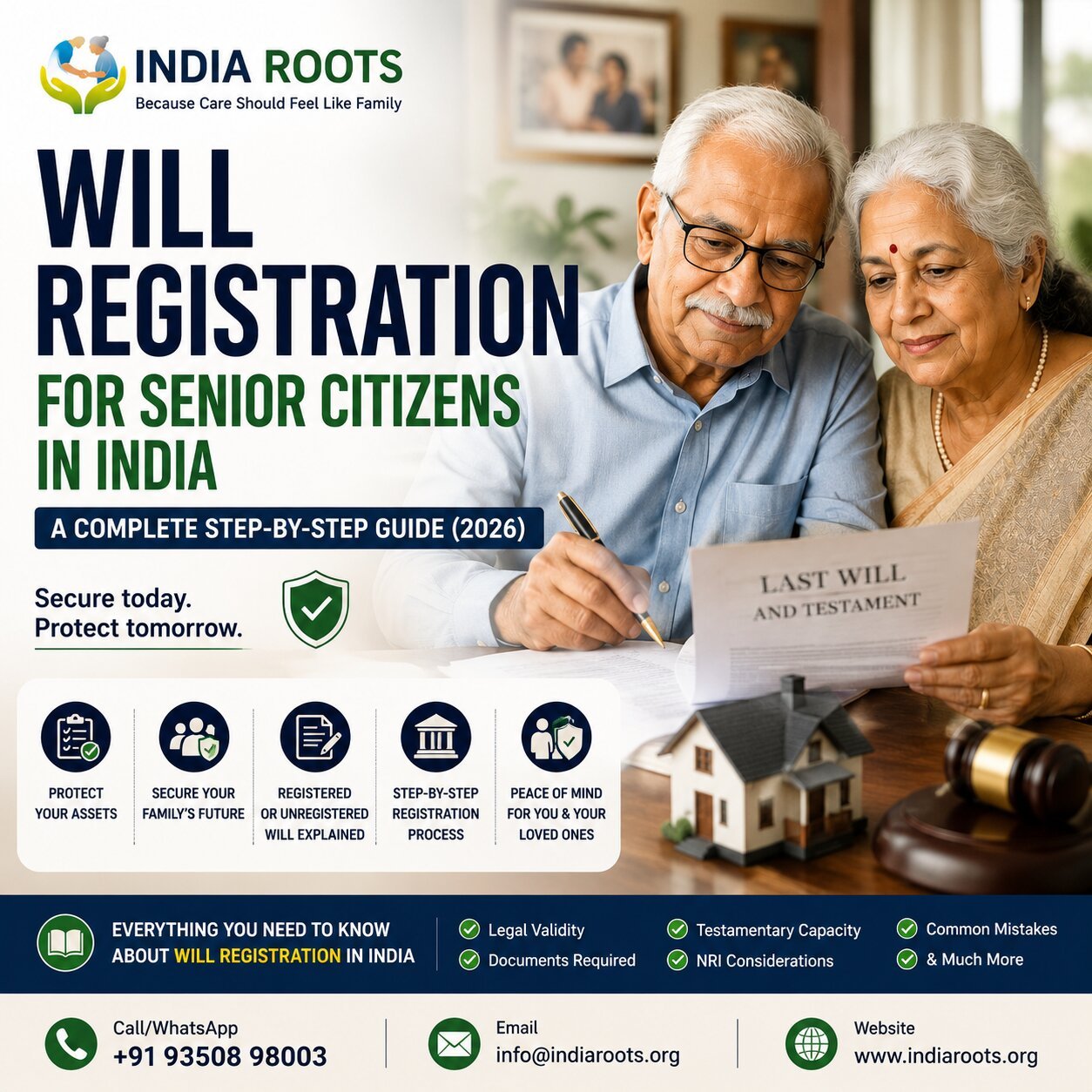
Many elderly parents spend a lifetime building a home, saving carefully, and acquiring property — and yet one of the most important documents in that entire journey is often the one that gets postponed the longest: their Will.
It’s an uncomfortable topic. Families avoid bringing it up because it feels like planning for loss, and no one wants to have that conversation over a Sunday phone call. But delaying estate planning doesn’t make the eventual need go away — it simply increases the chances of confusion, disputes, and legal complications for the very people the parent was trying to protect.
Having a valid Will isn’t really about “distributing assets.” It’s about clarity. It’s about making sure a parent’s wishes are respected exactly as they intended, and making sure the people they love aren’t left untangling ambiguity during an already difficult time.
This guide walks through everything a senior citizen — or an adult child helping a parent — needs to know about Will registration in India: what a Will actually is, whether registration is necessary, the step-by-step process, required documents, common mistakes, and special considerations for NRI families managing this from abroad.
Quick Answer: Should Senior Citizens Register Their Will in India?
A Will does not have to be registered under Indian law to be legally valid, provided it meets the legal requirements for proper execution. However, registration can provide additional evidence of authenticity and may help reduce the likelihood of disputes later. Whether registration is the right choice depends on individual circumstances, and this decision should be made in consultation with a qualified legal professional.
What Is a Will?
A Will is a legal declaration of a person’s wishes regarding how their assets should be distributed after their death. Specifically, a Will typically:
- States how property and assets should be distributed
- Names the beneficiaries who will receive specific assets
- Appoints an executor responsible for carrying out the Will’s instructions
- Can be revoked or modified at any time during the testator’s lifetime
- Only takes legal effect after the person’s death
Understanding this last point matters — a Will is not a static, one-time document. It’s meant to evolve as life circumstances change.
Why Every Senior Citizen Should Have a Will
A Will serves a purpose far broader than simply listing who gets what. It:
- Protects family assets by ensuring there’s a clear, documented record of intent
- Prevents inheritance disputes among family members who might otherwise disagree on what a parent “would have wanted”
- Ensures property goes to intended beneficiaries, rather than being determined by default succession laws
- Reduces legal uncertainty for the family during an already emotional time
- Protects vulnerable dependants, such as a spouse or family member who may need financial security
- Provides peace of mind — both for the parent making the Will and the family who will eventually rely on it
What Can Be Included in a Will?
A Will can typically cover a wide range of assets, including:
- Residential property
- Agricultural land (subject to applicable state laws)
- Bank accounts
- Fixed deposits
- Investments (stocks, mutual funds, bonds)
- Jewellery
- Vehicles
- Business interests
- Digital assets, where applicable
- Personal belongings of sentimental or financial value
Because the scope of a Will can be broad, many families find it useful to prepare a full documentation checklist first — our guide on NRI documentation assistance in India is a helpful starting point for organizing the paperwork that typically surrounds estate planning.
Registered vs Unregistered Will
One of the most common points of confusion is whether a Will needs to be registered. Here’s a side-by-side comparison:
| Feature | Registered Will | Unregistered Will |
|---|---|---|
| Legal Validity | Yes. A registered Will is legally valid when executed in accordance with applicable law. | Yes. An unregistered Will can also be legally valid if it has been properly executed. |
| Registration | Registered at the appropriate Sub-Registrar Office. | Registration is not mandatory under Indian law. |
| Evidence of Authenticity | Registration may provide stronger documentary evidence of authenticity. | Authenticity depends on the circumstances and supporting evidence if challenged. |
| Storage | An official record of the registered Will is maintained by the registration authority. | Safe storage remains the responsibility of the testator or the family. |
| Risk of Challenge | Registration may help reduce the likelihood of disputes in some situations. | May be more likely to be questioned if disputes arise, depending on the facts of the case. |
It’s important to be clear here: registration is optional, not mandatory, under Indian law. An unregistered Will can still be entirely valid if it is properly signed, witnessed, and executed. That said, many families choose registration for the added layer of documentation it provides — particularly in situations involving significant property or where disputes are a realistic concern.
What Is Testamentary Capacity?
Before a Will can be considered valid, the person making it needs what’s legally referred to as “testamentary capacity.” In simple terms, this means the person making the Will should generally:
- Understand what a Will is and what it does
- Know the nature and extent of their own assets
- Understand who their natural beneficiaries are (spouse, children, etc.)
- Be making the decision voluntarily, free from coercion or undue influence
If there are any concerns about cognitive impairment — such as early-stage dementia or memory-related conditions — it’s advisable to seek both medical and legal guidance before proceeding. This isn’t just a legal formality; it’s a safeguard that protects the validity of the Will itself and protects the parent from any future claims of undue influence.
Who Can Make a Will in India?
Generally speaking, a person making a Will should be:
- An adult of sound mind
- Acting voluntarily and of their own free will
- Not acting under undue influence, fraud, or coercion from any party
These requirements exist to ensure the Will genuinely reflects the person’s own intentions.
Step-by-Step Process for Registering a Will
Step 1: List Assets and Liabilities
Start with a complete inventory — property, bank accounts, investments, loans, and any other financial obligations. This becomes the foundation the rest of the Will is built on.
Step 2: Identify Beneficiaries
Decide clearly who should receive what. Vague intentions lead to disputes; specific, documented decisions prevent them.
Step 3: Choose an Executor
The executor is the person responsible for carrying out the instructions in the Will after the testator’s passing — managing the estate, settling debts, and distributing assets as specified. This should be someone trustworthy, organized, and ideally someone the family already respects in this kind of role.
Step 4: Prepare the Will
It’s strongly recommended to work with a qualified legal professional when drafting a Will. Vague or informal language, even with good intentions, can create ambiguity that leads to exactly the kind of disputes a Will is meant to prevent.
Step 5: Arrange Witnesses
Indian law generally requires witnesses to be present during the signing of a Will. A legal professional can advise on the specific requirements applicable to the situation.
Step 6: Visit the Sub-Registrar Office (If Registering)
If the family chooses to register the Will, this involves visiting the local Sub-Registrar Office with the testator, the draft Will, and the required identity documents to complete the formal registration process.
Step 7: Keep Copies Safely
Once complete, store the original Will securely and make sure the executor knows exactly where it is kept. A Will that can’t be found when it’s needed defeats its own purpose.
Documents Commonly Required
| Document | Purpose | How IndiaRoots Helps |
|---|---|---|
| Aadhaar Card | Required for identity verification and used across government services, banking, and official documentation. | Coordinates appointments and accompanies parents to the UIDAI centre when required. |
| PAN Card | Essential for financial records, tax-related documentation, and identity verification. | Helps organise documents and prepares everything required before appointments. |
| Property Documents | Verify ownership details and support the preparation and registration of the Will. | Collects, organises, and reviews property paperwork before legal appointments. |
| Passport Photographs | Used for identity verification and registration formalities where required. | Ensures photographs and supporting documents are ready before the scheduled visit. |
| Address Proof | Confirms the testator’s current residential address for official verification. | Checks documentation in advance to help avoid unnecessary delays or repeat visits. |
| Draft Will | The primary legal document presented during the registration process. | Coordinates appointments with legal professionals and helps organise the registration process. |
| Witness Identity Proof | Required to verify the identity of witnesses participating in the Will registration process. | Helps coordinate witness documentation and ensures all required paperwork is available before the appointment. |
Common Mistakes to Avoid
- Waiting too long to start the process at all
- Using vague language that leaves room for interpretation
- Forgetting newly acquired assets, especially property bought later in life
- Not updating the Will after major life events like marriage, divorce, or the death of a beneficiary
- Naming an unsuitable executor — someone unavailable, unreliable, or likely to cause conflict
- Keeping the Will somewhere no one can find it
- Assuming nominations replace a Will (they don’t — more on this below)
- Failing to review the Will periodically, even when nothing seems to have changed
Does Nomination Replace a Will?
This is one of the most common misconceptions families have. A nomination — such as naming someone on a bank account or insurance policy — and a Will serve different legal purposes, and one generally does not replace the other. A nominee is often considered a trustee for the purpose of receiving the asset, but the ultimate legal right to that asset is typically still governed by the Will (or succession law, if there is no Will).
Because this distinction affects how bank accounts specifically are handled, it’s worth reviewing our guide on how to update bank nomination for elderly parents alongside the Will registration process — the two should be handled together, not treated as substitutes for each other.
For anything specific to an individual’s situation, consulting a qualified legal professional is strongly recommended.
When Should a Will Be Updated?
A Will isn’t a “set it and forget it” document. It’s worth revisiting after:
- Marriage
- Divorce
- Death of a named beneficiary
- Purchase of new property
- Sale of existing assets
- Birth of grandchildren
- Moving overseas
- Any major financial change
A periodic review — even just every few years — helps ensure the Will continues to reflect current wishes and circumstances.
Special Considerations for NRI Families
When parents live in India and children are abroad, Will registration involves a few extra layers of coordination:
- Parents in India are usually the ones physically completing the process, which means logistics matter — appointments, travel to the Sub-Registrar Office, and document collection all need to happen locally.
- Children abroad often want to stay closely involved in decision-making, even if they can’t be physically present.
- Property management becomes more complex when it involves assets that NRIs may not be able to inspect or manage directly.
- Executors based in India are often practically easier to work with than executors based overseas, given the local nature of the process.
- Power of Attorney may be relevant where an NRI family member needs to act on a parent’s behalf for related administrative tasks — though this is a distinct legal tool from a Will itself, and the two shouldn’t be confused.
- Communication across time zones can slow down an already detail-heavy process if not managed proactively.
For families navigating the Power of Attorney side of this alongside Will registration, our detailed guide on Power of Attorney for elderly parents in India covers how the two documents typically work together. And for families also managing property from abroad, how NRIs can manage property documents in India without travelling is a useful companion read, since property documentation and Will preparation often go hand in hand.
How IndiaRoots Helps
To be clear from the outset: IndiaRoots coordinates the administrative process around Will registration — it does not provide legal advice or draft legal documents. Legal drafting and advice should always come from a qualified advocate or legal professional.
What IndiaRoots does help with:
- Appointment scheduling with legal professionals
- Document organisation and preparation
- Escorting parents to appointments and government offices
- Coordinating with advocates on the family’s behalf
- Coordinating Sub-Registrar Office visits
- Secure document collection and handling
- Ongoing family communication across time zones
- Progress updates throughout the process
Managing Alone vs With IndiaRoots
| Task | Managing Alone | With IndiaRoots |
|---|---|---|
| Collecting Documents | Gathering identity proofs, property papers, and supporting documents can be time-consuming and overwhelming for elderly parents. | IndiaRoots organises, verifies, and prepares all required documents locally before appointments. |
| Lawyer Coordination | Multiple phone calls and follow-ups are required to arrange meetings and discuss documentation. | Appointments with legal professionals are scheduled and coordinated on the family’s behalf. |
| Sub-Registrar Office Visit | Parents often travel alone, manage queues, and complete the registration process without assistance. | IndiaRoots accompanies parents, provides end-to-end assistance, and helps coordinate the registration visit. |
| Family Communication | Coordinating updates across different time zones can be slow and stressful for NRI families. | Regular progress updates keep overseas family members informed throughout the process. |
| Document Checklist | Important paperwork can easily be overlooked, resulting in delays or repeat visits. | A complete document checklist is reviewed and prepared before every appointment. |
| Follow-up & Completion | Multiple visits and repeated follow-ups are often required to complete the registration process. | IndiaRoots manages all follow-ups locally until the process is completed successfully. |
Case Example: Helping an NRI Family in Canada
A family based in Canada, with parents living in Chandigarh, wanted to update their father’s existing Will to reflect a newly purchased property. Rather than coordinating multiple long-distance phone calls and hoping documents were correctly organized, IndiaRoots stepped in to:
- Organize the relevant property records
- Schedule the appointment with the family’s chosen advocate
- Coordinate the registration visit at the Sub-Registrar Office
- Keep the family in Canada updated at each stage of the process
The family didn’t need to manage logistics from overseas or worry about missed documentation — they simply stayed informed while the process moved forward locally.
Frequently Asked Questions
Is Will registration compulsory in India?
No. A Will can be legally valid without being registered, provided it is properly executed according to legal requirements. Registration is optional and adds an additional layer of documented evidence.
Is a registered Will stronger than an unregistered Will?
Registration can provide additional evidence of authenticity and may help reduce the likelihood of disputes, but this depends on individual circumstances. A qualified legal professional can advise on what’s appropriate for a specific situation.
Can a senior citizen change their Will later?
Yes. A Will is revocable during the testator’s lifetime and can be updated or replaced as circumstances change.
Who should be an executor?
Someone trustworthy, organized, and willing to take on the responsibility of managing the estate and carrying out the Will’s instructions. This can be a family member, a trusted friend, or in some cases a professional.
Can NRIs help parents register a Will?
Yes, NRIs can absolutely be involved — from helping organize documents remotely to coordinating with local service providers who can manage the on-the-ground logistics.
Is witness presence required?
Indian law generally requires witnesses during the execution of a Will. Specific requirements should be confirmed with a legal professional.
Where should the original Will be stored?
In a secure location known to the executor and, ideally, communicated clearly to close family members so it can be located when needed.
Can IndiaRoots help elderly parents with the registration process?
Yes — IndiaRoots coordinates appointments, organizes documentation, and accompanies parents through the administrative process, while legal drafting and advice remain the responsibility of a qualified legal professional.
Conclusion
Creating a Will is one of the most important steps a senior citizen can take to protect their wishes and reduce uncertainty for the people they love. While registration is optional under Indian law, many families choose it for the added assurance it provides. Proper planning today — however uncomfortable the conversation may feel in the moment — can help avoid confusion, delay, and disputes for the family down the line.
Need Help Coordinating Will Registration for Your Parents?
IndiaRoots helps NRI families coordinate appointments, organise documentation, accompany elderly parents to government offices, and keep families informed throughout the process.
📞 Call/WhatsApp: +91 93508 98003
📧 Email: info@indiaroots.org
🌐 Contact IndiaRoots to Learn More