Emergencies happen without warning. A fall in the bathroom, a sudden chest pain, a missed dose of medication — these things don’t wait for a convenient time, and they certainly don’t wait for you to book a flight from Toronto, London, or Dubai.
For NRI families, this unpredictability is compounded by distance. You can’t drive over in ten minutes. You can’t walk into the hospital and demand answers at the front desk. You’re often relying on a shaky phone call, a time-zone gap, and a relative who’s just as panicked as you are.
Elderly parents in India face several kinds of emergencies — falls, cardiac events, strokes, nighttime medical crises, missing medicines, and even documentation emergencies involving Aadhaar, pension, or insurance. Each one plays out differently, but the underlying problem is the same: families that haven’t prepared in advance lose critical time when it matters most.
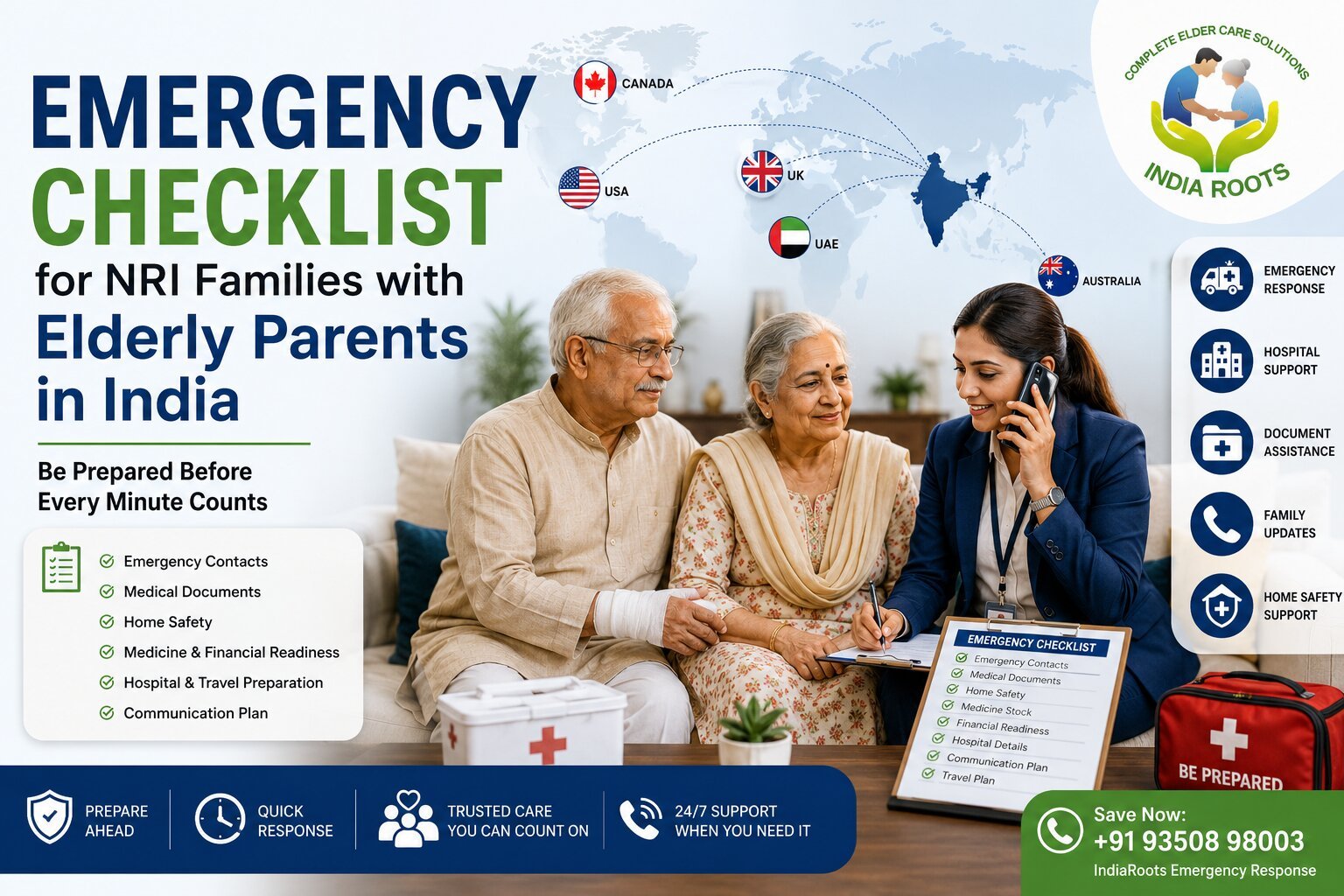
This guide is a complete emergency checklist for NRI families — covering contacts, documents, home safety, finances, hospital preparation, and a minute-by-minute plan for the first hour after something goes wrong. At the end, you can download the full checklist as a PDF to save and share with your family.
If you’re also building a longer-term care plan rather than just an emergency response, our guide on NRI parent care services in India is a useful next read.
Why Every NRI Family Needs an Emergency Plan
Living abroad changes the entire shape of an emergency response. A few realities make this especially hard for NRI families:
- Time zone gaps mean a crisis in India often happens while you’re asleep, and by the time you wake up, hours may have already passed.
- Delayed communication — relatives may wait to “not worry you,” losing valuable time before you’re even informed.
- Hospitals in India often require an attendant present at all times, not just at admission, which can be impossible to arrange on short notice.
- Documentation requirements for admission, insurance claims, and consent can stall care if paperwork isn’t ready.
- Flights aren’t instant. Even with the will to be there, travel from abroad typically takes 18–30+ hours door to door.
- Emotional stress compounds all of this — decision-making from a distance, under panic, is exhausting and error-prone.
Falls are a particularly significant risk factor among seniors globally, and are one of the leading causes of injury-related hospitalization in older adults — which is why they’re addressed in depth later in this guide.
The core principle to hold onto: the first hour after an emergency often determines the outcome. Everything in this checklist is built around making that first hour faster and calmer.
The Most Common Emergencies Elderly Parents Face in India
Falls at Home
Falls are the most frequent emergency for elderly parents living alone or with limited supervision. Common causes include:
- Bathroom slips on wet tiles
- Missteps on stairs, especially poorly lit ones
- Fractures from falls onto hard flooring, often the hip or wrist
If this has happened to your family, you’re not alone — many NRIs have lived through exactly this scenario, as shared in My Father Had a Fall in India and I’m in Canada.
Heart Attack or Stroke
These are time-critical emergencies where minutes matter. Watch for:
- Chest pain or pressure
- Sudden weakness, especially on one side of the body
- Slurred speech or difficulty speaking
- Loss of consciousness
If any of these appear, the priority is immediate transport to the nearest hospital equipped to handle cardiac or stroke cases — not necessarily the “preferred” hospital across town.
Medical Emergencies During the Night
Nighttime crises are especially dangerous because response is slower and confusion is higher. These include:
- Breathing difficulties
- High fever that spikes suddenly
- Low blood sugar episodes, particularly in diabetic parents
Missing Medicines
A surprisingly common and preventable emergency:
- Running out of a prescription with no refill on hand
- Local pharmacy closures during odd hours or holidays
- Missed doses due to memory lapses when living alone
Government Documentation Emergencies
Sometimes the “emergency” isn’t medical at all — it’s administrative, and it can block access to money or care just as effectively:
- Aadhaar linkage or verification issues
- Pension disbursement problems
- Banking access being frozen or delayed
- Insurance policy lapses going unnoticed
Emergency Contact List Every NRI Should Maintain
Keep this list updated in your phone and in a shared cloud document, not just with one family member.
| Contact | Name | Phone | Notes |
|---|---|---|---|
| Parent | ________________ | ________________ | Primary contact |
| Local Doctor | ________________ | ________________ | Include clinic hours |
| Nearby Hospital | ________________ | ________________ | Note emergency line separately |
| Ambulance Service | ________________ | ________________ | Local + citywide emergency number |
| Trusted Neighbour | ________________ | ________________ | Someone within a 10-minute walk |
| Relative (Local) | ________________ | ________________ | Someone within 30 minutes |
| Care Coordinator | IndiaRoots | +91 93508 98003 | Professional emergency coordination |
| Pharmacy | ________________ | ________________ | Preferably one offering home delivery |
| Family Lawyer | ________________ | ________________ | For POA and legal matters |
| Insurance Company | ________________ | ________________ | Include policy number & helpline |
Save all of these both in your phone’s contacts and in a shared family cloud folder, so the list survives a lost phone or a relative being unreachable.
Medical Documents to Keep Ready
Keep both physical and digital copies of:
- Aadhaar card
- PAN card
- Health insurance policy documents
- Recent medical reports
- Blood group confirmation
- Current prescription list
- Known allergy list
- Existing conditions summary
- Record of previous surgeries
- Doctor contact details
- Hospital records / patient ID numbers
Digital copies matter because paper documents can be misplaced, left behind, or inaccessible if your parent is admitted somewhere unexpectedly. A scanned, cloud-stored version means anyone authorized in the family can pull it up instantly, from anywhere.
Home Safety Checklist for Elderly Parents
Bathroom
- Anti-slip mats installed
- Grab bars near toilet and shower
- Good lighting, including night lights
Bedroom
- Bed height appropriate for easy sitting/standing
- Emergency bell or alert button within reach
- Phone kept on the nightstand, charged
Living Room
- Loose carpets and rugs removed or secured
- Wires and cables secured against tripping
- Adequate lighting throughout walking paths
Kitchen
- Gas safety checks done regularly
- Fire extinguisher accessible and not expired
- Frequently used medicines within easy reach
Entrance
- CCTV installed, if feasible
- Reliable door lock in good working condition
- Emergency contact sticker visible near the door
Medicine Emergency Checklist
- Maintain at least a 30-day stock of all regular medications
- Set up automatic reminders for refills, not just for doses
- Identify a local pharmacy that offers home delivery
- Keep prescriptions updated and renewed ahead of expiry
- Maintain a small stock of emergency medicines (fever, pain relief, glucose tablets, etc.) as advised by their doctor
Financial Emergency Preparation
- Keep emergency cash accessible at home, not solely in digital form
- Confirm bank account nominations are correctly filled out
- Consider a joint account with a trusted local family member, where appropriate
- Set up UPI so smaller transactions and local payments are easy for your parent to manage
- Enable auto-pay for critical utilities to avoid service disruption
- Set reminders for insurance premium due dates
- Periodically verify pension credits are being received on schedule
Financial readiness prevents a second crisis from stacking on top of a medical one — nothing complicates emergency care faster than a delayed payment or a frozen account at the exact wrong moment.
Documents Every NRI Should Store Digitally
Organize a shared cloud folder (Google Drive, Dropbox, or similar) with clearly labeled subfolders:
- Passport copies
- OCI/PIO card
- Aadhaar
- PAN
- Property papers
- Insurance documents
- Medical reports
- Bank documents
- Pension papers
Use a cloud service with strong security and share access only with immediate family members you trust completely. This single folder can save hours during a crisis when documents are suddenly needed for hospital admission, insurance claims, or legal steps.
Hospital Emergency Preparation
Before an emergency ever happens:
- Identify the nearest 2–3 hospitals capable of handling likely emergencies (cardiac, trauma, general)
- Know the location of the emergency entrance specifically, not just the main gate
- Save ambulance numbers directly in your phone, not just a relative’s
- Understand the hospital’s admission process, including what deposit or documentation they typically require
- Keep a scanned copy of your parent’s ID ready to send instantly if needed
Communication Plan for Overseas Families
When something happens, communication chaos can waste as much time as the emergency itself. Establish a clear priority order for who gets contacted, and in what sequence:
- Parent (to assess the situation directly, if possible)
- Neighbour (for immediate physical presence)
- Local caregiver or care coordinator
- Hospital
- Siblings and extended family
- Care coordinator update loop, if using a professional service
Create one dedicated WhatsApp group for family emergencies — separate from your regular family chat — so critical updates don’t get buried under unrelated messages.
What to Do in the First 60 Minutes After an Emergency
First 10 Minutes
- Call your parent directly to assess the situation
- Call the nearest trusted neighbour to request immediate physical presence
- Contact ambulance services if the situation appears serious
First 30 Minutes
- Inform the identified hospital that a patient is en route
- Arrange for admission logistics, including ID and initial documentation
- Notify siblings and other close family members with a clear, factual update
First Hour
- Speak directly with the treating doctor once your parent is admitted
- Arrange for an attendant to stay with them around the clock
- Begin travel planning if your presence will be needed in person
How Professional Elder Care Helps During Emergencies
This is exactly the gap that services like IndiaRoots are built to close. When family can’t physically be there, professional emergency support can provide:
- Immediate local response — someone dispatched within minutes, not hours
- Hospital coordination, including admission logistics and paperwork
- Direct doctor communication so families get clear, accurate updates
- Medicine arrangement and delivery
- Documentation support for insurance and hospital requirements
- Regular family updates so you’re never left wondering
- Emergency transportation coordination
- On-ground presence when no family member can arrive immediately
- If you’re in Chandigarh specifically, our dedicated guide on Emergency Elder Care in Chandigarh covers local hospital networks and response times in more detail. For a broader view of what emergency support can look like, visit our Emergency Response Services page. And if you’re thinking beyond emergencies toward everyday care, NRI Parent Care Services in India is worth reading next.
Frequently Asked Questions
What should I do if my elderly parent falls while I’m abroad?
Call a trusted local contact immediately to physically check on them, and get them to the nearest hospital rather than waiting to arrange travel first. For a real family’s experience with this exact situation, read My Father Had a Fall in India and I’m in Canada.
Should I keep digital copies of medical records?
Yes. Digital copies stored in a shared, secure cloud folder ensure any family member can access critical medical history instantly, even if physical documents are unavailable or the parent is admitted somewhere unexpected.
How often should emergency contacts be updated?
Review and update your emergency contact list every six months, or immediately after any change — a new doctor, a different preferred hospital, or a relative moving.Can someone accompany my parents to the hospital if I can’t travel?
Yes. Professional emergency response services can dispatch someone locally to accompany your parent, coordinate admission, and represent your family on the ground. Learn more on our Emergency Response Services page.
What documents should always be ready?
At minimum: Aadhaar, PAN, insurance documents, medical reports, prescription list, allergy list, and doctor contact details — ideally stored both physically and digitally.
Is professional emergency support useful even if relatives live nearby?
Yes. Even with relatives close by, professional support adds coordinated, accountable follow-through — someone whose sole job is managing the crisis, rather than relying entirely on a relative who may also be overwhelmed or unavailable at the wrong moment.
Conclusion
Emergencies involving elderly parents can’t always be prevented — but preparation dramatically reduces both the stress and the delays that make bad situations worse. Keeping emergency contacts, documents, medicines, and financial details current isn’t a one-time task; it’s a habit worth revisiting every six months.
For additional guidance, the World Health Organization publishes ongoing research on falls prevention and healthy ageing, and the National Institute on Aging offers resources specifically on emergency preparedness for older adults. In India, the National Disaster Management Authority also provides broader emergency preparedness recommendations relevant to elderly households.