Supporting aging parents from abroad doesn’t have to mean helpless worry. Here’s everything NRI families need to know about elder care in Haryana.
How Can NRI Families Support Parents Living Alone in Haryana?
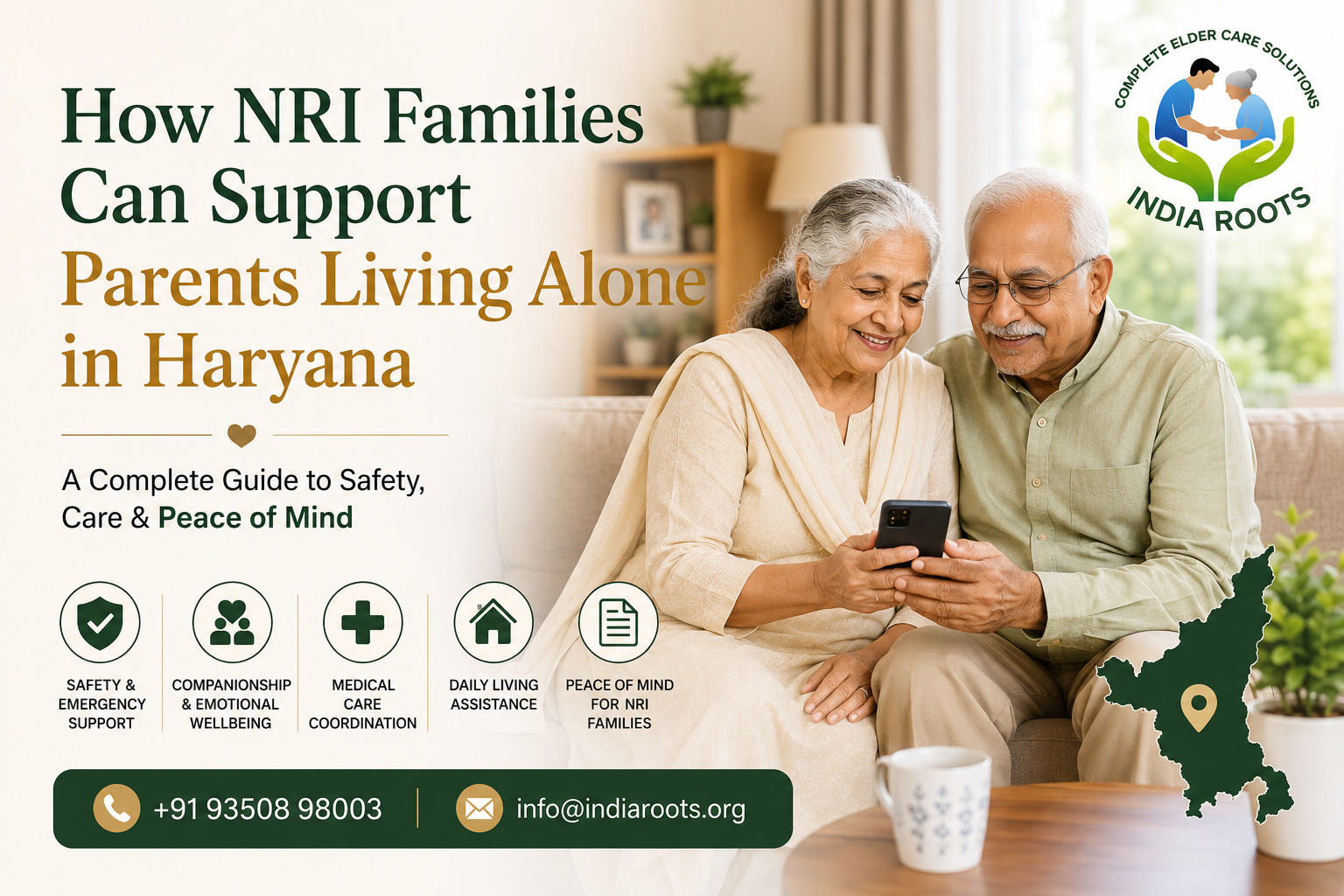
NRI families can support elderly parents in Haryana through regular communication, emergency planning, medical coordination, companionship, daily assistance, and trusted elder care services. Professional in-home support helps parents stay safe, independent, and emotionally connected while children live abroad.
The Quiet Worry Every NRI Family Understands
It is early morning in Toronto. You have a meeting in an hour, but before you open your laptop, you call home. Your mother picks up on the third ring. “Sab theek hai beta,” she says, the way she always does. But something feels different today. Her voice is slower. She mentions, almost in passing, that she skipped her Tuesday doctor’s appointment because there was no one to take her. Your father got tired walking to the market and had to come back without buying vegetables.
You hang up, sit with your chai going cold, and feel that familiar weight settle in your chest.
This is not a story unique to one family. It plays out every single day — in kitchens in Vancouver, in offices in London, in apartments in Melbourne and New Jersey. NRI families who built their lives abroad but left their hearts, and their parents, behind in Haryana.
The distance guilt is real. The worry is constant. And phone calls, as loving as they are, cannot accompany your mother to the hospital. They cannot remind your father to take his evening medication. They cannot sit with your parents during the long, quiet evenings when the house feels too big and too silent.
Most parents in Haryana do not ask for help. They are proud, independent, and deeply rooted in the places they have called home for decades. They would rather manage alone than burden their children who are “doing so well abroad.” So they downplay. They say sab theek hai even when it is not.
Supporting parents from abroad is entirely possible — but it requires structure, planning, and reliable elder care support on the ground.
Why More Elderly Parents in Haryana Are Living Alone
A generation ago, the joint family system meant that elderly parents were almost never truly alone. There were always children, grandchildren, and extended family nearby. Decisions were made together. Meals were shared. Care happened naturally, woven into daily life.
That world has changed.
Over the past two decades, Haryana has seen a significant migration of young professionals to Canada, the United Kingdom, the United States, and Australia. Children moved abroad for education, stayed for jobs, built careers and families. The move was not abandonment — it was aspiration. But the result, for many elderly parents, is a large house that now holds two people instead of ten.
Nuclear families have quietly replaced the joint family in many urban and semi-urban parts of Haryana. Even siblings who remained in India often live in different cities, managing their own responsibilities.
What makes this more complex is that most parents do not want to leave. They have spent their lives in places like Gurugram, Karnal, Panipat, Rohtak, Hisar, Ambala, Panchkula, and Faridabad — and in dozens of smaller towns and villages across the state. Their neighbours know them. Their temples and gurudwaras are nearby. Their doctors know their medical history.
Independence is a right. Isolation is a risk. The goal for every NRI family should be to protect the first while preventing the second.
The Biggest Challenges Parents Living Alone in Haryana Face
Understanding what your parents are actually dealing with — not what they tell you on the phone, but what their daily reality looks like — is the first step to finding the right senior citizen care in Haryana.
A. Medical Emergencies
This is the fear that wakes NRI families at 3 AM. A fall in the bathroom. A sudden chest pain. A diabetic episode in the early morning when no one is around.
Haryana’s elderly population faces a rising burden of lifestyle diseases. Hypertension, Type 2 diabetes, cardiac conditions, and arthritis are common. Managing these conditions requires regular monitoring, consistent medication, and fast access to care when something goes wrong.
The problem is response time. In a medical emergency, the minutes between something happening and help arriving are critical. A parent living alone may not be able to call for help quickly. Neighbours may not hear. Family members thousands of miles away can only make frantic calls and wait.
Even in cities with strong hospital infrastructure — Medanta – The Medicity and Fortis Memorial Research Institute in Gurugram, major facilities in Faridabad, Panchkula, and Ambala, and PGIMER Chandigarh for families in the Ambala and Panchkula belt — the journey from home to hospital can be an insurmountable challenge for a senior who is alone and unwell.
B. Loneliness and Emotional Isolation
This is the challenge that gets spoken about least and matters perhaps the most.
When children leave, the house does not just become quieter. It becomes a different kind of place. Days that were once structured around family meals and shared routines lose their shape. Festivals that were once loud and full become days to get through.
Many elderly parents across Haryana experience a gradual but significant reduction in social interaction after their children move abroad. Slowly, the social world shrinks. And yet, when you call, they say sab theek hai.
Loneliness is not just an emotional experience. Research consistently shows that chronic loneliness among the elderly is linked to faster cognitive decline, weakened immunity, depression, and a significantly higher risk of serious health events. It is a medical concern, not just a personal one.
C. Managing Daily Life Gets Harder With Age
The tasks that once took no thought — going to the market, managing domestic staff, paying utility bills, handling basic home maintenance — become genuinely difficult as parents age.
Carrying groceries is harder when knees are unreliable. Supervising household help requires energy and presence of mind. A leaking tap or a broken geyser can become a week-long source of stress when there is no one to arrange repairs. None of these are dramatic crises. But they accumulate, and they are often invisible to family members who are not physically present.
D. Hospital Visits Become Difficult
Routine medical care becomes increasingly important with age — and surprisingly hard to manage alone.
Getting to a hospital requires safe, reliable transport. Long queues at government hospitals or crowded private facilities are exhausting for seniors with limited stamina. Understanding what a doctor has said, remembering it clearly, asking the right follow-up questions — all of this is harder when you are unwell and alone.
For families in Gurugram, navigating large hospitals like Medanta or Fortis without a companion is genuinely overwhelming. For parents in smaller towns across Haryana, reaching adequate care in the first place adds another layer of difficulty.
E. Financial and Documentation Stress
Pension paperwork. Aadhaar updates. PAN card issues. Insurance renewals. Banking procedures that keep changing.
For many elderly parents, particularly those less comfortable with digital systems, routine financial and documentation tasks become significant sources of anxiety. Add the very real risk of financial fraud and scams targeting elderly people, and you have a layer of vulnerability that most NRI families worry about but feel powerless to address from abroad.
Signs Your Parents in Haryana May Need More Support
Parents are skilled at reassurance. By the time a parent tells you something is wrong, it has often been wrong for a while. Here are the signs to watch for, even across a video call.
- Missing medications regularly, or unsure what they are taking
- Making frequent, unplanned doctor visits — or avoiding medical care entirely
- Increased forgetfulness, losing track of days, forgetting recent conversations
- Changes in eating habits — skipping meals, not cooking, losing weight
- Visible loneliness — mentioning that days feel long, evenings feel heavy
- The house looking less well-kept than it once was
- Difficulty managing bills or growing confusion about finances
- Increasing dependence on neighbours for basic tasks
- A recent fall or health scare that was mentioned only in passing
Any one of these signs warrants a deeper conversation. Several together are a clear signal that the current situation needs more structured elder care support in Haryana.
Small warning signs have a way of becoming bigger problems when distance prevents early intervention.
Practical Ways NRI Families Can Support Parents Living Alone in Haryana
1. Put an Emergency Plan in Place
The first and most important step is to build a system that functions even when you are not reachable.
Identify trusted neighbours or friends who can check in quickly and have your contact information. Make sure your parents have a working mobile phone with important numbers saved and easy to find. Most importantly, consider having professional emergency support available — a care coordinator who can respond on the ground within minutes, not just pass along a message.
Think through the scenario: if your father has a fall at 7 PM, who is the first person to know? How quickly can they reach him? Who decides which hospital? Who accompanies him? Who calls you with accurate information? Having clear answers before an emergency happens is one of the most important things you can do.
2. Arrange Regular Health Monitoring
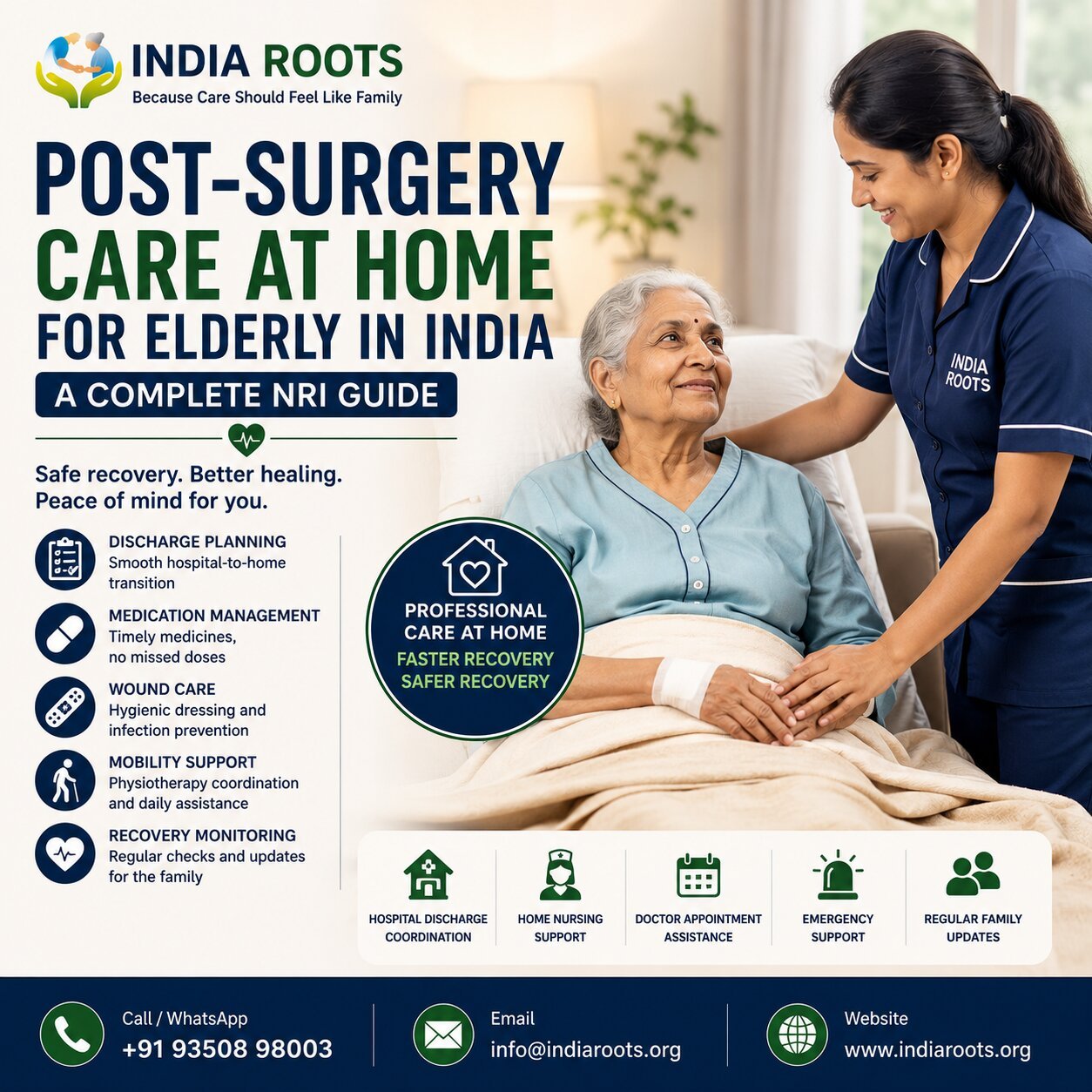
Prevention is always better than crisis management. Regular health monitoring is one of the most meaningful investments NRI families can make through professional senior care services in Gurugram and across Haryana.
This includes consistent medication reminders, scheduled health check-ups as a regular routine, and coordination of doctor appointments and follow-up visits. For parents managing chronic conditions, regular home monitoring of blood sugar and blood pressure — with results communicated to family abroad in clear terms — provides an ongoing picture of health that phone calls alone cannot offer.
3. Prioritise Emotional Wellbeing
This is not a secondary consideration. It is central to your parents’ health and quality of life.
Daily calls matter. Video calls that include grandchildren — however brief — matter even more. Making your parents feel connected to your life, not just updated about it, makes a genuine difference.
But family calls have limits. Companionship visits from a trusted caregiver — regular, predictable, something to look forward to — address the kind of loneliness that cannot be reached through a screen. Think about the calendar too. Festivals, birthdays, anniversaries — these are days when being alone feels sharpest. Arranging for someone to be present during Diwali, Gurpurab, or Holi is not a luxury. It is care.
4. Get Help Managing Daily Life
Identify the daily and weekly tasks that have become difficult and arrange reliable help for them. Groceries, cooking support, supervision of domestic help, home maintenance coordination, utility bill payments — these are manageable, but they need someone on the ground.
The goal is not to take over your parents’ life. It is to remove the friction that makes daily life harder than it needs to be, and to give them back the energy to enjoy it.
5. Consider Professional Elder Care Services in Haryana
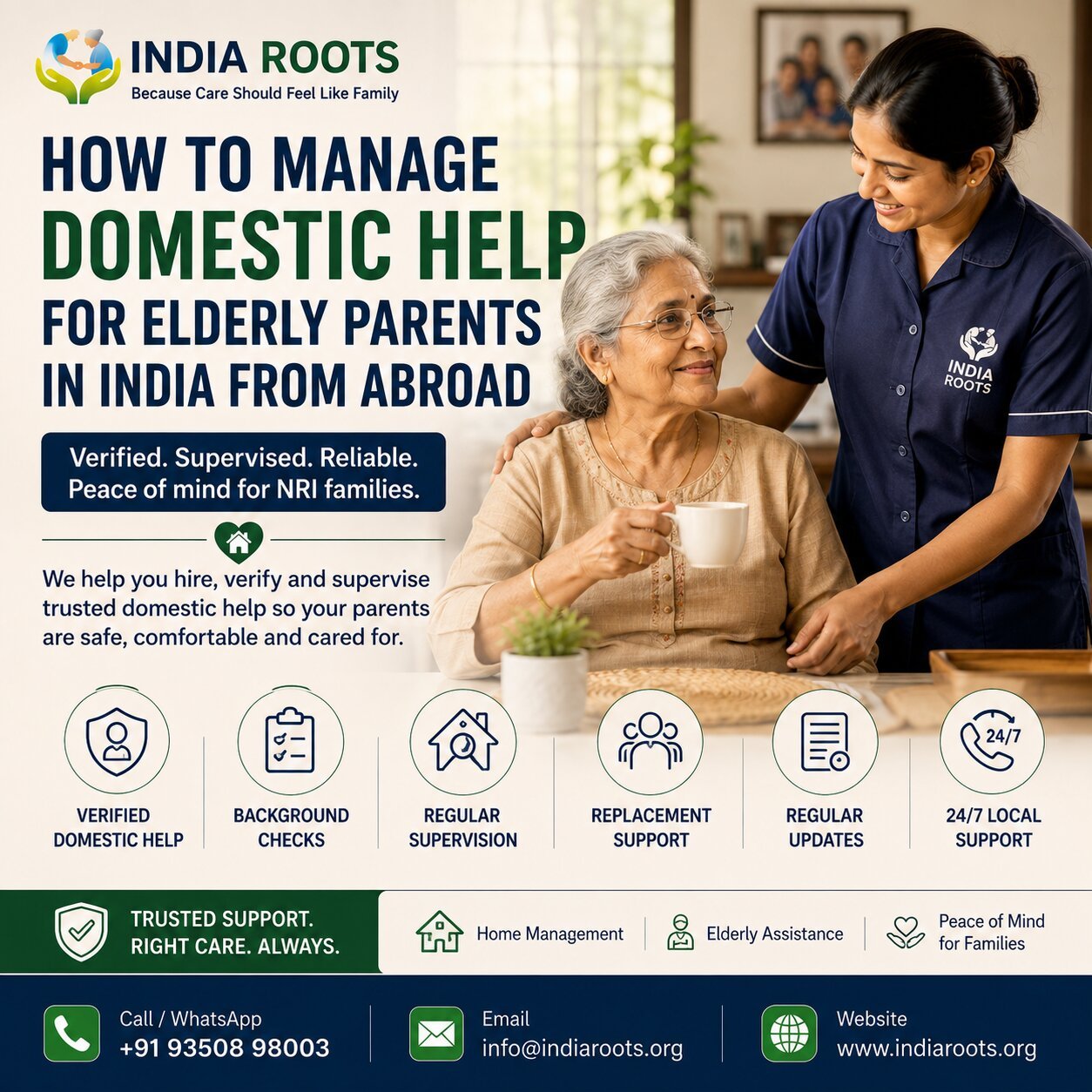
There is a point at which the patchwork of neighbours, occasional relatives, and phone calls from abroad is no longer enough. Professional in-home elder care in Haryana exists to bridge precisely this gap.
A good elder care service provides more than a list of tasks. It provides a consistent, trusted presence — a care coordinator who knows your parents, understands their needs, communicates regularly with family abroad, and responds quickly when something changes. For NRI families, the value of this is immeasurable: instead of managing five different phone numbers and hoping someone responds in an emergency, you have one accountable person who knows your parents and is genuinely invested in their wellbeing.
Related Elder Care Services in Haryana
If you are exploring support options for your parents, these are the core services that IndiaRoots provides across Haryana:
- Emotional Wellbeing & Companionship — Regular visits, conversation, and social engagement to keep loneliness at bay
- 24/7 Emergency Response — On-ground support during medical crises, with real-time updates for families abroad
- Home & Lifestyle Support — Groceries, domestic staff supervision, home maintenance, and errand management
- Financial & Bill Payment Assistance — Managing utility payments, banking tasks, and routine financial coordination
- Documentation & Liaison Services — Aadhaar, PAN, pension paperwork, insurance, and government liaison support
Why In-Home Care Works Better Than Relocation
Many NRI families, at some point, raise the idea of moving their parents — to live with another sibling, to come abroad, or to move into a senior facility. The resistance that comes back is almost always the same. This is my home. I know my neighbours. My mandir is nearby. I have lived here for forty years.
This is not stubbornness. It is wisdom.
Research on elderly wellbeing consistently shows that aging in a familiar environment produces better outcomes than relocation. Familiar surroundings support cognitive function. Existing social networks provide meaningful connection. The routines of a known place give structure and purpose.
Relocation, particularly late in life, carries real risks — adjustment difficulties, loss of support networks, disorientation, depression. For parents who are managing well overall, it is often both unnecessary and harmful.
The goal is not to uproot your parents from the life they have built. It is to surround them with support within that life — to make staying home in Haryana safe, comfortable, and connected.
When home care for elderly in Haryana is done well, parents keep their independence and their dignity. They remain in the place where they feel most like themselves. And families abroad gain something equally important: peace of mind.
Why NRI Families in Canada, the UK, the USA and Australia Are Choosing Elder Care for NRI Families in Haryana
NRI families navigating elder care from abroad are not simply looking for a service provider. They are looking for a relationship built on trust.
What matters most is consistent, honest communication — not reassuring summaries, but real information about health, mood, daily life, and any changes worth knowing about. Verified caregivers whose presence brings comfort rather than intrusion. A single, reliable point of contact who can be reached when something happens and who responds.
Emergency readiness is non-negotiable. Not a protocol on paper, but a genuine ability to respond quickly, make sound decisions, and keep family informed throughout.
For families with parents in Gurugram, Faridabad, Panchkula, Ambala, Karnal, Panipat, Rohtak, Hisar, and surrounding areas, having this kind of professional elder care support in Haryana changes the experience of being far away. It does not eliminate worry — that is part of loving someone. But it replaces helpless, anxious worry with something more grounded: informed concern, backed by real action on the ground.
Areas We Support Across Haryana
IndiaRoots provides elder care for NRI families and senior citizen care across all major cities and districts in Haryana, including:
Gurugram (Gurgaon), Faridabad, Panchkula, Ambala, Karnal, Panipat, Rohtak, Hisar, Sonipat, Kurukshetra, Yamunanagar, Sirsa, Bhiwani, Jhajjar, Rewari, Bahadurgarh, and surrounding towns and villages.
Whether your parents live in a major city or a smaller town, trusted in-home elder care support in Haryana is available.
Frequently Asked Questions
How can NRIs support parents living alone in Haryana? NRI families can support aging parents through regular communication, professional elder care services in Haryana, emergency planning, health monitoring, and arranging help with daily tasks and medical coordination. Having reliable on-ground support removes the helplessness that comes with physical distance.
What elder care services are available in Haryana? Elder care services in Haryana include emergency response assistance, medical appointment coordination, regular health monitoring, companionship visits, daily life support such as grocery and errand management, domestic help supervision, and help with documentation and financial tasks.
How do I help elderly parents from abroad? Start by having an honest conversation about what your parents are finding difficult. Then build a support system that addresses those specific needs — which may include professional care coordination, a trusted neighbour network, regular health monitoring, and a clear emergency plan.
Is emergency elder care available in Haryana? Yes. Professional elder care services in Haryana can provide emergency response support, hospital accompaniment, and real-time communication with NRI families during medical crises across cities including Gurugram, Faridabad, Panchkula, and Ambala.
Can someone accompany my parents to hospital appointments? Yes. Medical accompaniment — travelling with elderly parents to appointments, helping communicate with doctors, managing prescriptions, and following up on tests — is a core part of senior care services in Gurugram and across Haryana.
What are signs elderly parents need help? Key signs include missed medications, reluctance to seek medical care, visible loneliness, poor eating habits, declining home upkeep, confusion around bills, increased dependence on neighbours, and any recent fall or health scare.
How much do elder care services cost in Haryana? Costs vary depending on the level of support required. Most services offer an initial consultation to help families identify the right level of care. Contact IndiaRoots directly for a personalised assessment.
Conclusion: Love Shouldn’t Depend on Distance
Your parents spent years — decades — making sure you were okay. When you were sick, they sat up through the night. When you left for abroad, they told you to go, to build your life, not to worry.
They meant it. But meaning it does not mean they do not need support.
Supporting your parents from abroad does not mean replacing love with a service. It means making sure love has support on the ground. It means that when your mother needs to get to the hospital, there is someone to take her. When your father has a difficult night, there is someone who notices. When the festival feels too quiet, there is a familiar face sitting with them.
The distance is real. The love is also real. And with the right elder care support in Haryana, the distance does not have to mean they are alone.
Worried About Parents Living Alone in Haryana?
You may not always be physically present — but your parents should never feel unsupported.
IndiaRoots helps NRI families care for elderly parents across Haryana through companionship, emergency response, medical coordination, home support, and day-to-day assistance.
Talk to a care expert today.
📞 +91 93508 98003 📧 info@indiaroots.org
Trusted elder care for NRI families. Supporting senior citizens across Haryana.