Losing a parent is one of life’s most difficult experiences. Alongside grief, families often face a long list of administrative responsibilities that cannot be postponed. One of the earliest documents many families are asked to obtain is a Legal Heir Certificate.
Whether you need to transfer property, update government records, claim pension benefits, or manage bank accounts, this certificate often becomes an essential part of the documentation process. For NRI families, managing these formalities from overseas can feel especially overwhelming — different time zones, unfamiliar offices, and a grieving family back home who shouldn’t have to navigate bureaucracy alone.
This guide explains what a Legal Heir Certificate is, when it’s required, how the application process generally works, and how IndiaRoots’ NRI documentation assistance helps families coordinate the process locally.
Quick Answer: What Is a Legal Heir Certificate?
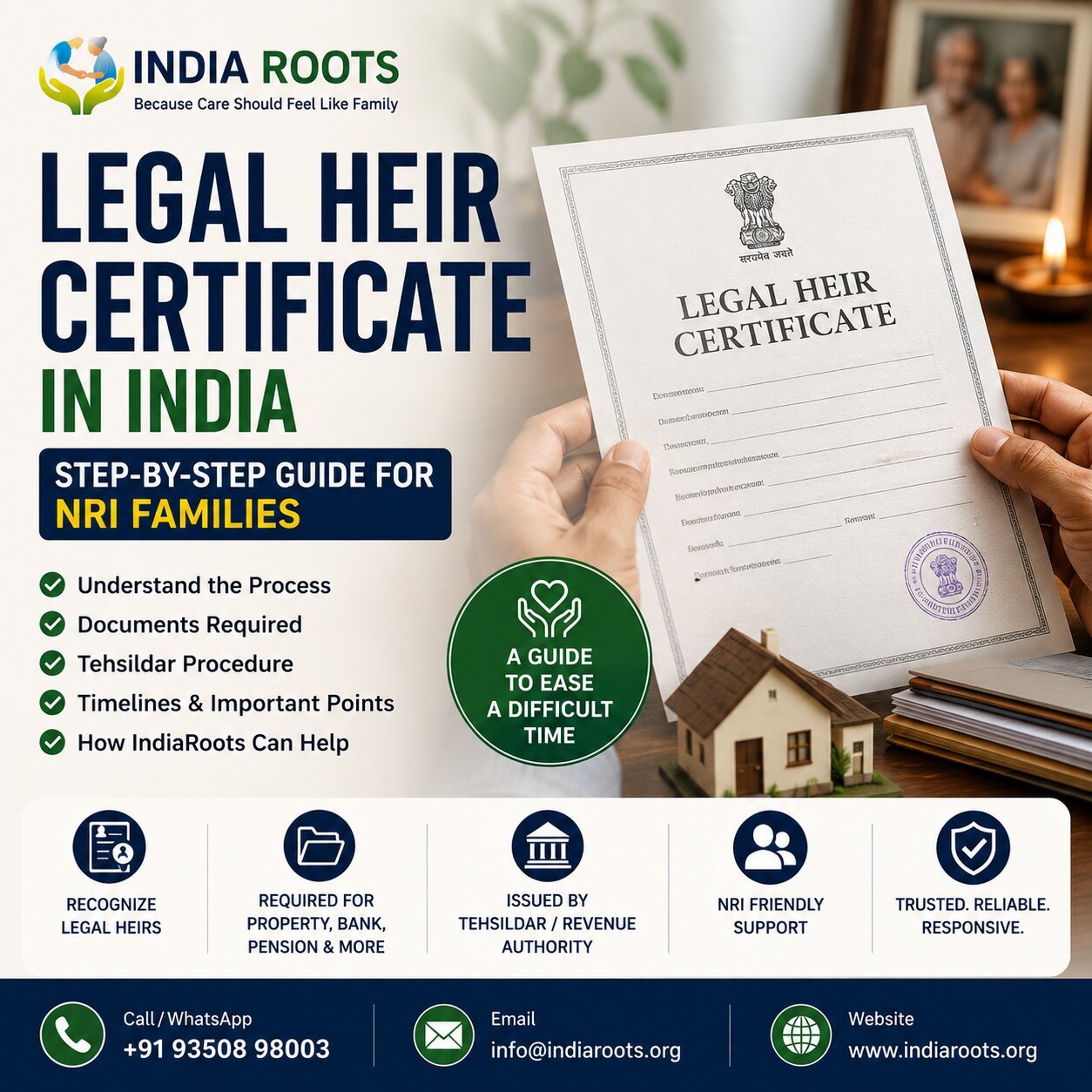
A Legal Heir Certificate is an official document issued by the competent revenue authority in many states that identifies the surviving legal heirs of a deceased person. It’s commonly required for updating government records, claiming certain benefits, transferring assets, and completing various administrative formalities. The exact issuing authority and process vary by state.
What Is a Legal Heir Certificate?
A Legal Heir Certificate is a government-issued record that formally establishes who the surviving legal heirs of a deceased person are. It’s typically issued after a death and is used to:
- Establish the family relationship between the deceased and their heirs
- Help government departments, banks, and institutions confirm who is entitled to act on behalf of the deceased’s estate
- Support various administrative and procedural requirements that follow a death in the family
Because India’s revenue administration is handled at the state level, the exact name, issuing office, and process for this certificate can differ from one state to another. Some states use the term “Legal Heir Certificate,” while others may use related terms for similar purposes. It’s worth checking the specific requirement with the concerned authority or institution before applying, since the right document sometimes depends on what it will be used for.
When Is a Legal Heir Certificate Required?
Families are commonly asked for this certificate in situations such as:
- Pension claims, including family pension after a parent’s passing
- Bank formalities, such as closing or transferring accounts held by the deceased
- Insurance claims
- Property mutation, where applicable, as part of updating land or property records
- Utility transfers, such as electricity or water connections
- Government benefit claims
- Municipal record updates
It’s worth noting that some institutions may ask for additional or different legal documents depending on the nature of the transaction — for instance, a bank may have its own internal requirements alongside the certificate itself. It’s always best to confirm exact requirements with the specific institution involved.
Legal Heir Certificate vs Succession Certificate
These two documents are often confused, but they serve different purposes and are issued through entirely different processes.
| Feature | Legal Heir Certificate | Succession Certificate |
|---|---|---|
| Issued By | Revenue Authority (such as the Tehsildar or other competent authority, depending on the state). | Civil Court through a judicial process. |
| Main Purpose | Establishes the identity of the deceased person’s legal heirs for various administrative purposes. | Authorises eligible heirs to collect certain debts and securities belonging to the deceased. |
| Property Matters | Commonly used for many administrative processes, including updates to government records and certain property-related matters where accepted. | Generally relates to debts and securities rather than serving as proof for all property matters. |
| Time Required | Usually completed faster, depending on state procedures and document verification. | Generally takes longer because it involves court proceedings. |
| Court Proceedings | Generally not required. Issued through the revenue administration process. | Required. Issued only after completion of the court process. |
The right document for your family depends on the specific purpose and the applicable legal requirements in your case. If you’re unsure which one you need, it’s worth checking with the institution requesting the document, or consulting a legal professional — this article is meant to inform, not to substitute for legal advice.
If your family’s situation also involves a will left by the deceased, our guide on Will Registration for Senior Citizens in India may be a useful companion read, as registered wills can affect how succession is handled.
Who Can Apply?
Generally, the following family members are recognised as eligible applicants, subject to the applicable law and personal circumstances:
- Spouse
- Son
- Daughter
- Mother
- Father, where applicable
- Other legal heirs as recognised under the relevant law
Since eligibility and the exact list of recognised heirs can depend on personal law and state rules, it’s best to confirm your specific position with the concerned authority.
Step-by-Step Application Process
While the exact procedure varies by state, the general process usually follows these steps:
Step 1: Obtain the death certificate. This is the foundational document and is almost always required before anything else can proceed.
Step 2: Collect identity documents. Aadhaar, PAN, and other identity proofs for the applicant and, where required, the other heirs.
Step 3: Prepare proof of relationship. This might include the family register, ration card, or other documents establishing the family connection to the deceased.
Step 4: Complete the application. This typically involves filling out a prescribed form, often available at or near the relevant government office.
Step 5: Submit to the Tehsildar or other competent authority, depending on the state and jurisdiction.
Step 6: Verification by revenue officials. This step often involves local enquiry and may include a visit or verification at the applicant’s residence.
Step 7: Certificate issued, once verification is complete.
Documents Commonly Required
| Document | Purpose | How IndiaRoots Helps |
|---|---|---|
| Death Certificate | Officially establishes the fact of death and is required for most legal heir applications. | Helps ensure the certificate is obtained and available in the required format before the application is submitted. |
| Aadhaar Card | Used for identity verification of the applicant and supporting family members. | Reviews documents for accuracy and checks that all details are consistent. |
| PAN Card | Supports identity verification and links financial records where required. | Verifies PAN details as part of the overall document preparation process. |
| Family Register (where applicable) | Helps establish family composition and relationships where accepted by the local authority. | Assists with sourcing and organising the document locally. |
| Ration Card (if applicable) | May serve as supporting proof of household and family relationship where relevant. | Collects and organises the document when required for the application. |
| Address Proof | Confirms the applicant’s or deceased person’s current residential address. | Verifies and organises address documents before submission. |
| Identity Proof | Confirms the identity of the applicant and supporting family members. | Checks all identity documents for consistency to help prevent application delays. |
| Passport-sized Photographs | Required for completing application forms and official records. | Ensures photographs are arranged and ready before the appointment. |
| Property Records (if relevant) | May support applications involving property-related administrative processes. | Reviews and organises property records where they are relevant to the application. |
| Application Form | The formal request submitted to the competent authority for issuing the Legal Heir Certificate. | Prepares, reviews, and coordinates submission of the application on your behalf. |
How Long Does It Take?
Processing time depends on several factors: which state you’re applying in, the workload at the local Tehsildar or revenue office, whether all documents are complete and consistent on first submission, and how straightforward the verification process turns out to be. Because of this variability, it’s best not to rely on a fixed timeline — some cases move quickly, while others take longer, particularly if there’s any ambiguity in family records or if multiple heirs need to be involved in the process.
Common Reasons for Delay
A few issues tend to slow the process down more than others:
- Missing or incomplete documents
- Errors in the application itself
- Name mismatches across different documents
- Aadhaar detail mismatches
- Verification pending at the local level
- Situations involving multiple legal heirs who need to be accounted for
- Incomplete or outdated family records
Most of these are avoidable with careful preparation before submission — which is often where families managing the process from abroad run into the most friction.
Special Considerations for NRI Families
Handling this process while living abroad brings its own set of practical challenges:
- Time zone differences can make it hard to coordinate with government offices during their working hours
- Document coordination across countries — getting the right paperwork to the right place — takes time and careful tracking
- Certified copies of documents may be needed, and the process for certifying them can vary depending on your country of residence
- A Power of Attorney, where appropriate, can allow a trusted family member or representative to act on your behalf — see our guide on Power of Attorney for Elderly Parents in India for more on how this works
- Communication with relatives in India needs to stay consistent so nothing falls through the cracks during an already emotional time
- Government office visits are often unavoidable at some stage of the process, which is difficult to manage remotely
If your family is also dealing with property left behind, our article on NRI property documentation in India without travelling covers the related steps for property transfer and mutation.
How IndiaRoots Helps
To be clear upfront: IndiaRoots does not issue certificates or provide legal advice. The certificate itself is issued only by the relevant government authority, and legal questions should always go to a qualified legal professional.
What we do help with is the coordination and legwork around the process, including:
- Document collection and organisation
- Appointment scheduling with the relevant office
- Accompanying family members on government office visits
- Local follow-up with the Tehsildar’s office
- Communication between the family in India and abroad
- Regular progress updates so you’re never left wondering where things stand
- Secure handling of sensitive documents throughout
This is the same kind of support we provide across other documentation needs — from updating bank nomination details for elderly parents to broader NRI documentation assistance.
Managing It Alone vs With IndiaRoots
| Task | Managing Alone | With IndiaRoots |
|---|---|---|
| Collecting Documents | Time-consuming and challenging, especially when coordinating everything from overseas. | Documents are collected, organised, and prepared locally before submission. |
| Government Office Visits | Multiple visits may be required, creating delays and added stress for family members. | Appointments and office visits are coordinated on your behalf. |
| Tehsildar Follow-up | Difficult to manage without someone available locally. | Regular follow-up is actively managed until the process is completed. |
| Family Communication | Updates can be delayed or inconsistent across different time zones. | Regular, structured progress updates keep the entire family informed. |
| Application Tracking | Progress is often uncertain, requiring repeated follow-ups. | The application is monitored throughout the process until completion. |
| Documentation | Missing a required document can delay the entire application. | A comprehensive checklist is prepared in advance to help ensure nothing is overlooked. |
Case Example: Helping an NRI Family in Canada
A family based in Canada lost their father, who had been living in Punjab. With the children abroad and unable to travel immediately, IndiaRoots stepped in to collect the required documents locally, coordinate the visit to the Tehsildar’s office, organise the verification process, and keep the family updated throughout — so they could focus on grieving and supporting each other rather than chasing paperwork.
Frequently Asked Questions
What is a Legal Heir Certificate?
It’s an official document, issued by the relevant state revenue authority, that identifies the surviving legal heirs of a deceased person.
Is it mandatory?
Requirements vary depending on the transaction and institution involved. Some processes require it; others may accept alternative documentation. It’s best to confirm with the specific institution.
Who issues it?
Typically a revenue authority such as the Tehsildar’s office, though this varies by state.
Can NRIs apply?
Yes, though the process often requires coordination with someone present in India, or in some cases a Power of Attorney arrangement.
How long does it take?
This varies significantly by state and case complexity — we’d avoid promising a fixed timeline, since local workload and document completeness both play a role.
What documents are needed?
Commonly the death certificate, identity proofs, proof of relationship, and address proof, though exact requirements vary by state and case.
Can one legal heir apply on behalf of all?
This depends on state rules and the specific circumstances of the family. It’s worth confirming with the local authority.
Is it the same as a Succession Certificate?
No — they serve different purposes and are issued through different processes. See the comparison table above.
Does IndiaRoots provide legal advice?
No. We coordinate documentation and logistics; legal questions should go to a qualified legal professional.
Can IndiaRoots coordinate the application?
Yes — we help with document collection, appointment scheduling, office visits, and follow-up throughout the process.
Conclusion
Obtaining a Legal Heir Certificate is often one of the first administrative steps after losing a loved one. While the process differs between states, being prepared with the correct documents and having reliable local support can make it considerably smoother — especially for families living overseas who can’t easily be present for every step.
Need Help Coordinating a Legal Heir Certificate for Your Family?
If you’re living abroad and need assistance managing the documentation process in India, IndiaRoots can help coordinate appointments, organise paperwork, accompany family members to government offices, and provide regular progress updates.
📞 Call/WhatsApp: +91 93508 98003
📧 Email: info@indiaroots.org
🌐 Contact IndiaRoots to Learn More