When Every Minute Matters
It was 2:47 AM in Toronto when Suresh’s phone rang.
His mother’s neighbour was on the line — voice shaking, words tripping over each other. His 76-year-old mother had fallen in the bathroom. She was conscious but couldn’t move. She had been lying on the cold floor for nearly twenty minutes before the neighbour heard her calling out.
Suresh was 11,500 kilometres away.
In the minutes that followed, he did what thousands of NRI sons and daughters do in that exact moment — he froze. He didn’t know which ambulance number to call. He didn’t know which hospital to go to. He didn’t have a single trusted person in Chandigarh he could call at 3 AM and ask to go be with his mother right now.
This is not an unusual story. It plays out in homes across Chandigarh every week — a fall, a chest pain, a sudden confusion episode, a diabetic emergency — and somewhere across the world, a family member receives the call they have always dreaded.
Emergency elder care exists to make sure that when that call comes, everything that needs to happen next already has someone handling it — quickly, competently, and with the family fully informed throughout.
Why Chandigarh Seniors Need Emergency Support
Chandigarh has seen steady growth in its senior population over the past two decades. As one of India’s most liveable cities, it has also become a city where elderly residents increasingly choose to remain — even as their adult children have moved to other countries or other cities for work and opportunity.
This has created a situation that is deeply familiar to NRI families across Canada, the United Kingdom, Australia, and the United States. Parents who are fiercely independent, proud of their home, rooted in their neighbourhood — and increasingly alone.
A Growing Senior Population The proportion of senior citizens in Chandigarh continues to rise. More people are living longer, and more are doing so without the immediate presence of family around them.
More NRI Families Than Ever Punjab has one of the highest rates of overseas migration in India. Chandigarh, as the capital of Punjab and Haryana, has a disproportionately large NRI-connected population. Countless families manage the care of elderly parents from thousands of miles away, relying on neighbours, domestic helpers, and occasional visits.
Seniors Choosing to Live Independently Many seniors actively prefer living alone. They want their routines, their independence, their familiar environment. This preference is deeply valid and should be respected — but it requires a safety net that matches the level of risk.
The Reality of Living Alone After 60 After the age of 60, the risk profile of a person changes meaningfully. Falls become more dangerous. Chronic conditions like heart disease, diabetes, and respiratory illness become harder to manage. Cognitive changes can create safety risks that weren’t present before. Living alone in this phase of life, without professional emergency backup, is a significant and avoidable risk.
Common Medical Emergencies Elderly Parents Face
Knowing what kinds of emergencies are most common among seniors helps families understand why 24/7 emergency elder care in Chandigarh is not a precaution — it is a necessity.
Falls and Fractures
Falls are the single most common cause of serious injury in seniors. Wet bathroom floors, uneven stairs, a moment of dizziness while rising from a chair — any of these can cause hip fractures, wrist injuries, or head trauma. What makes falls particularly dangerous is that many seniors who fall cannot get up or call for help on their own. A fall that goes unattended for hours can lead to dehydration, hypothermia, pressure injuries, and severe psychological trauma, on top of the physical injury itself.
Heart Attack Symptoms
Chest tightness, pressure radiating to the arm or jaw, sudden nausea, cold sweats, shortness of breath — these are signs of a cardiac emergency that requires immediate medical attention. In cardiac care, time is muscle. Every minute of delay reduces the amount of heart tissue that can be saved. Having someone trained to recognise these signs and activate emergency services immediately is genuinely life-saving.
Stroke Emergencies
The FAST method — Face drooping, Arm weakness, Speech difficulty, Time to call for help — is the most important thing to know about strokes. Strokes are among the most time-critical of all medical emergencies. Treatment within the first hour dramatically improves outcomes. Seniors living alone may not be able to call for help when a stroke occurs, making an external response system essential.
Diabetic Episodes
India has one of the world’s largest diabetic populations, and many Chandigarh seniors manage this condition daily. Hypoglycemia — dangerously low blood sugar — can cause sudden weakness, confusion, and unconsciousness with very little warning. Hyperglycemia can escalate to diabetic ketoacidosis, a serious and potentially fatal complication. Recognising these episodes early and getting the right response quickly is critical.
Breathing Difficulties
For seniors living with COPD, asthma, heart failure, or other conditions affecting the lungs, a sudden breathing crisis is a genuine emergency. These episodes can escalate within minutes and require immediate medical intervention. A trained emergency coordinator who can assess severity and dispatch the right help — and who knows which hospital in Chandigarh has the right facilities — makes an enormous difference.
Sudden Confusion and Dementia Episodes
Seniors with Alzheimer’s disease or other forms of dementia are at risk of sudden, severe confusion episodes, including wandering outside the home in a disoriented state. These situations require calm, trained, immediate intervention. A senior who wanders out of the house at night in a confused state faces serious risks of injury, exposure, or becoming lost. Emergency response coverage is not optional for families managing dementia from a distance.
The Biggest Fear of NRI Families
If you ask NRI families what they lie awake worrying about, the answer is rarely abstract. It is specific and vivid.
Being Thousands of Miles Away
The distance is not just geographical. It is emotional. It is the helplessness of receiving a crisis call and knowing you cannot physically be there. It is the guilt of having built a life abroad while your parents age alone. And it is the fear — always present at the back of the mind — that something will go wrong at the worst possible moment.
Not Knowing What is Happening
Information gaps are agonising. Receiving a call that your parent is in the hospital, and then hearing nothing for hours because no one is answering the phone or knows how to communicate clearly — this is one of the most commonly reported sources of distress among NRI families during a parent’s medical emergency.
No Trusted Local Contact
Neighbours are kind but not trained. Domestic helpers are helpful but not equipped to navigate a hospital admission. Friends have their own families and their own crises. Most NRI families do not have a single reliable, always-available, trained person in Chandigarh they can call at any hour to physically go and be with their parent during an emergency.
Difficulty Managing Hospitals Remotely
Indian hospitals — even excellent ones — require a physical presence to function well. Admission paperwork needs to be completed. Doctors need to be spoken to in person. Payment arrangements need to be made. Decisions need to be taken quickly, by someone who is there and understands the situation. Managing this remotely, across time zones, through a patchy phone connection, is genuinely very difficult.
What Emergency Elder Care Services Include
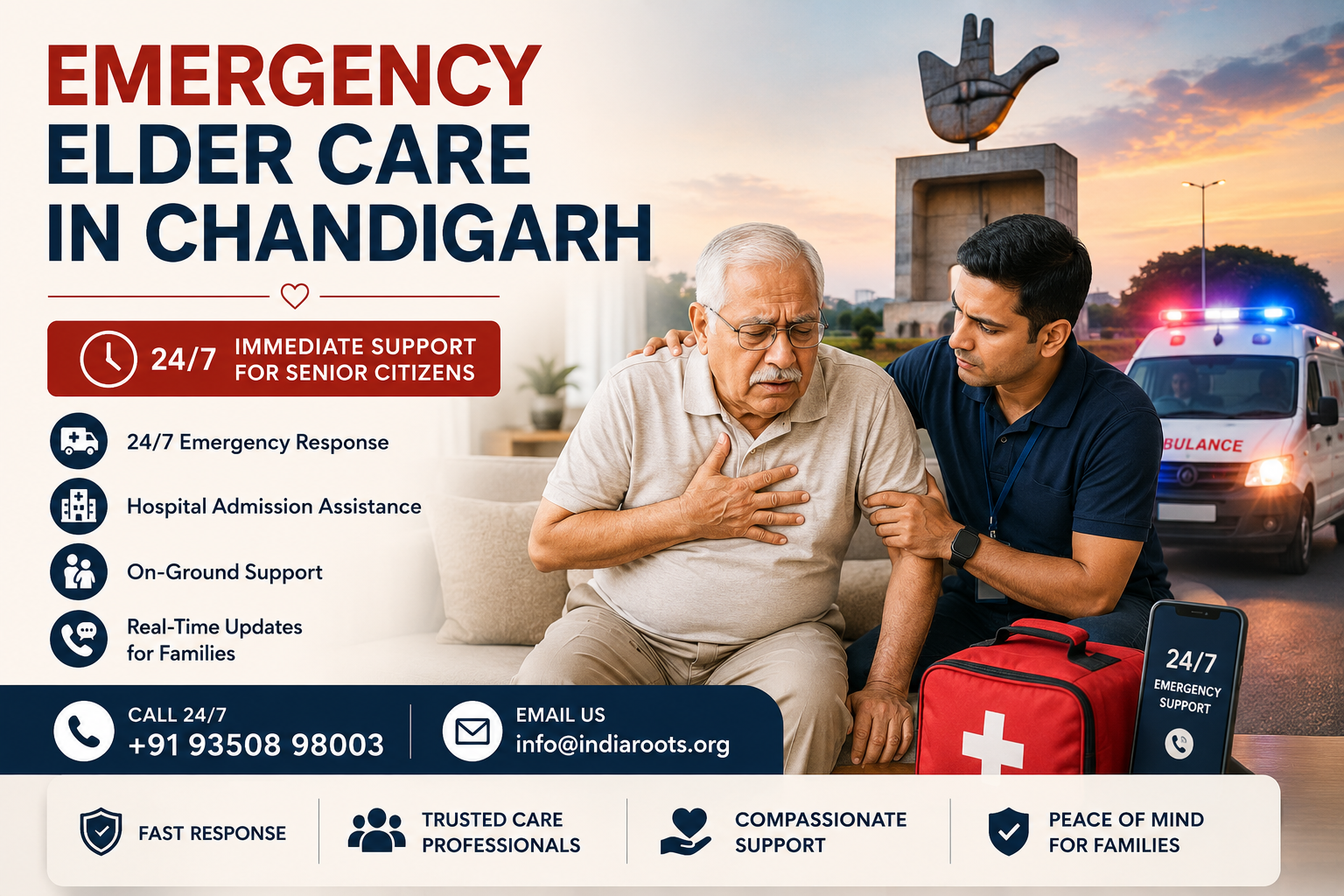
A professional emergency elder care service is not simply an ambulance on call. It is a comprehensive support system that activates the moment something goes wrong and remains engaged through the entire crisis and recovery period.
24/7 Emergency Helpline A dedicated line staffed around the clock — not a voicemail, not a callback service, not an answering machine. When someone calls at 4 AM because a senior has had a fall, a trained human being answers and begins coordinating immediately.
Immediate On-Ground Response Trained emergency coordinators who can physically reach the senior within minutes. Someone who can assess the situation with calm competence, provide first-level assistance, and take charge until medical professionals arrive and after they do.
Ambulance Coordination Knowing which ambulance service to call for the location, ensuring the right address is communicated, describing the nature of the emergency so appropriate equipment is on board, and following up to confirm dispatch and estimated arrival time.
Hospital Admission Support This is often where the most significant value is delivered. Navigating hospital admissions in India — particularly during a high-pressure emergency — requires someone who knows the process, can complete paperwork efficiently, communicate clearly with triage staff, and ensure the senior receives timely attention. An experienced coordinator with hospital relationships makes a real difference.
Doctor Communication A coordinator who can speak directly with treating physicians, understand the diagnosis and treatment plan in plain terms, relay this information accurately to the family abroad, and ask the right follow-up questions. Families should never have to guess what is happening with their parent’s medical care.
WhatsApp Updates for Families Real-time updates sent directly to family members wherever they are in the world — with photographs, copies of medical documents, and clear, plain-language explanations of what is happening and what the next steps are. This transforms helpless anxiety into informed involvement.
Post-Hospital Recovery Support The weeks following a hospitalisation are among the highest-risk periods in a senior’s life. Discharge does not mean the crisis is over. A comprehensive service continues support through recovery — medication management, physiotherapy coordination, follow-up appointment assistance, and daily monitoring to catch complications early.
Emergency Hospitals in Chandigarh We Coordinate With
Chandigarh and the surrounding Tricity region are served by several excellent medical institutions. Knowing which facility is best suited to which type of emergency — and having someone who can navigate the system at each one — is a significant advantage.
Postgraduate Institute of Medical Education and Research (PGIMER), Chandigarh One of India’s premier government medical institutions, PGIMER is equipped to handle the most complex and serious cases. It can be busy and difficult to navigate during emergencies without someone who knows the system. Having a coordinator with established familiarity with PGIMER’s emergency processes is genuinely valuable.
Fortis Hospital, Mohali A leading private hospital with strong capabilities in cardiac care, orthopaedics, and neurology — all directly relevant to the most common senior emergencies. Well-equipped emergency department with experienced staff.
Max Super Speciality Hospital, Mohali Comprehensive emergency services with particular strength in neurology and cardiac care. A strong option for stroke and heart emergencies requiring specialist intervention.
Government Medical College and Hospital, Chandigarh Accessible emergency care and an important option when proximity and speed are the priority, or when immediate stabilisation is needed before a transfer to a specialist facility.
Please note: Hospital selection in any given emergency depends on the nature of the medical condition, the senior’s location, bed availability, and family preference. Our coordinators provide guidance based on real-time information at the time of the emergency.
Warning Signs Your Parents Need Emergency Response Coverage
Some seniors face a substantially higher risk of experiencing a medical emergency than others. If any of the following apply to your parent, arranging professional emergency coverage is not something to defer — it is something to do this week.
| Risk Factor | Why It Matters |
|---|---|
| Lives alone | No immediate help available if something goes wrong. |
| Previous fall | History of falling is the strongest predictor of future falls. |
| Heart disease | Significantly increased risk of cardiac emergency. |
| Diabetes | Sudden blood sugar crises can escalate to unconsciousness rapidly. |
| Dementia | Wandering, severe confusion, and safety risks at any time. |
| Recent hospital discharge | Statistically the highest-risk period for readmission. |
| Limited mobility | Increases fall risk and reduces the ability to seek help independently. |
If two or more of these apply to your parent, the question is not whether emergency coverage is needed. It is why it has not already been arranged.
What To Do During a Senior Citizen Emergency in Chandigarh
If you receive a call that your elderly parent is in a crisis right now, move through these steps as quickly and calmly as possible.
Step 1: Stay Calm Panic produces poor decisions. Take one breath. Understand what you know. Then begin moving through the steps.
Step 2: Call Emergency Services — Dial 112 India’s national emergency number is 112. Ensure someone on the ground places this call immediately if an ambulance is required. If you are calling from abroad, instruct the person with your parent to call 112 right away.
Step 3: Contact the Appropriate Hospital If possible, call the hospital’s emergency department in advance to alert them that a senior patient is coming and describe the nature of the emergency. This can reduce waiting time at admission.
Step 4: Notify Other Family Members Quickly loop in any other family members who should be informed and who may be able to assist in coordinating from their end.
Step 5: Activate Your Emergency Care Team This is the step that changes everything. If you have an active emergency elder care arrangement with IndiaRoots, a single call activates on-ground response, hospital coordination, and family communication — all simultaneously. This is exactly why the arrangement needs to be in place before the emergency, not during it.
Step 6: Share Medical Records Ensure that your parent’s current medication list, known diagnoses, allergies, and the treating doctor’s contact details are accessible — stored digitally and shared with your care coordinator. This information can directly influence emergency treatment decisions.
Why Families Trust IndiaRoots for Emergency Elder Care in Chandigarh
IndiaRoots was built for exactly this situation — for the NRI families who have built lives abroad without being able to stop worrying about the parents they left behind.
24/7 Availability Emergencies do not follow business hours. The IndiaRoots emergency line and on-ground response operate every hour of every day — nights, weekends, public holidays, festival days. When something happens at 2 AM on a Sunday, someone answers.
On-Ground Emergency Coordinators These are not remote operators reading from a script. These are trained professionals physically located in Chandigarh who can be at a senior’s home within minutes, who know the local hospitals, who have established relationships with medical staff, and who handle emergencies with genuine competence and calm.
Hospital Admission Assistance The coordinator who arrives at the hospital with your parent does not leave at the door. They complete the paperwork, communicate with the treating team, ensure your parent is not left alone and confused, and keep you informed throughout.
Real-Time Family Updates You will not be left wondering. WhatsApp updates with clear information, photographs where appropriate, and direct access to the coordinator handling the situation — so you are always informed and never helpless.
Verified Care Professionals Every person involved in delivering IndiaRoots care is background-verified, trained, and accountable. These are not strangers found at the last minute. They are professionals whose work you can trust.
Chandigarh-Specific Coverage Local knowledge matters enormously in emergency response. IndiaRoots coordinators know Chandigarh’s geography, hospitals, traffic patterns, and medical systems. This is not a generic national service applied to a local context — it is a service built for this region.
Areas We Serve Around Chandigarh
IndiaRoots provides emergency elder care services across the Chandigarh Tricity region and surrounding areas:
Chandigarh · Mohali · Panchkula · Zirakpur · Kharar · Derabassi · New Chandigarh
If you are unsure whether your parent’s specific locality falls within the coverage area, contact us directly. Coverage is actively expanding across New Delhi, Punjab and Haryana.
Frequently Asked Questions
How quickly can emergency support reach my parents in Chandigarh?
IndiaRoots maintains coordinators positioned across the Tricity region to ensure the fastest possible response. The goal in every case is to have someone on-ground within minutes of the emergency call being received. Exact response times depend on the senior’s specific location and traffic conditions at the time.
Is the service available at night?
Yes. The emergency helpline and on-ground response operate 24 hours a day, 7 days a week, including nights, weekends, and all public holidays. Medical emergencies do not wait for business hours, and neither do we.
Can NRI families arrange coverage remotely?
Absolutely. The majority of IndiaRoots clients are NRI families who set up coverage from abroad. The entire process can be completed remotely — a conversation to understand your parent’s situation, a care plan, and the arrangement is in place. You do not need to be in India to set this up.
Do you coordinate hospital admissions?
Yes, this is a core part of the service. Our coordinators handle admission paperwork, communicate with medical staff, arrange necessary attendants, assist with payment and insurance documentation, and ensure the family is fully updated throughout the hospitalisation.
Do you stay with seniors during hospitalisation?
Yes. Support does not end at the emergency department door. Coordinators can remain present during hospitalisation, communicate between the medical team and the family, ensure the senior is comfortable and not left alone, and assist with the discharge planning process.
Which hospitals do you work with?
IndiaRoots coordinators work with all major hospitals in the Chandigarh region, including PGIMER, Fortis Hospital Mohali, Max Super Speciality Hospital Mohali, and Government Medical College and Hospital Chandigarh, as well as other facilities depending on the nature of the emergency and the senior’s location at the time.
What happens after discharge?
Post-discharge, IndiaRoots can support recovery through medication management, physiotherapy coordination, follow-up appointment assistance, and regular check-ins to monitor the senior’s condition and catch any complications early. The weeks following hospitalisation are a high-risk period, and our support continues through them.
Don’t Wait for an Emergency to Happen
One fall. One stroke. One midnight emergency.
That is all it takes to show a family how vulnerable an elderly parent is when living alone — and how much it matters to have the right support in place before the crisis, not during it.
Most families think about this seriously for a few days after a scare. Then life gets busy. The plan gets deferred. Until the next scare. Or something worse.
The best time to prepare for a medical emergency is right now — when there is no crisis, when there is time to choose carefully, when everything can be explained and put in place without the pressure of an active emergency bearing down.
IndiaRoots provides trusted 24/7 emergency elder care support across Chandigarh, Mohali, Panchkula, Zirakpur, and nearby areas — ensuring your parents are never alone during a crisis, and ensuring that you, wherever you are in the world, are always informed, always represented, and never left wondering what is happening.
📞 +91 93508 98003 📧 info@indiaroots.org
Book a Free Emergency Preparedness Consultation Today.
One conversation now. Complete peace of mind from here on.