Watching a parent forget your name — even for a moment — is a pain that is difficult to put into words.
For NRI families living in Canada, the UK, Australia, or the UAE, this experience carries an added weight. When elderly parents live independently in India and their children are thousands of kilometres away, managing Alzheimer’s disease from a distance can feel impossible.
Questions keep families awake at night:
- Is it still safe for my parent to live alone?
- What happens if they wander outside and no one notices?
- How do I coordinate doctors, medications, and emergencies from another country?
- When does home care stop being enough?
Families facing memory-related conditions also often benefit from having important legal and healthcare documents in place before a crisis occurs.
Read our guide: [Power of Attorney for Elderly Parents in India: Complete NRI Guide (2026)].
The reality is that Alzheimer’s does not follow a timetable, and neither does the worry that comes with it.
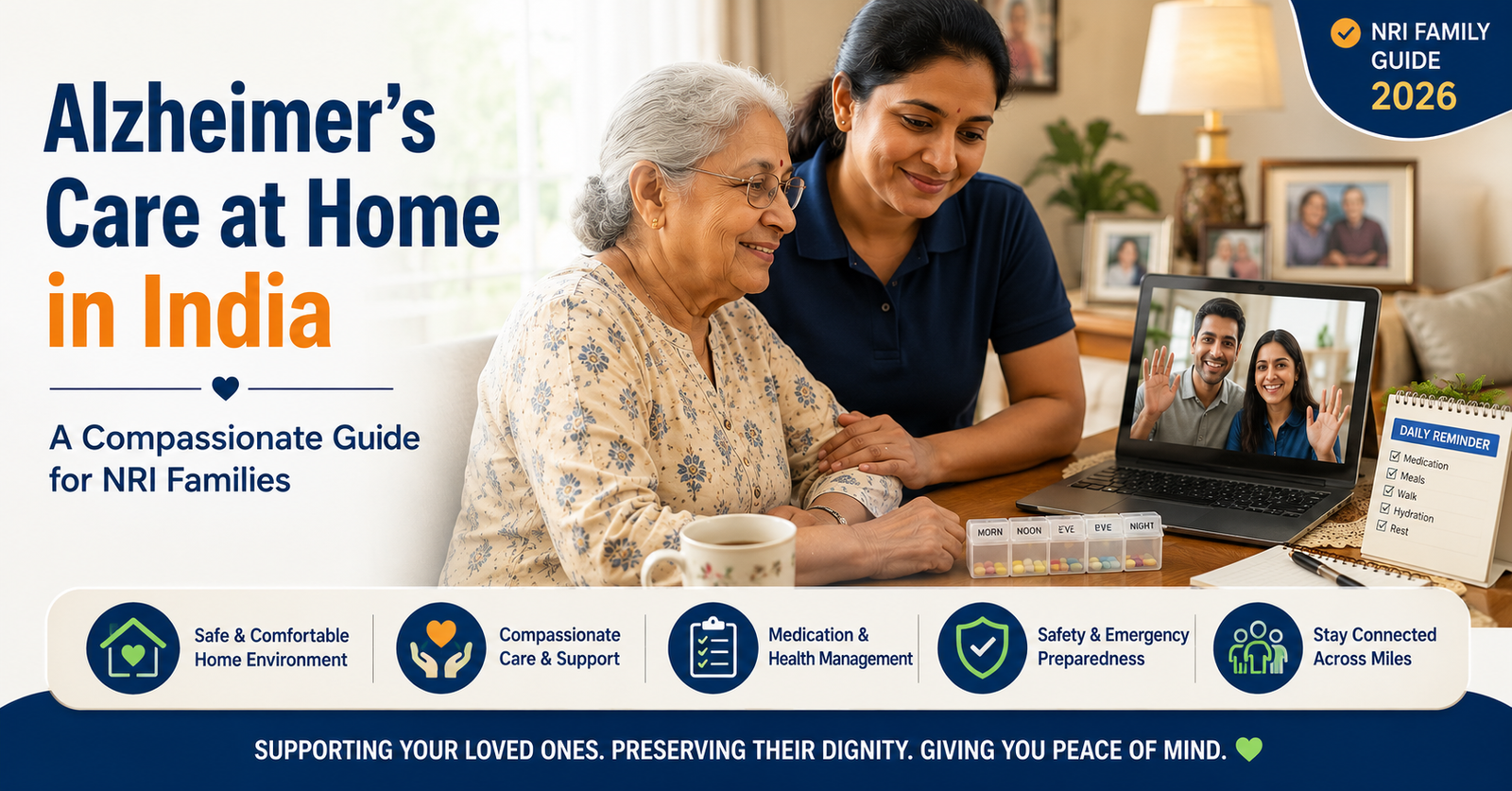
This guide is for NRI families navigating exactly this situation. It explains what Alzheimer’s looks like at different stages, what home modifications and daily routines genuinely help, what warning signs should never be ignored, and how structured local support can make home-based care safer and more sustainable — for both the parent and the family abroad.
Can Alzheimer’s Patients Live at Home Safely?
Yes. Many Alzheimer’s patients can continue living safely at home during the early and middle stages of the disease if appropriate safety modifications, caregiver support, medication management, and emergency planning are in place.
Home-based care is not only possible — for many families, it is the best available option. Familiar surroundings reduce confusion and anxiety, predictable routines support cognitive stability, and remaining at home preserves dignity and independence in ways that institutional settings cannot always replicate.
With the right support structures in place, home care for dementia patients in India can be both safe and sustainable for years.
Understanding Alzheimer’s Disease
What Is Alzheimer’s Disease?
Alzheimer’s disease is a progressive neurological disorder and the most common cause of dementia worldwide. It gradually damages the brain cells responsible for memory, thinking, language, and behaviour.
Unlike ordinary forgetfulness that comes with ageing, Alzheimer’s worsens over time and eventually affects a person’s ability to perform everyday tasks independently.
According to the Alzheimer’s and Related Disorders Society of India (ARDSI), an estimated 5.3 million Indians are currently living with dementia, and that number is expected to more than double by 2050. Despite this scale, awareness remains low and structured family support systems are still developing across the country.
Early Signs Families Often Notice
The earliest signs of Alzheimer’s are frequently mistaken for normal ageing, which is why many families seek help only after the disease has already progressed. Watch for these early indicators in elderly parents:
- Forgetting recent conversations or events while remembering distant memories clearly
- Asking the same question multiple times within a short period
- Misplacing everyday items such as keys, glasses, or mobile phones and being unable to retrace steps
- Confusion about dates, days of the week, or the current season
- Difficulty managing finances, paying bills, or handling bank transactions
- Missing important appointments or social commitments without realising
- Withdrawal from previously enjoyed activities or social interactions
- Noticeable mood changes, including increased anxiety, suspicion, or irritability
For NRI families, these signs are often first noticed during video calls — when a parent seems confused, repeats stories told just minutes earlier, or appears disoriented about the details of daily life.
How Alzheimer’s Progresses Over Time
Understanding the three stages of Alzheimer’s helps families plan appropriate levels of care at each point.
| Warning Sign | Why It Matters |
|---|---|
| Recent fall or near-fall | Significantly increases the risk of serious injury and future falls. |
| Missed medications | Can lead to worsening health conditions and preventable emergencies. |
| Unexplained weight loss | May indicate nutritional issues, illness, or difficulty managing daily meals. |
| Increasing forgetfulness | Could signal cognitive decline affecting safety and independence. |
| Social withdrawal | Often associated with depression, loneliness, or declining health. |
Most home-based dementia care strategies are most effective during the early and middle stages. Late-stage Alzheimer’s almost always requires professional nursing or institutional support.
Alzheimer’s vs Dementia: What’s the Difference?
Many people use the terms Alzheimer’s and dementia interchangeably, but they are not the same — and understanding the distinction helps families seek the right diagnosis, treatment, and support.
Dementia is an umbrella term describing a group of symptoms involving cognitive decline: memory loss, confusion, difficulty with language, and impaired reasoning. It is not a single disease but a clinical syndrome with multiple possible causes.
Alzheimer’s disease is the most common specific cause of dementia, accounting for approximately 60 to 80 percent of all dementia cases globally. Other causes of dementia include vascular dementia (caused by reduced blood flow to the brain), Lewy body dementia, and frontotemporal dementia.
In practical terms: a person with Alzheimer’s always has dementia, but a person with dementia does not necessarily have Alzheimer’s disease. An accurate diagnosis from a neurologist or geriatrician is essential, as the underlying cause influences treatment options, progression timelines, and the specific support a family should put in place.
For NRI families supporting elderly parents in India, requesting a formal dementia evaluation — not simply attributing symptoms to old age — is often the most important first step.
Challenges Faced by NRI Families
Managing a parent’s Alzheimer’s care while living abroad involves a unique and often underestimated set of challenges. Understanding these challenges is the first step toward addressing them effectively.
Distance and Communication Barriers
A twelve-hour time difference between India and Canada, or a five-and-a-half-hour gap with the UK, makes real-time communication genuinely difficult. Medical emergencies rarely happen at convenient hours, and reaching the right person quickly can be the difference between a manageable situation and a crisis.
Video calls, while helpful, cannot replace physical presence. Families often describe feeling helpless when a parent appears confused or distressed on screen and there is nothing they can do immediately from overseas.
Limited Local Support Networks
Not every family has a sibling, cousin, or trusted neighbour close enough to check in regularly. Many elderly parents in Indian cities live semi-independently, having outlived their peers or with family who have relocated. When the primary support network is physically absent, gaps in dementia care at home can grow quickly and quietly.
Managing Medical Coordination Remotely
Coordinating doctor appointments, follow-up reviews, specialist consultations, and laboratory tests from another country requires significant and sustained organisation. Medical records need to be maintained and shared. Medications need to be refilled and administered correctly. Without a reliable local contact, even straightforward healthcare tasks can become complicated.
Emergency Situations Without a Response Plan
Falls are among the most common and serious risks for Alzheimer’s patients. Wandering — where a patient leaves the home and becomes disoriented — is another serious concern. Medication errors and missed doses can lead to hospitalisation. Without a clear emergency response plan and someone nearby who can act quickly, these situations carry significantly higher risk for elderly parents living alone.
Caregiver Burnout Among Elderly Spouses
In many households across India, an elderly spouse becomes the primary caregiver for a partner with Alzheimer’s. This is rarely sustainable. Caregiver spouses — often in their seventies or older — frequently experience physical exhaustion, social isolation, depression, and their own declining health. NRI families often discover this secondary crisis only after it has become serious.
Why Home-Based Alzheimer’s Care Is Often Preferred
Despite the challenges involved, home-based care remains the preferred option for many families across India — and for good reason.
Familiar Surroundings Reduce Anxiety
One of the most consistent findings in dementia care research is that familiar environments reduce confusion and agitation in Alzheimer’s patients. A parent who has lived in the same home for thirty years carries an embodied memory of that space even as cognitive memory declines. The smell of the kitchen, the layout of the rooms, the view from the window — these environmental cues provide a quiet form of orientation that institutional care settings cannot replicate.
Predictable Routines Lower Distress
Alzheimer’s patients respond significantly better to structured, predictable daily schedules. Morning prayers at the same time, meals served in the same sequence, afternoon walks along familiar routes — these routines anchor the day in ways that reduce agitation and improve overall wellbeing. Home environments make routine maintenance far more natural than care facilities, which must manage multiple residents simultaneously.
Stronger Emotional Connection to Family History
Home is where family photographs line the walls, where children’s school certificates still hang, where familiar music plays. These sensory and emotional touchpoints provide meaningful stimulation for dementia patients, activating longer-term emotional memories even when short-term recall has deteriorated significantly.
Greater Dignity and Independence
Many elderly parents in India — particularly those from generations with strong values around self-reliance and family — experience institutional placement as deeply distressing, even when the facility is high-quality. Remaining at home, with appropriate support, preserves a sense of agency and dignity that matters enormously to both patients and families.
Home Care vs Assisted Living for Alzheimer’s Patients
Families considering their options often find a direct comparison useful when weighing the right approach for their parent’s current stage and needs.
| Factor | Home Care | Assisted Living |
|---|---|---|
| Familiar Environment | ✓ Fully preserved | Limited |
| Family Involvement | High | Moderate |
| Independence | Higher | Lower |
| Cost Flexibility | Higher | Lower |
| Personalised Routine | ✓ Fully customisable | Limited |
| Medical Supervision | Depends on support in place | ✓ Built in |
| Emotional Comfort | Generally higher | Varies |
| Scalability as Disease Progresses | Requires additional planning | More structured |
For most families managing early-to-mid stage Alzheimer’s care for elderly parents, home care — when properly supported — offers the best combination of comfort, familiarity, and cost-effectiveness. The balance shifts as care needs intensify in later stages.
Essential Home Safety Measures for Alzheimer’s Patients
Adapting the home environment is one of the most practical and impactful steps a family can take. Many accidents and crises that affect home care dementia patients are preventable with relatively straightforward modifications.
Fall Prevention
Falls are the leading cause of serious injury in elderly Alzheimer’s patients. Home modifications that significantly reduce fall risk include:
- Removing all loose rugs, especially in hallways and near the bathroom
- Improving lighting throughout the home, particularly on staircases and in corridors used at night
- Installing grab bars beside the toilet and inside the shower or bathtub
- Clearing pathways of furniture, cables, and any tripping hazards
- Replacing footwear with non-slip slippers or socks with grip soles
Securing Entrances and Exits
Wandering is one of the most frightening risks associated with mid-stage Alzheimer’s. To reduce this risk:
- Install door alarms that alert when an exterior door is opened
- Use childproof safety locks on doors leading outside
- Consider a door alarm system connected to a family member’s phone or a local caregiver’s device
- Display emergency contact information clearly near all exits and telephones
Medication Management
Medication errors — missed doses, double doses, or confusion about which medication to take when — are both common and dangerous in Alzheimer’s patients. A structured approach should include:
- Weekly or monthly pill organisers labelled clearly by day and time
- A written medication schedule posted in a visible location
- Regular caregiver supervision during medication times
- All medications stored out of reach to prevent accidental overdose or misuse
Kitchen Safety
The kitchen is statistically among the most hazardous rooms in the home for dementia patients. Practical safety steps include:
- Installing automatic stove shut-off devices or replacing gas stoves with induction cooktops
- Locking away sharp utensils, cleaning products, and other hazardous items
- Labelling cabinet contents clearly in large text
- Keeping only frequently used items accessible and removing unnecessary clutter
Emergency Readiness
Every household managing Alzheimer’s care at home should maintain:
- An up-to-date medical file with diagnoses, medications, allergies, and previous hospitalisation records
- A printed emergency contact list accessible to anyone who enters the home
- Documented hospital preferences so that in an emergency, the right decisions are made quickly
Room-by-Room Alzheimer’s Home Safety Checklist
| Room | Safety Feature | Priority Level |
|---|---|---|
| Bedroom | Night lights or motion-sensor lighting | Essential |
| Clear pathways from bed to bathroom | Essential | |
| Emergency call button or mobile phone within reach | High | |
| Secured windows to prevent falls | High | |
| Bathroom | Grab bars beside toilet and in shower | Essential |
| Anti-slip mats inside and outside shower area | Essential | |
| Shower seating or bath chair | High | |
| Water temperature regulator to prevent scalding | High | |
| Kitchen | Automatic stove shut-off device | Essential |
| Locked storage for knives and cleaning products | Essential | |
| Clearly labelled cabinet contents | Medium | |
| Restricted access to electrical appliances | Medium | |
| Living Areas | Secured or removed loose rugs | Essential |
| Furniture arranged with clear, wide pathways | High | |
| No clutter on floors or staircases | Essential | |
| Entrances/Exits | Door alarms connected to caregiver | Essential |
| Safety locks on exterior doors | High | |
| Emergency contacts displayed near exit | Essential |
Essential Documents Every Family Should Maintain
One of the most overlooked aspects of Alzheimer’s support for families is documentation. As cognitive decline progresses, elderly parents become increasingly unable to provide their own medical history, locate important papers, or communicate their preferences in a crisis. Families that maintain organised records in advance avoid enormous complications when time matters most.
Every NRI family caring for a parent with Alzheimer’s or dementia should ensure the following documents are current, accessible, and held by at least two trusted parties:
- Aadhaar Card — essential for hospital registration, government scheme access, and identity verification across India
- Health Insurance Policy — including policy number, insurer contact, and claim process details
- Medical History File — diagnoses, surgical history, allergies, previous hospitalisations, and treating physicians’ contact information
- Current Prescription List — all medications with dosages, schedules, and the prescribing doctor
- Emergency Contact Sheet — local contacts, overseas family members, and the family’s preferred hospital
- Power of Attorney — a General or Durable Power of Attorney enabling an authorised person in India to make legal, financial, and healthcare decisions on the patient’s behalf
- Hospital Preference List — the family’s preferred facilities and any relevant notes for treating physicians
- Will — where applicable and where the patient retains the capacity to execute one
Read our complete guides: [How to Update Aadhaar for Elderly Parents in India] and [Power of Attorney for Elderly Parents in India: Complete NRI Guide (2026)].
Daily Care Tips for Families
Whether a family member, hired caregiver, or care coordinator is providing day-to-day assistance, the following practices make a measurable difference in quality of life for Alzheimer’s patients.
Establish and Maintain Predictable Routines
Consistency is among the most powerful tools in dementia care at home. Waking up, eating, bathing, exercising, and sleeping at the same times each day reduces confusion and agitation. Even small rituals — a cup of tea at a specific time, an afternoon rest period — provide structure that anchors the day.
When routines must change, introduce changes gradually and explain them calmly and repeatedly rather than expecting the patient to adapt quickly.
Use Simple, Clear Communication
Alzheimer’s progressively affects language processing and comprehension. Effective communication adapts to this reality:
- Give one instruction at a time rather than a sequence of tasks
- Use short, simple sentences and speak slowly without condescension
- Maintain a calm, reassuring tone even when the situation is stressful
- Avoid repeatedly correcting — if a parent believes it is a different decade, arguing rarely helps and frequently causes distress
- Use visual cues alongside verbal instructions where possible
Encourage Appropriate Physical Activity
Gentle physical activity improves mood, reduces agitation, supports sleep, and slows functional decline in Alzheimer’s patients. Activities suitable for most early-to-mid stage patients include:
- Morning or evening walks in familiar surroundings — a neighbourhood park, the building compound, or a quiet local street
- Light stretching or chair-based exercises
- Gentle yoga or movement therapies appropriate to the patient’s mobility, ideally physician-approved
Always consult the treating physician before beginning any new exercise programme.
Promote Meaningful Mental Engagement
Cognitive engagement — even in simplified forms — supports emotional wellbeing and can slow the pace of decline. Families can support this through:
- Looking through family photographs and gently prompting memories
- Playing familiar music from the patient’s youth — Hindi film music, regional folk songs, or devotional music often elicit strong emotional responses
- Simple puzzles, sorting tasks, or colouring activities appropriate to the patient’s current ability
- Religious or cultural practices that carry deep personal meaning
The goal is not to challenge the patient but to provide stimulation that feels meaningful and achievable.
Manage Difficult Behaviours With Patience and Strategy
Alzheimer’s often brings behavioural changes — agitation, repeated questioning, accusations, resistance to care, sleep disturbances, and sundowning (increased confusion in the evening hours). Managing these with patience rather than confrontation is essential.
Redirection — gently shifting attention to a different activity or topic — is often more effective than explanation or correction. When a parent is agitated, reducing stimulation, speaking softly, and providing physical comfort are typically more helpful than reasoning through the episode.
Managing Alzheimer’s Care From Abroad
For NRI families, the distance between a child in Toronto or Melbourne and a parent in India does not remove the responsibility of care — it simply changes how that care is coordinated. The following practices help families maintain effective oversight from overseas.
Establish a Regular Communication Schedule
Weekly video calls — at a consistent time that works for both the parent’s routine and the family’s schedule — allow families to observe early changes in cognition, mood, or physical appearance. Changes that happen gradually can be difficult to notice; a structured schedule creates comparison points over time.
When speaking directly with a parent with Alzheimer’s, keep conversations focused on familiar, positive topics. Lengthy or complicated discussions can increase confusion and distress.
Separately, families should maintain regular communication with any local caregiver, neighbour, or care coordinator who is in regular contact with the parent.
Maintain and Share Medical Records Digitally
A centralised, digitally accessible medical file should include current diagnoses and treating physician contact information, all prescribed medications with dosages and schedules, allergy information and any previous adverse reactions, hospital visit history and discharge summaries, vaccination records, and upcoming appointment dates. Using secure cloud storage that all relevant family members can access ensures no single person holds a critical information bottleneck — particularly important in an emergency.
Coordinate Healthcare Appointments Systematically
Families managing NRI parent care remotely should maintain a shared calendar tracking all upcoming medical appointments, medication refills, and laboratory tests. Assigning clear responsibility for each task — whether to a local family member, hired caregiver, or care coordinator — prevents important follow-ups from being missed.
For families managing care across Indian cities, this may include regular neurology reviews, memory clinic consultations, or geriatrician appointments at major healthcare centres in the parent’s city.
Build a Reliable Local Support Network
No single person can sustain effective round-the-clock remote oversight. An effective local support network for an Alzheimer’s patient might include a trusted family member or neighbour who can check in regularly, a trained home care attendant for daily personal care support, a local care coordinator who manages logistics and communicates regularly with the overseas family, and the patient’s treating physician and any involved specialist.
Having multiple people involved — with clearly understood roles — reduces the risk of any single point of failure.
Plan for Emergencies Before They Happen
Every NRI family managing a parent’s Alzheimer’s care should have a documented emergency plan that answers: who is the first local contact to call if the parent falls, wanders, or requires hospitalisation? Which hospital is preferred and why? Who has the authority to make medical decisions if the overseas family member cannot be reached immediately? Is a Power of Attorney or healthcare directive in place?
Establishing legal instruments such as a General Power of Attorney (GPA) or Durable Power of Attorney in advance avoids significant complications during a crisis.
When Elderly Parents Should Not Live Alone
One of the most difficult decisions NRI families face is determining when a parent’s current living arrangement has become unsafe. These warning signs indicate that additional support — or a fundamental change in arrangement — is urgently needed.
Warning Signs Families Should Never Ignore
Frequent Wandering
If a parent has left the home and become confused or lost — even once — the risk of a serious incident increases significantly. Wandering at night or near traffic is a medical emergency risk that cannot be managed through video calls alone.
Consistently Missed Medications=
Missed doses of critical medications — for blood pressure, diabetes, thyroid disorders, or seizures — can rapidly lead to hospitalisation. If medication management cannot be reliably supervised, professional Alzheimer’s support for families is needed immediately.
Leaving Gas or Appliances On Unattended
Any incident of a parent leaving the stove on, the door unlocked overnight, or appliances running unsafely signals that independent living has become dangerous.
Repeated Falls — With or Without Injury
A single fall may be an isolated incident. Repeated falls indicate a pattern that is likely to result in serious injury if left unaddressed.
Difficulty Recognising Close Family Members
When a parent begins failing to recognise children, siblings, or a spouse, the disease has progressed to a stage that requires significant daily support and medical review.
Increasing Agitation or Paranoia
Significant behavioural changes — including accusations, extreme agitation, or paranoid thinking — that are escalating in frequency or intensity require medical review and likely increased supervision.
Signs That Professional Support May Be Needed
Beyond the warning signs above, the following indicators suggest that professional home care or facility-based care should be seriously evaluated:
- Difficulty with basic activities of daily living — bathing, dressing, eating, or toileting — that was not present previously
- Caregiver fatigue in an elderly spouse or local family member who is no longer able to provide safe care sustainably
- Medical monitoring needs that require nursing-level skills beyond what a family caregiver can provide
- Repeated hospitalisations for preventable causes such as falls, infections, or medication non-compliance
How IndiaRoots Supports Families Caring for Parents With Alzheimer’s
IndiaRoots was built specifically to address the gap that NRI families experience when elderly parents need reliable local support and there is no family member nearby to provide it.
For families managing dementia care in India from abroad, IndiaRoots provides:
Regular Welfare Checks
Scheduled in-person visits to assess the parent’s safety, wellbeing, and day-to-day condition — with updates communicated directly to the family overseas.
Emergency Response Support
A rapid local response to falls, wandering incidents, medical emergencies, or hospitalisation — coordinated with the family in real time regardless of time zone.
Hospital Coordination
Assistance with arranging appointments, accompanying patients to local hospitals and specialist centres, and communicating with medical teams on the family’s behalf.
Medication and Appointment Assistance
Support with ensuring medications are filled and administered correctly, and that follow-up appointments are scheduled, tracked, and attended.
Family Updates and Communication
Regular, structured updates to overseas family members — by call, WhatsApp, or written report — so families are always informed without needing to chase multiple contacts for information.
Documentation and Liaison Support
Assistance with Aadhaar updates, bank liaison, property documentation, Power of Attorney execution, and other bureaucratic tasks that are difficult to manage remotely but frequently arise in the context of Alzheimer’s support for families.
To discuss your family’s situation and how IndiaRoots can help, contact us at +91 93508 98003 or write to info@indiaroots.org.
Real-Life Example: Supporting a Family in Australia Caring for a Parent in India
A family based in Melbourne had been managing their 78-year-old mother’s care through daily video calls and occasional visits. Their mother had been diagnosed with early-stage Alzheimer’s two years earlier and had, until recently, been managing reasonably well with the help of a part-time domestic helper.
Over several months, the family noticed a pattern of concerning changes: missed medications, repeated questions about whether her son had called — even immediately after the call ended — an incident where a neighbour found her in the building stairwell confused about how to return to her flat, and increasing difficulty managing the gas stove safely.
The family was not yet ready for institutional care — and their mother was deeply resistant to the idea — but it was clear that the current arrangement was no longer safe.
Through IndiaRoots, the family arranged structured welfare checks three times per week, with written updates shared via WhatsApp after each visit. A medication management system was introduced, with an IndiaRoots coordinator supervising the morning and evening routine. The gas stove was replaced with a safer induction cooktop, and door alarms were installed at the entrance. Their mother was enrolled in a weekly memory activity group that gave her meaningful social engagement outside the home.
For the family in Melbourne, the most significant change was psychological: they no longer spent every evening worried about what might be happening between calls. They had a reliable local presence they trusted, and a clear escalation path if anything changed.
Their mother continues to live in her own home — the home where she raised her children — with dignity, safety, and the daily support she needs.
Frequently Asked Questions
Can Alzheimer’s patients live at home safely?
Yes, in many cases — particularly during the early and middle stages. Safe home living requires appropriate safety modifications, structured daily routines, reliable caregiver support, and a clear emergency plan. As the disease progresses to later stages, the level of support required increases substantially, and institutional care may become necessary.
What is the difference between Alzheimer’s disease and dementia?
Dementia is a broad clinical term describing symptoms of cognitive decline — memory loss, confusion, difficulty with language and reasoning. Alzheimer’s disease is the most common specific cause of dementia, accounting for approximately 60 to 80 percent of all cases. Not all dementia is Alzheimer’s; other causes include vascular dementia, Lewy body dementia, and frontotemporal dementia.
When should professional care be considered for a parent with Alzheimer’s?
When the current arrangement can no longer safely meet the patient’s needs. Specific triggers include repeated falls, consistent medication errors, wandering incidents, inability to perform basic personal care tasks, and caregiver fatigue in a spouse or local family member.
How can NRI families effectively support parents with Alzheimer’s from abroad?
Through regular video communication, digitally maintained and shared medical records, coordinated healthcare appointments, reliable local support networks, advance legal planning including Power of Attorney, and professional NRI parent care services where needed.
What specific services does IndiaRoots provide for Alzheimer’s and dementia care?
IndiaRoots supports families with welfare checks, emergency response coordination, hospital accompaniment and liaison, medication and appointment management, regular family updates, and documentation and bureaucratic assistance for elderly parents living independently across India.
Is home-based Alzheimer’s care affordable in India compared to a care facility?
Home-based care, when structured appropriately, is often significantly more cost-effective than institutional placement in India, particularly for early-to-mid stage Alzheimer’s. Families frequently find that structured home care — with a part-time attendant and periodic professional oversight — is both financially and emotionally preferable during earlier stages of the disease.
What documents should NRI families maintain for a parent with Alzheimer’s?
Essential documents include the parent’s Aadhaar card, health insurance policy, medical history file, current prescription list, emergency contact sheet, Power of Attorney, hospital preference list, and a Will where applicable and while the patient retains capacity to execute one.
Conclusion
Alzheimer’s disease asks an enormous amount of families — including families who are thousands of kilometres away and doing everything they can from a distance.
The worry is real. The love that drives NRI families to seek every possible solution for their parents in India is equally real.
What this guide has aimed to show is that home-based Alzheimer’s care is not only possible — it is, in many cases, the best available option, provided it is supported by the right safety measures, daily practices, document preparation, and reliable local help.
No family should have to navigate this alone. With the right support in place, elderly parents living independently across India can continue to do so with dignity, safety, and the daily care they deserve.
If you are managing a parent’s Alzheimer’s or dementia care from abroad and would like to understand how IndiaRoots can help, reach out to our team at +91 93508 98003 or write to info@indiaroots.org. We are here.
Related Reading:
- [What To Do When Your Elderly Parent Refuses Help]
- [Power of Attorney for Elderly Parents in India: Complete NRI Guide (2026)]
- [How to Update Aadhaar for Elderly Parents in India]
- [Common Documentation Problems Faced by Seniors Living Alone in India]
- [What Makes IndiaRoots Different from Traditional Elder Care Services in India?]