Can NRIs living in the USA manage elderly parents in India?
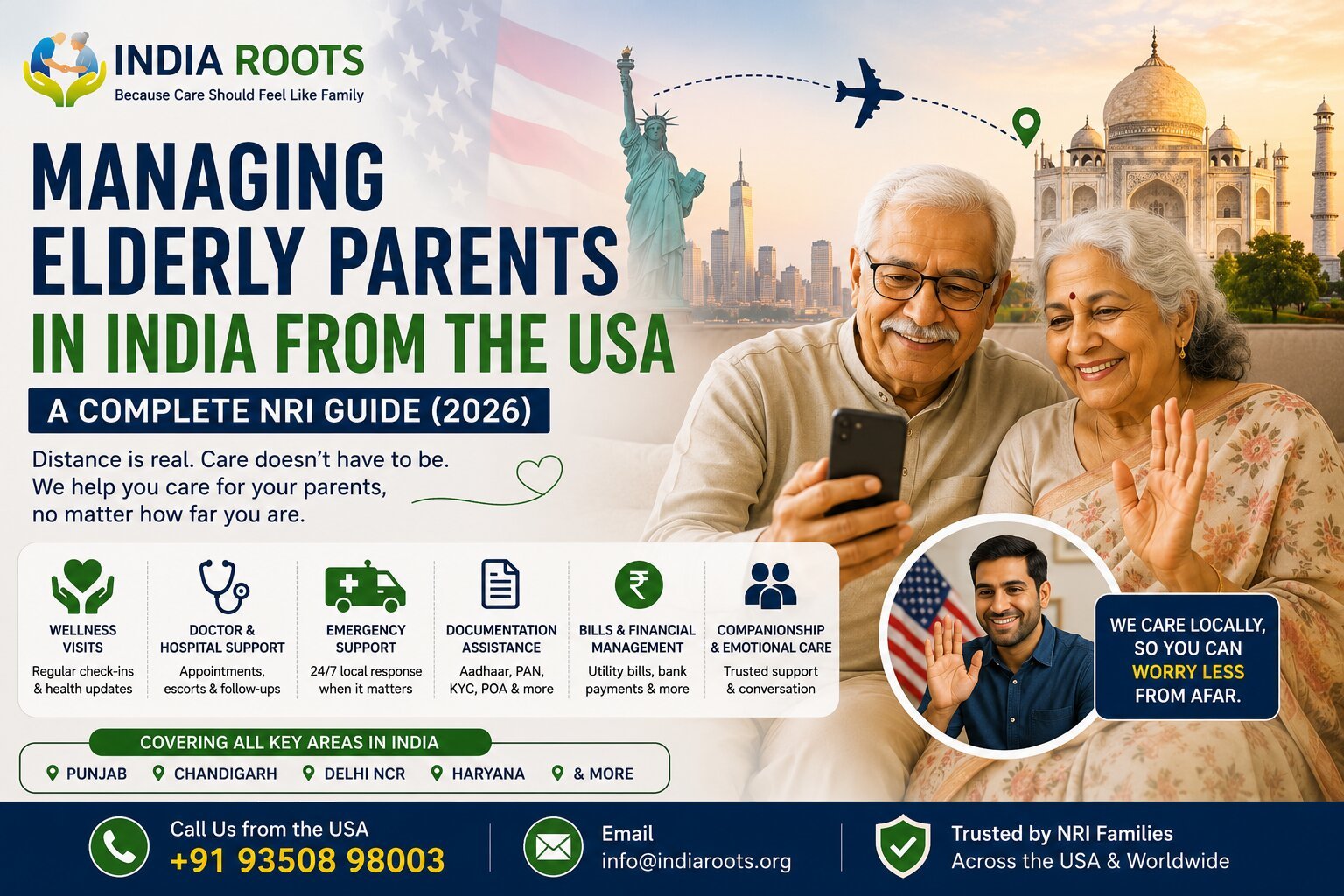
Yes — but it requires more than good intentions and daily phone calls. NRIs in the USA can successfully manage elderly parents in India by combining regular structured communication, trusted local support, healthcare coordination, emergency planning, proactive documentation management, and financial oversight. The single most critical element is a reliable on-ground care partner — someone physically present in India who visits your parent, observes honestly, responds to emergencies, and reports back to you consistently across a time zone gap of nine and a half to thirteen and a half hours. IndiaRoots provides exactly this across Punjab, Chandigarh, Delhi NCR, Haryana, and surrounding regions. Call or WhatsApp +91 93508 98003 or email info@indiaroots.org.
The USA-India Distance — A Different Kind of Far
It is 2:30am in San Jose when the phone rings.
Priya Iyer is awake instantly. The screen says Amma. Her mother in Chandigarh never calls at this hour. Her heart is already moving faster than her thoughts as she answers.
Her mother’s voice is calm — deliberately, carefully calm. Her father slipped in the bathroom. He is on the floor. He says he is fine. She does not know what to do.
Priya is 8,200 miles away. The time is 2:30 in the morning. The nearest flight from SFO to Delhi takes seventeen hours minimum, with a connection. Even if she books right now — which she is already trying to do while talking — she cannot be there for at least twenty-four hours.
What happens in those twenty-four hours?
This is the specific terror of being an Indian-American NRI with elderly parents in India. It is not just the distance. It is the combination of extreme distance, a time zone gap that puts India’s waking hours squarely inside your sleeping or working hours, flight times that make emergency travel a multi-day undertaking, and parents who — across thousands of miles — consistently underestimate or underreport what is actually happening in their home.
This guide is for Priya. And for the son in Dallas who calls his parents in Ludhiana every Saturday morning and worries all week about what he is not being told. And for the couple in New Jersey whose parents are in Delhi and whose last visit was fourteen months ago because flights are expensive and leave is limited and something always comes up.
Why This Is Becoming a Major Challenge
The Indian-American community is one of the most established and fastest-growing immigrant communities in the United States. Cities like San Jose, San Francisco, Fremont, Edison, New Jersey, Houston, Dallas, Austin, Frisco, Irving, Seattle, Chicago, New York, and Atlanta are home to hundreds of thousands of Indian families — many of them first-generation immigrants who came to the US for graduate school or skilled employment in the 1990s and 2000s and built their lives here.
The pattern is consistent and now deeply structural: children emigrate in their twenties and thirties, build careers and families in America, and their parents — initially capable and independent — remain in India. In their homes. In the cities they built their lives in: Chandigarh, Ludhiana, Delhi, Gurugram, Amritsar, Noida, Hyderabad, Ahmedabad, and hundreds of smaller cities and towns.
Now, in 2026, those parents are in their seventies and eighties. The parents who seemed entirely self-sufficient when their children left India ten or fifteen or twenty years ago are now ageing in ways that require consistent attention, coordination, and — increasingly — professional support. And the children who left India at 28 are now 48, with mortgages, teenage children, demanding careers, and parents in India who need more than a weekly video call can provide.
This is not a fringe situation. It is the dominant elder care reality facing the Indian-American community — and it is intensifying with every passing year as the founding generation of Indian immigrants moves deeper into their retirement years.
The Biggest Challenges for NRIs in the USA
The Time Zone Gap — 9.5 to 13.5 Hours
The time zone difference between the USA and India is the largest of any major Indian diaspora country — and it varies significantly depending on where in the US you live and the time of year.
- East Coast (New York, New Jersey, Boston): India is 9.5 hours ahead in summer, 10.5 hours ahead in winter
- Central (Dallas, Houston, Chicago, Austin): India is 10.5 hours ahead in summer, 11.5 hours ahead in winter
- Pacific (San Jose, San Francisco, Seattle, Los Angeles): India is 12.5 hours ahead in summer, 13.5 hours ahead in winter
In practical terms, this means:
When your parent wakes at 6am in Chandigarh and needs to speak to you, it is 5:30pm the previous evening in Dallas or 4:30pm in San Jose. You may be reachable — or you may be in traffic, cooking dinner, or at your child’s soccer practice.
When a crisis happens in India at 9pm IST — a fall, a sudden illness, a hospitalisation — it reaches a family in Houston at 9:30am CST. Mid-morning. Potentially mid-meeting. And by the time you have processed the information, made calls, and attempted to coordinate anything on the ground in India, three or four more hours have passed.
Your parent’s entire productive daytime — the hours when they go to the bank, see a doctor, handle a repair, navigate a government office — falls between midnight and early afternoon on the US East Coast, and between 9pm and 7am on the West Coast. You simply cannot be present in real time for any of it.
The time zone does not make caring from the USA impossible. But it makes physical presence on the ground in India — someone who is actually there, during India’s day — not optional.
Medical Emergencies — The Gap Nobody Plans For
Most Indian-American families have a version of a plan for a medical emergency: call a relative, hope a neighbour is available, figure it out as it unfolds. Very few have an actual protocol — specific names, specific numbers, a designated first responder, a hospital identified in advance, a Power of Attorney already in place.
When Priya’s father slipped in Chandigarh at 2:30am California time, there was no plan. There was a frightened mother, a distant daughter, and twenty-four hours of travel between them.
This is the gap that costs families most — not in the moment of crisis itself, but in the weeks and months before it, when the plan could have been made and was not.
Long-Distance Travel — The USA Reality
Unlike the Canada-India distance, where a direct flight from Toronto to Delhi or Amritsar runs roughly fourteen hours, travel from the US involves:
- Minimum flight times of sixteen to eighteen hours from the East Coast, seventeen to twenty hours from the West Coast
- Almost always at least one connection, adding three to six hours
- Total door-to-door travel times of twenty-four to thirty hours from most US cities
- Last-minute return flights that can cost USD 1,500 to 3,000 or more
- US visa re-entry considerations for those on work visas
Emergency travel from San Jose or Dallas or New York to Chandigarh or Delhi is not something that happens quickly or cheaply. This reality makes having reliable infrastructure in India — professional care, emergency protocols, someone already on the ground — not just helpful but essential.
Financial and Administrative Responsibilities
Aadhaar renewals. Bank KYC. Jeevan Pramaan pension certificates. PAN card maintenance. Property tax. Home insurance. Utility bills. These tasks require physical attendance in India and cannot be managed remotely. For US-based NRIs, the choices are: ask an already-stretched elderly parent to manage them alone, ask a relative who may or may not be reliable, or leave them undone until a deadline forces a crisis.
Most families end up doing a combination of all three — with the resulting patchwork of half-completed tasks and expiring documents being one of the most consistent problems IndiaRoots encounters when we begin working with a new family.
Emotional Challenges — The Invisible Weight
The guilt carried by Indian-Americans with elderly parents in India is real, significant, and rarely spoken about openly. It is the background radiation of every phone call, every missed birthday, every festival celebrated without the family together. It intensifies each time something goes wrong and you are not there — and compounds with the helplessness of being unable to do anything physical from eight thousand miles away.
Your parent’s response to this — unfailingly, lovingly, consistently — is to tell you everything is fine. Do not worry. They are managing. You focus on your life in America.
The problem is that this response, however well-intentioned, removes the information you need to actually help.
USA-Specific Considerations — OCI, Visa, and FBAR
OCI Card and Long-Term Planning
Most Indian-Americans who have taken US citizenship hold Overseas Citizen of India (OCI) status. OCI significantly simplifies travel — no visa required, multiple-entry lifetime validity, no registration required for stays under 180 days. If you do not yet have OCI status, obtaining it should be a priority, as it removes a significant logistical barrier to emergency travel to India.
OCI cardholders cannot vote or hold certain government positions in India, but for the purposes of managing elderly parents — property, banking, documentation, family responsibilities — OCI provides essentially the same practical access as Indian citizenship for most tasks.
Ensure your OCI booklet and the associated US passport are both current. OCI is linked to the passport it was issued with; if you renew your US passport, you need to relink your OCI. This is a routine administrative step that many people miss until it becomes urgent.
Emergency Travel Planning
Given the length and cost of travel from the US to India, emergency travel preparedness deserves specific attention:
- Keep your US passport valid with at least twelve months remaining
- Know your OCI status and ensure it is correctly linked to your current passport
- Maintain a dedicated travel fund — financial advisers commonly suggest three to five thousand USD set aside specifically for emergency India travel
- Know in advance which airlines fly direct or with fewest connections from your nearest major airport to Delhi, Amritsar, or the nearest airport to your parent’s city
- Ensure your employer understands your family situation — an established conversation before a crisis is significantly easier than a panicked leave request at 3am
FBAR and Foreign Financial Accounts
This is not legal or financial advice — and you should consult a qualified US tax adviser for your specific situation. However, US persons who have signature authority over, or financial interest in, foreign bank accounts with aggregate value exceeding USD 10,000 at any point in the calendar year may have reporting obligations under the Bank Secrecy Act (FBAR — FinCEN Form 114).
This is relevant for NRI families who manage their parents’ Indian bank accounts, have power of attorney over accounts, or make regular transfers that pass through accounts they control. The penalties for non-reporting are significant. Speak to a CPA familiar with NRI tax situations before taking on formal financial control of your parent’s accounts in India.
IndiaRoots can provide on-ground financial errand support — bill payments, bank visits with your parent, pension management — in ways that do not require you to hold formal account authority, which may be a cleaner arrangement for US-based families with FBAR considerations.
A Practical System for Managing Parents Remotely
Managing elderly parents from the USA is not about calling more. It is about building a system — a structure of people, processes, and arrangements on the ground in India that function reliably across a time zone gap of ten or thirteen hours.
Build Your India-Side Support Network
At minimum, your India-side network should include:
A trusted neighbour — someone who can physically reach your parent within fifteen minutes and who has your direct WhatsApp number. Establish this relationship explicitly, not as a vague assumption.
A treating physician — with a direct mobile number your family also has. Not just the clinic number — the doctor’s personal number, with an established understanding that they will speak to you by WhatsApp if needed.
A reliable transport arrangement — a vetted driver, a dependable auto arrangement, or a care service that manages transport. Without this, every medical appointment becomes a logistical obstacle.
A professional on-ground care partner — IndiaRoots. The element that transforms a patchwork of goodwill into a reliable system. Someone who visits in person, handles what needs to be handled, and reports back to you — during India’s day, which is your night.
Maintain Structured Communication
Build a communication rhythm that gives you consistent, accurate information rather than periodic reassurance:
Daily — short WhatsApp check-in or call; primarily to hear voice and note mood; medication confirmation
Weekly — longer video call; observe face, home environment, energy; health check-in; grocery and supply review
Monthly — focused call on practical matters: bills paid, medications adequate, upcoming appointments, any home concerns
Quarterly — document review, home safety check, chronic condition review
Annually — comprehensive health check-up, Jeevan Pramaan, property document review, emergency plan update
How to Handle Medical Care from the USA
The appointment problem
From San Jose or Dallas, you cannot schedule your parent’s doctor appointment in Chandigarh in real time. By the time you are awake and available, the clinic’s phone lines may be closed. IndiaRoots handles appointment scheduling during Indian business hours, confirms attendance, and ensures your parent actually goes.
Being in the room
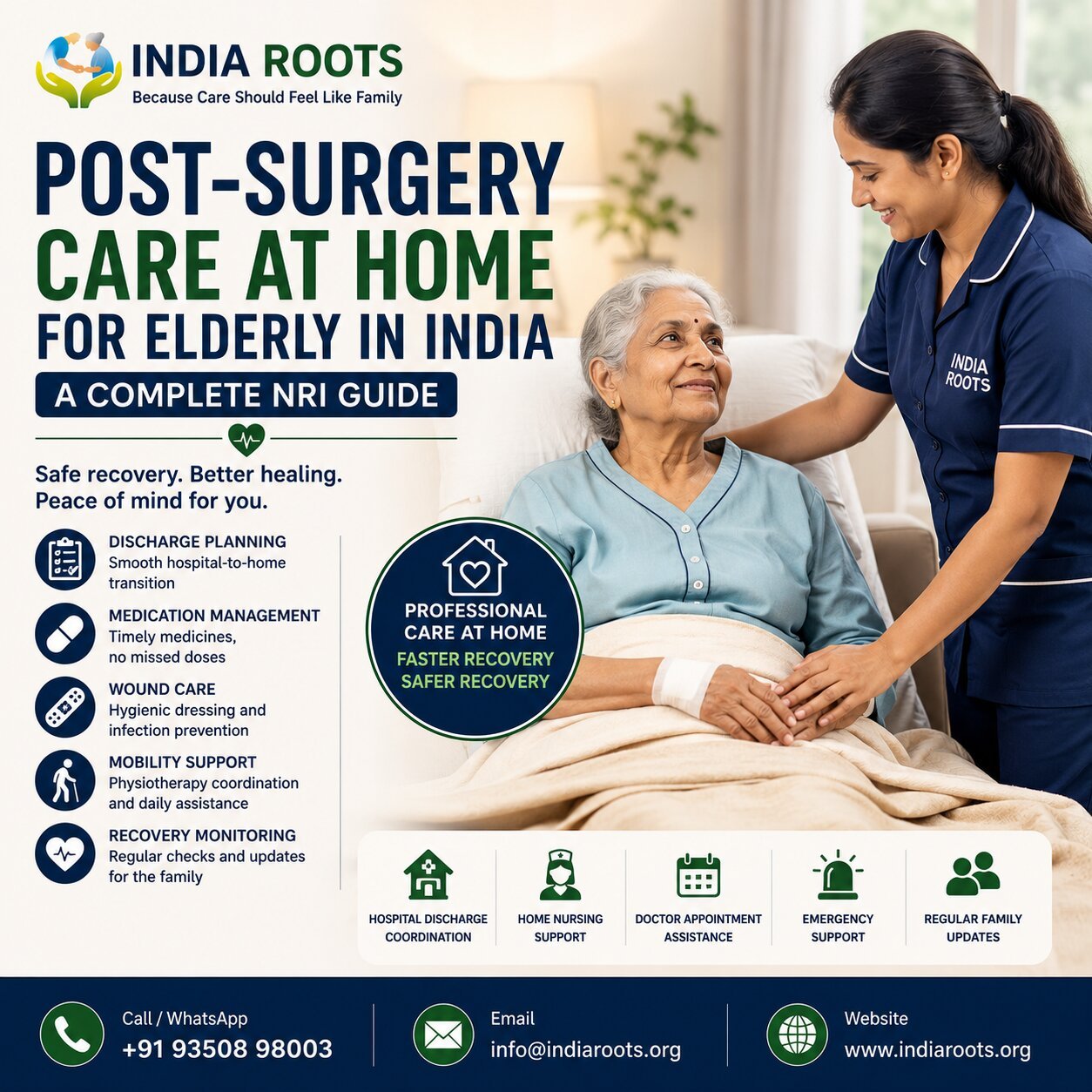
Elderly patients consistently underreport symptoms and misunderstand diagnoses. Someone needs to sit in the consultation, listen, note the prescription, and relay the information accurately. From the US, that cannot be you. IndiaRoots medical escort associates attend appointments, note the doctor’s instructions, purchase medications, and send a written summary to the family.
Medication monitoring
A medication error caught by an IndiaRoots associate in Ludhiana — a father cutting diabetes tablets in half because he believed it was “better for the kidneys” — was flagged in a visit report to his son in Fremont. The son had called every day for six weeks and had no idea. In-person observation catches what phone calls cannot.
Hospital emergency protocol
If your parent is hospitalised, someone needs to be physically present — to speak with the attending doctor, manage admission paperwork, ensure your parent is not alone, and update you in real time across the time zone. IndiaRoots maintains emergency response protocols for all enrolled clients and coordinates with hospitals across our service cities.
Managing Finances and Bills from Abroad
Regular transfers
Use services like Wise, Remitly, or your bank’s international wire service to maintain a reliable monthly transfer schedule to your parent’s Indian account. Ensure an adequate buffer for unexpected expenses — medical, household, or administrative.
Bill payments
IndiaRoots manages all routine bill payments for enrolled clients — electricity, water, gas cylinder, property tax, society maintenance — ensuring no deadline is missed and no service is disconnected.
Pension management
The annual Jeevan Pramaan life certificate submission is a hard, non-negotiable deadline. IndiaRoots tracks it for all clients and manages submission every year without the family needing to chase it.
Fraud protection
Telephone and digital fraud targeting elderly people in India — KYC scams, fake bank officials, OTP requests, WhatsApp impersonation — is significantly more prevalent than most US-based families realise. IndiaRoots educates clients about these patterns and reports any suspicious contacts to the family immediately.
Essential Documents Every NRI Must Keep Updated
| Document | Why It Matters | How IndiaRoots Helps |
|---|---|---|
| Aadhaar Card | The primary identity document required for government services, banking, pensions, healthcare, and numerous official processes. | IndiaRoots accompanies your parent to the UIDAI centre and manages the biometric update process from start to finish. |
| PAN Card | Essential for financial transactions, income tax filings, investments, and many banking activities. | Coordinates visits to NSDL or UTI facilitation centres and assists with Aadhaar–PAN linking whenever required. |
| Bank KYC | Keeps bank accounts active, secure, and compliant with RBI regulations. | Accompanies your parent to the bank branch and completes the KYC renewal process with all required documents. |
| Pension Documents | Ensure uninterrupted pension payments. Missing the annual Jeevan Pramaan submission can result in pension suspension. | Tracks annual deadlines and manages Jeevan Pramaan submission without the family having to follow up. |
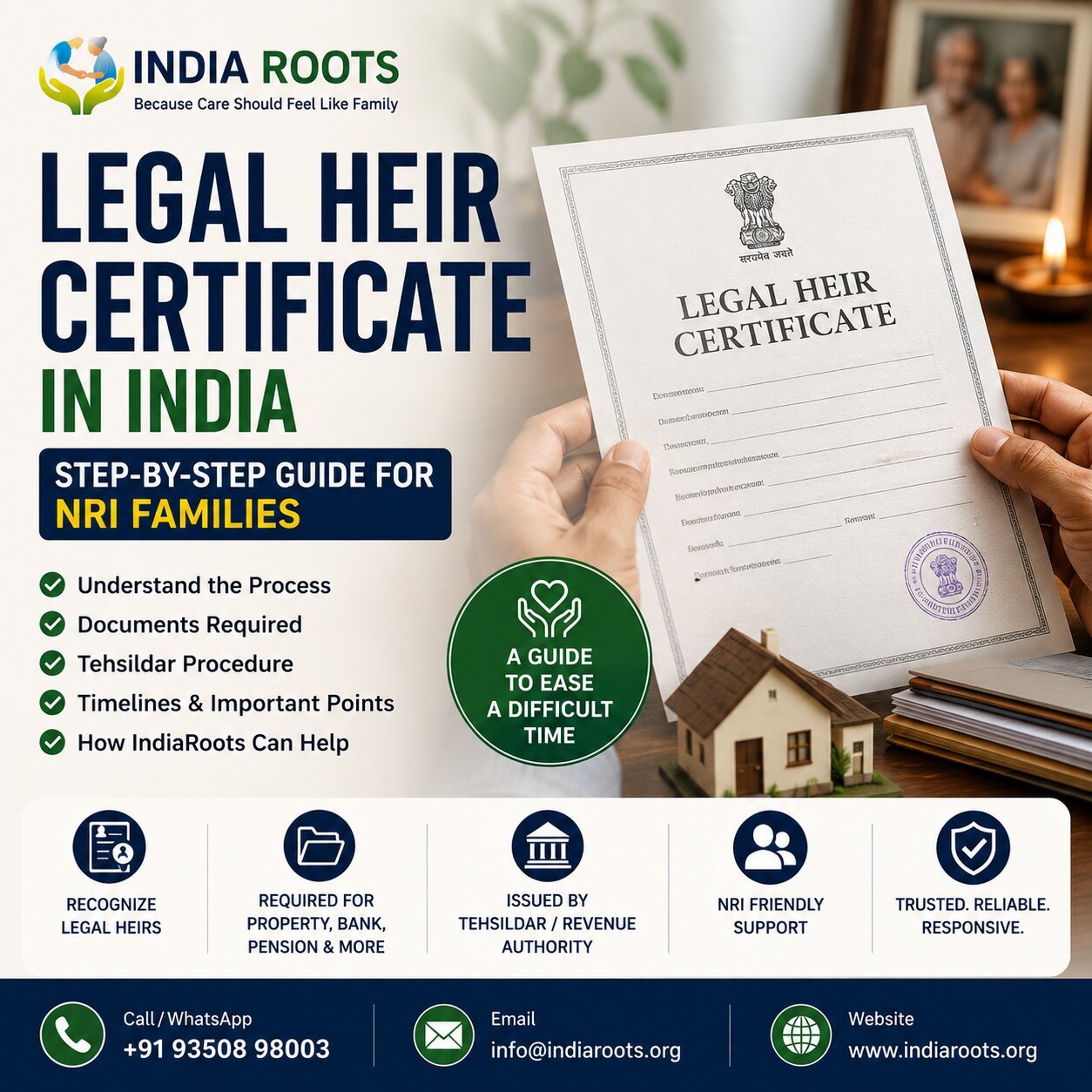
| Property Papers | Protect ownership rights, simplify inheritance planning, and reduce legal disputes. | Liaises with the Tehsildar office, manages mutation applications, and coordinates property documentation. |
| Health Insurance | Ensures hospital claims are processed correctly and medical expenses are covered on time. | Verifies policy status, organises supporting documents, and assists with insurance claim paperwork. |
| Power of Attorney (POA) | Enables a trusted person to manage legal, financial, and property matters in India when an NRI cannot travel. | Coordinates the Power of Attorney process with legal professionals and manages registration formalities. |
| Will | Helps prevent inheritance disputes and ensures assets are distributed according to the parent’s wishes. | Assists with coordinating will drafting, legal consultations, and registration with qualified professionals. |
Read our detailed guides:
- Power of Attorney for Elderly Parents in India
- NRI Documentation Assistance in India
- How to Update Bank Nomination for Elderly Parents
Emergency Planning — Before You Need It
Every Indian-American family with elderly parents in India needs a written emergency plan. Not a mental note. A document — shared across your family WhatsApp group, reviewed annually, accessible to anyone who might need it.
Your USA-to-India emergency plan must include:
- Direct mobile number of your parent’s treating physician
- Name, address, and emergency line of the nearest hospital
- Number of at least one trusted neighbour reachable within 15 minutes
- Number of a nearby family member or relative — even 45–60 minutes away
- Location of a spare house key held by a trusted person
- Complete, current medication list accessible to anyone accompanying your parent to hospital
- Health insurance policy number and insurer’s emergency contact
- Location of emergency cash your parent can access easily
- Your IndiaRoots care associate’s direct number: +91 93508 98003
- Your OCI card and US passport validity confirmed
- Emergency travel fund in place
When the call comes at 2:30am:
First — contact IndiaRoots (+91 93508 98003) if we are not already managing the situation. We can be on the ground in India faster than you can arrange anything from San Jose or Dallas.
Second — contact the treating hospital directly, identify the attending doctor, get a direct number.
Third — confirm your Power of Attorney is in place and communicated to the hospital.
Fourth — assess honestly whether to travel. IndiaRoots will tell you plainly when your physical presence is needed. For many situations — a fall that does not require surgery, a hospitalisation with clear treatment — we can manage on the ground while you remain in the US and book travel on your own timeline.
Warning Signs Your Parents May Need More Support
These signs indicate that the current arrangement — however loving — is no longer sufficient.
Physical and health signs
- Unexplained weight loss or significant change in appetite
- Any fall, even one described as minor
- Medications skipped or taken at wrong times or doses
- Missed medical appointments
- Visible decline in personal hygiene or home condition during video calls
Cognitive and emotional signs
- Repetition in conversation — same stories or questions within a single call
- Confusion about recent events, dates, or times
- Withdrawal from topics or conversations previously engaged with
- Flat or subdued mood that is out of character
Practical and administrative signs
- Bills going unpaid or utilities being disrupted
- Home repair issues accumulating unaddressed
- Documents expiring or deadlines being missed
- Increasing difficulty with phone or basic technology
Social signs
- Friends or regular contacts disappearing from conversation
- Reduced interest in going out or community activities
- Long periods of silence or television watching where activity previously existed
Any combination of three or more of these is a sufficient reason to call IndiaRoots today.
Managing Alone vs. With IndiaRoots
| Task | Managing from USA | With IndiaRoots |
|---|---|---|
| Doctor Appointment | Requires multiple late-night calls across time zones, with no certainty that appointments are scheduled or attended. | Appointments are scheduled during India business hours, parents are accompanied to the hospital, and a written visit report is shared with the family. |
| Medical Emergency | Often depends on neighbours or relatives, with family members informed much later because of the 13-hour time difference. | Emergency protocols are activated immediately, local assistance is coordinated, and family members are notified within minutes. |
| Medication Monitoring | Medicine schedules can easily be overlooked, leaving parents without essential medication for several days. | Medication supplies are monitored proactively and refills are arranged before prescriptions run out. |
| Aadhaar / PAN Update | Nearly impossible to coordinate remotely, resulting in important identity documents remaining outdated for years. | IndiaRoots books appointments, accompanies parents to government offices, and helps complete updates within the same week. |
| Bill Payments | Utility bills may be forgotten, leading to late fees, service interruptions, or unnecessary stress. | All recurring bills are tracked, monitored, and paid on schedule to ensure uninterrupted essential services. |
| Jeevan Pramaan Submission | Missing the annual submission deadline can result in pension payments being suspended. | IndiaRoots tracks the annual November deadline and ensures Jeevan Pramaan is submitted every year. |
| Property Documentation | Managing mutation, tax records, and property paperwork from overseas is often slow and confusing. | IndiaRoots coordinates directly with the Tehsildar office and other local authorities to manage documentation efficiently. |
| Family Updates | Weekly phone calls may not accurately reflect your parents’ health, wellbeing, or daily challenges. | Detailed written reports and regular updates are provided after every scheduled visit, keeping families fully informed. |
| Fraud Protection | Elderly parents may become targets of phone or banking scams without their family’s knowledge. | Suspicious calls or activities are identified promptly and reported to the family before significant harm occurs. |
| Companionship & Emotional Support | Video calls and phone conversations provide comfort but cannot replace meaningful in-person interaction. | Regular companion visits build trusted relationships over time, reducing loneliness and improving emotional wellbeing. |
A USA-to-India Parent Care Routine
Daily
- Short WhatsApp message or call — hear voice, note mood
- Medication confirmation
Weekly
- Video call — observe face, home environment, energy levels
- Health check-in — new symptoms, upcoming appointments
- Grocery and household supply check
Monthly
- Bill payment review — all paid, no outstanding amounts
- Medication refill review — adequate supply for next 30 days
- IndiaRoots visit report review — read carefully and respond to any flags
Quarterly
- Chronic condition doctor appointment
- Home safety review — repairs needed, hazards identified
- Document review — expiring IDs, pending KYC, upcoming deadlines
Annually
- Full health check-up
- Jeevan Pramaan submission (November deadline)
- Property document review
- Emergency plan review and update — including OCI and passport validity
- IndiaRoots care plan review if your parent’s situation has changed
How IndiaRoots Helps NRIs in the USA
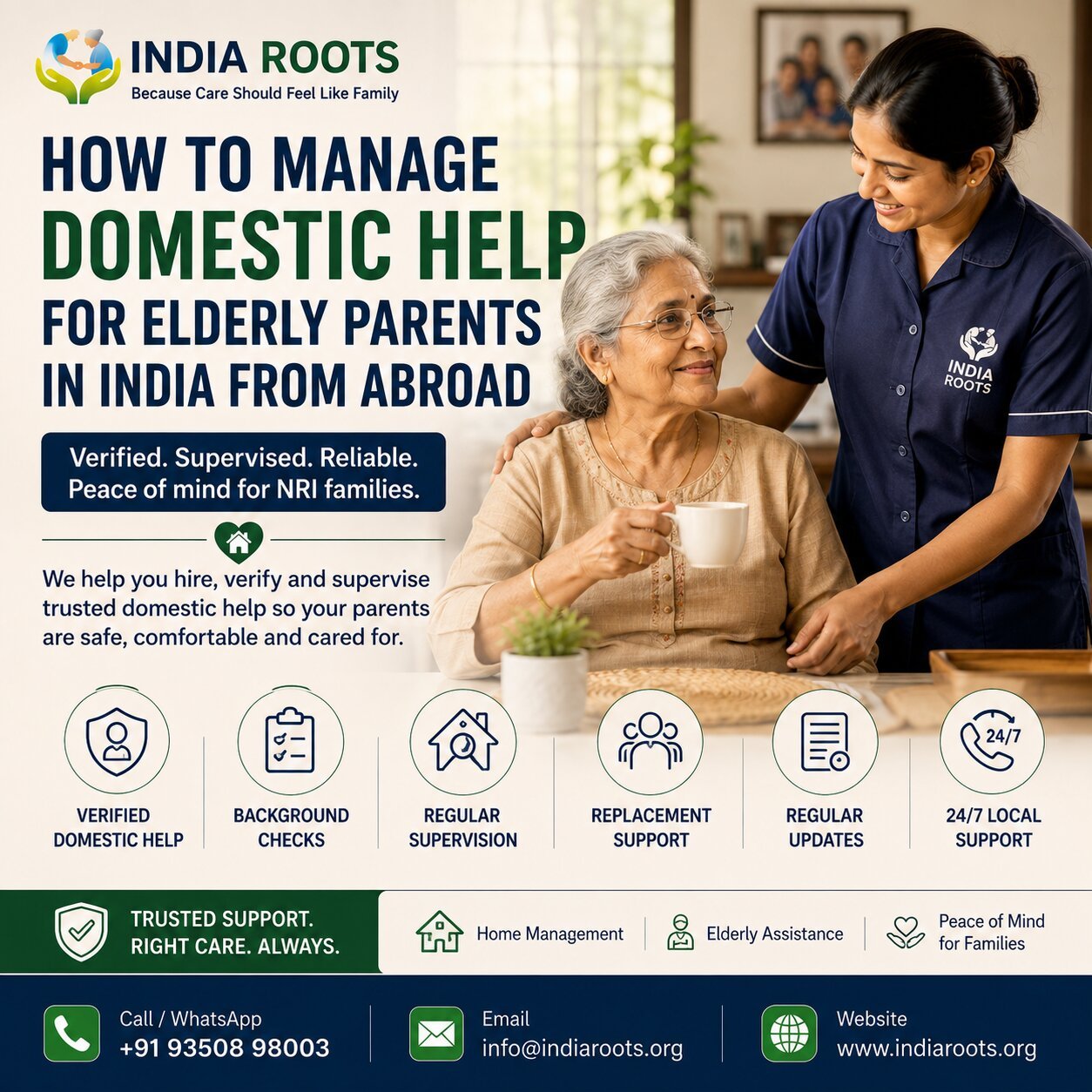
IndiaRoots is an on-ground elder care organisation with teams across Punjab, Chandigarh, Delhi NCR, and Haryana — precisely the cities where most Indian-American families’ parents live. We are not a platform or a staffing service. We are a relationship-based organisation with trained, background-verified care associates who visit your parent in person, build genuine relationships with them, and handle everything that needs to happen on the ground.
Regular wellness visits — in-person visits on your chosen schedule, with a structured honest report after every single visit.
Medical escort and coordination — appointments scheduled during Indian business hours, transport arranged, consultations attended, doctor’s instructions noted, medications collected, full summary sent to you.
Emergency response — on-ground activation in any urgent situation; hospital coordination; immediate family notification regardless of whether it is 2pm in Dallas or 2am in San Jose.
Documentation support — Aadhaar, PAN, bank KYC, Jeevan Pramaan, Power of Attorney, property documentation. Every government office visit handled so your parent does not have to queue alone.
Bill and financial errand management — all routine payments tracked and made on schedule; supervised bank visits for transactions requiring physical presence.
Companionship — consistent, genuine human connection for parents whose social world has contracted. Often the service with the most immediately visible impact on quality of life.
Family reports — structured updates in your preferred format — WhatsApp message, voice note, written report — after every visit. You are in California or Texas; you know what happened in your parent’s house in Chandigarh this morning.
📞 Call or WhatsApp: +91 93508 98003
📧 Email: info@indiaroots.org
🌐 indiaroots.org
First consultation is free. We accommodate US time zones — evenings, weekends, early mornings — whatever works for you.
Case Studies — American Families, Indian Parents
Case Study 1 — The Silicon Valley Family, San Jose to Chandigarh
Rahul Sharma is a senior engineer at a technology company in San Jose. His parents live in Sector 9, Chandigarh. His father is 79, his mother 75. His mother developed a progressive mobility limitation in late 2023 — not serious enough for hospitalisation, but significant enough to affect her daily movement, her confidence going out, and her ability to manage stairs.
Rahul was calling every day but felt consistently that his picture of his mother’s situation was incomplete. He contacted IndiaRoots in January 2024.
Within the first month, IndiaRoots had begun weekly companionship visits, coordinated two physiotherapy appointments, updated his mother’s Aadhaar card — which had been pending for eight months — managed the Jeevan Pramaan submission that was three weeks from its deadline, and identified that a bathroom step had no grip tape, which was flagged and corrected within four days.
Rahul’s mother, initially reserved about accepting outside help, was asking by week six when her IndiaRoots associate was coming next.
Rahul told us: “I feel, for the first time in two years, like I actually know how my parents are doing.”
Case Study 2 — The Texas Community, Frisco to Ludhiana
The Indian community in the Dallas-Fort Worth metroplex — spanning Dallas, Frisco, Irving, Plano, and Allen — is one of the fastest-growing in the United States, with a significant Punjabi population whose parents remain in Ludhiana, Jalandhar, and Amritsar.
Amandeep Sidhu lives in Frisco. His parents are in Ludhiana. His father, 77, had been managing his diabetes independently for years — or so the family believed. An IndiaRoots wellness visit in March 2025 found that his father’s insulin had not been refrigerated correctly and that he had been self-adjusting his dose based on how he felt rather than blood glucose readings. His most recent HbA1c, when checked, was significantly outside the target range.
IndiaRoots coordinated an immediate doctor consultation, corrected the insulin storage, established a supervised medication schedule, and began weekly visits. Amandeep was updated within hours. He did not need to fly to India. The situation was managed on the ground while he remained in Frisco and stayed informed in real time.
Case Study 3 — The Emergency That Was Managed, New Jersey to Delhi
Sunita Mehta lives in Edison, New Jersey. Her mother, 73, lives alone in South Delhi following the death of Sunita’s father in 2022. In April 2025, Sunita’s mother fell in her kitchen — a minor fall, no fracture, but frightening enough to establish that the current arrangement was no longer adequate.
Sunita called IndiaRoots from New Jersey at 11pm EST — 8:30am Delhi time. Our Delhi team reached her mother within the hour, confirmed there was no serious injury, arranged a doctor home visit for precautionary assessment, and reported to Sunita in full by 1am her time.
IndiaRoots then conducted a home safety assessment, installed grab bars near the bathroom and kitchen area, established twice-weekly wellness visits, and initiated a home safety protocol. Sunita did not fly to India. She did not need to. The situation was handled — and the conditions that led to it were addressed — without her.
She told us: “For the first time since my father passed, I feel like my mother is actually being looked after.”
USA-to-India Parent Care Checklist
Print this or save it to your family WhatsApp group. Review it annually and after any significant health event.
Emergency preparedness
- Emergency contacts list updated and shared with all family members
- Nearest hospital identified and emergency number saved
- Trusted neighbour’s number saved — someone reachable within 15 minutes
- Spare house key held by a trusted person
- IndiaRoots contact saved: +91 93508 98003
Health and medical
- Complete medication list updated — dosages, timing, prescribing doctor
- Treating physician’s direct mobile number saved
- Health insurance policy active and claim process understood
- Chronic condition check-up scheduled for next quarter
Documents
- Aadhaar card current and linked to bank account and PAN
- PAN card updated and Aadhaar-PAN linkage confirmed
- Bank KYC current at all active accounts
- Jeevan Pramaan submission date confirmed (November)
- Property papers organised and mutation current
- Power of Attorney in place and registered
Financial
- All utility bills current — electricity, water, gas, property tax
- Regular money transfer schedule confirmed
- Pension deposits being received correctly
- Parent aware of common fraud patterns
Travel and identity (USA side)
- US passport valid with at least 12 months remaining
- OCI card linked to current passport
- Emergency travel fund in place
- Employer informed of family situation for emergency leave purposes
Care and wellbeing
- IndiaRoots wellness visits scheduled
- Communication routine — daily, weekly, monthly — established
- Parent socially engaged with regular human contact beyond phone calls
Frequently Asked Questions
How can I care for my elderly parents in India while living in the USA?
Build a system on the ground in India — not a patchwork of phone calls and goodwill. The system should include a trusted neighbour, a reliable treating physician whose number you have, financial and bill management, proactive document maintenance, and a professional on-ground care partner like IndiaRoots who visits in person, handles what needs handling, and reports back to you across the time zone.
How often should I visit India?
There is no universal answer — it depends on your parents’ health, your financial situation, and your leave arrangements. Most US-based NRI families visit once a year. If your parents are in good health with solid on-ground support in place, annual visits supplemented by IndiaRoots’ regular reporting can work well. If health is declining or a significant event has occurred, more frequent visits are warranted.
What documents should I keep updated for my parents in India?Priority documents are Aadhaar, PAN, bank KYC, Jeevan Pramaan (if parents receive a pension), property papers, health insurance, and a Power of Attorney. See our detailed guide: NRI Documentation Assistance in India
Can IndiaRoots accompany my parents to hospitals in India?
Yes. IndiaRoots regularly escorts elderly clients to hospitals and clinics across our service cities — including Fortis, Max, AIIMS, PGIMER, and local hospitals depending on location. We attend the consultation, note the doctor’s instructions, collect medications, and send you a written summary.
Does IndiaRoots provide emergency support?
Yes. IndiaRoots maintains emergency response protocols for all enrolled clients. In a crisis, our nearest associate reaches your parent, we coordinate with the appropriate hospital, ensure your parent is not alone, and contact you immediately regardless of time zone.
Can IndiaRoots help with property paperwork in India?
Yes. IndiaRoots liaisons with Tehsildar offices, property registration authorities, and GMADA as needed — managing mutation applications, property tax updates, and related documentation on behalf of enrolled families.
Do you provide support across all of India?
IndiaRoots currently serves Delhi NCR, Punjab, Haryana, Chandigarh, and surrounding regions — the primary locations of most Indian-American families’ elderly parents. Call +91 93508 98003 to confirm coverage for your parent’s specific city and address.
Can I arrange IndiaRoots services from the USA without travelling to India first?
Yes. IndiaRoots begins with a free consultation call with you in the US, conducts the in-home assessment with your parent in India, and establishes an ongoing care plan — entirely remotely from your end. Many US-based families engage us without making a prior trip.
What is the time zone situation for communicating with IndiaRoots?
IndiaRoots communicates primarily via WhatsApp, which means updates arrive at any hour and you read them when it suits you. For scheduled calls, we accommodate US time zones — East Coast evenings, West Coast afternoons, whatever works. Urgent matters are communicated immediately regardless of when it is in the US.
What does IndiaRoots cost for US-based families?
Pricing is fully customised based on visit frequency, service scope, and your parent’s location. Everything is discussed transparently in the initial free consultation. Email info@indiaroots.org or WhatsApp +91 93508 98003 to begin.
Conclusion
Living in the USA does not mean you cannot provide exceptional care for your parents in India. It means the care needs to be thoughtfully structured — with reliable systems, professional on-ground support, and honest information flowing back to you consistently, across a time zone gap that makes real-time involvement impossible for most of each day.
Priya in San Jose does not have to wait for the 2:30am phone call. Amandeep in Frisco does not have to book an emergency flight because his father’s insulin was stored incorrectly for a month. Sunita in Edison does not have to feel helpless after her mother falls.
IndiaRoots is already on the ground. Across Punjab, Chandigarh, Delhi NCR, and Haryana. Visiting in person. Handling what needs handling. Reporting back honestly to families in California and Texas and New York and New Jersey.
You do not have to choose between building your life in America and knowing your parents are genuinely cared for in India.
📞 Call or WhatsApp: +91 93508 98003
📧 Email: info@indiaroots.org
🌐 indiaroots.org
Most families in the US feel significantly less anxious about their parents within the first two weeks of IndiaRoots being on the ground.