Quick Answer
Can NRIs in Canada manage elderly parents in India effectively?
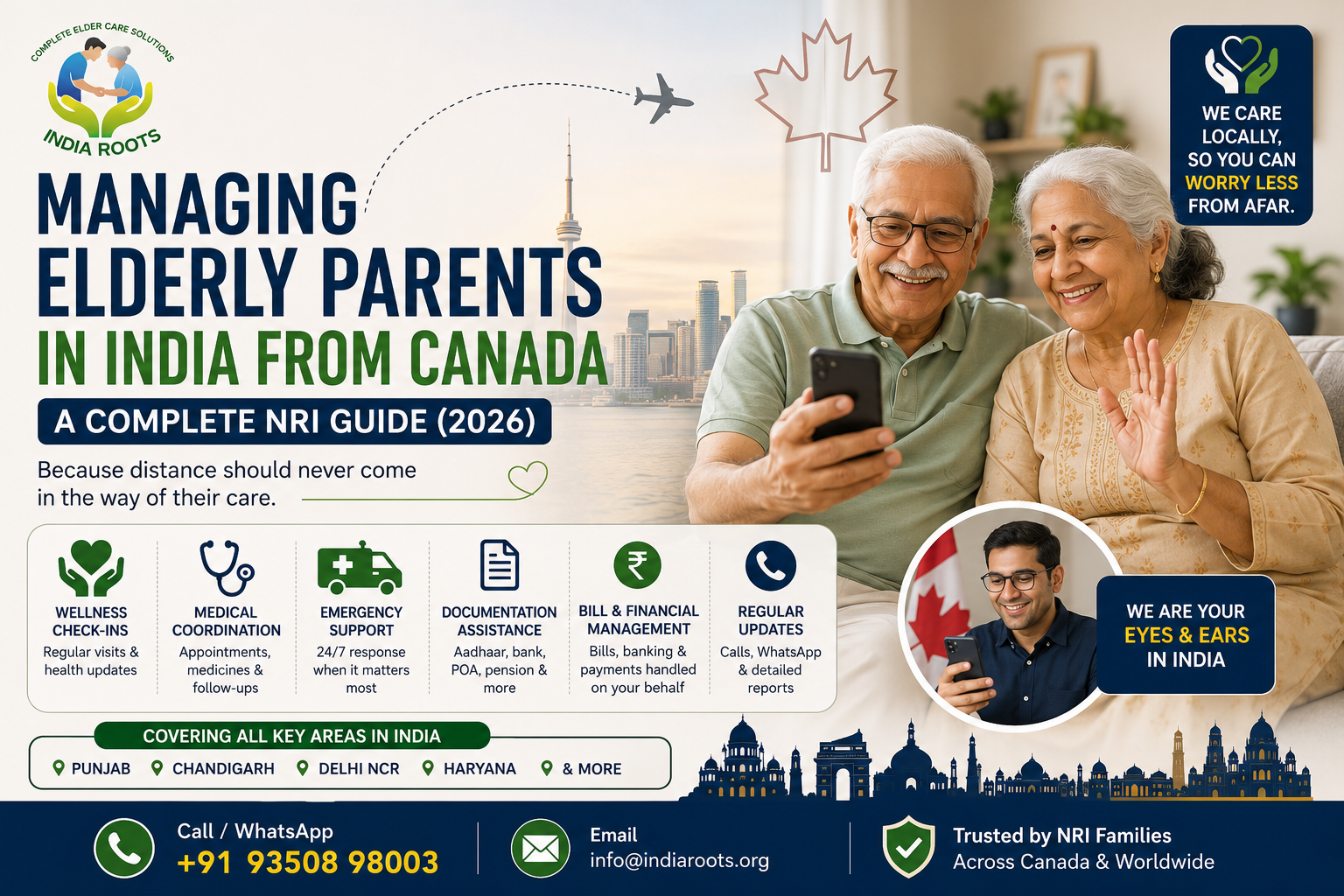
Yes — but only with the right systems in place. NRIs in Canada can manage elderly parents in India effectively through regular structured communication, local healthcare coordination, a Power of Attorney arrangement, proactive document management, financial oversight, and a trusted on-ground care partner. The single most important step is establishing reliable physical presence near your parents — someone who visits in person, observes honestly, responds to emergencies, and reports back to you consistently. IndiaRoots provides exactly this across Punjab, Chandigarh, Delhi NCR, Haryana, and surrounding regions. Call or WhatsApp +91 93508 98003 or email info@indiaroots.org.
The Canada-India Distance — Why It Hits Differently
Navjot Dhaliwal lives in Brampton. He left Ludhiana in 2009, built a career in logistics, bought a house, raised two children who now go to school in Peel Region. His parents are in Ludhiana — his father 76, his mother 73, both in reasonable health, both in the house where Navjot grew up.
He calls every evening after dinner. His mother answers. She sounds fine. She tells him about the neighbour’s daughter’s wedding, about the weather, about what she cooked. She does not tell him that his father forgot to take his diabetes medication for three days because they ran out and neither of them knew how to use the online pharmacy portal. She does not tell him that the water heater has not been working for two weeks. She does not tell him that his father woke up confused at 2am last Tuesday and she sat with him for an hour, frightened, before he settled back to sleep.
She does not tell him because she does not want to worry him. Because she knows how hard he works. Because she believes they are managing.
This is the quiet, specific weight of being a Canadian NRI with elderly parents in India. It is not the acute panic of a crisis — it is the chronic, low-grade uncertainty that lives in the ten-and-a-half hour time gap between Brampton and Ludhiana. The gap between what your parents say on the phone and what is actually happening in the house.
This guide is written to help you close that gap as responsibly and practically as possible.
Why This Is a Growing Concern for Canadian NRIs
Canada is home to one of the largest Indian diaspora communities in the world — and within that community, Punjabis represent the single largest group. Cities like Brampton, Surrey, Vancouver, Calgary, Edmonton, Mississauga, and Toronto have become home to hundreds of thousands of families with deep roots in Punjab, Haryana, and Delhi NCR. The Punjabi community in Brampton alone is among the most concentrated in the world outside of India.
The pattern that has emerged over the past two decades is consistent: the children emigrate, build lives, obtain permanent residency or citizenship, and settle. The parents — often in their sixties when the children left — remain in India. In their house. In their city. In the life they built.
Now those parents are in their seventies and eighties. The parents who seemed perfectly self-sufficient when their children left are now aging in ways that require attention, coordination, and sometimes urgent intervention. The children who left Punjab at 25 are now 45, with jobs, mortgages, and children of their own in Canada — and parents in Chandigarh or Amritsar or Jalandhar who need more support than a daily phone call can provide.
This is not a niche problem. It is the defining elder care challenge of the Canadian Punjabi community — and it is becoming more acute every year.
The Biggest Challenges of Managing Parents from Canada
Understanding the specific challenges clearly is the first step toward addressing them. Here is an honest breakdown of what managing elderly parents from Canada actually involves.
The Time Zone Gap — 10.5 Hours
India Standard Time is ten and a half hours ahead of Eastern Standard Time and thirteen and a half hours ahead of Pacific Standard Time. This means:
- When your parent wakes at 6am in Chandigarh and needs to ask you something, it is 7:30pm the previous evening in Toronto, or 4:30pm in Vancouver. You might be reachable — or you might be at work, at your child’s school event, or driving.
- When a crisis happens in India at 9pm IST, it reaches you at 10:30am EST — mid-morning, possibly in a meeting. By the time you have processed it, made calls, and tried to coordinate anything on the ground, two or three more hours have passed.
- Your parent’s productive daytime hours — when they need to go to the bank, see a doctor, handle a repair — are your sleeping hours. You cannot be on a call at 11am Chandigarh time if it is 1:30am in Brampton.
The time zone does not make management impossible. But it does mean that real-time remote coordination has hard limits — and that having someone physically present in India is not a luxury, it is a structural necessity.
Medical Emergencies — The Worst-Case Scenario
If your parent falls at home in Mohali tonight, what happens? Who is the first person to reach them? Who calls the ambulance? Who speaks to the doctor at Fortis Hospital? Who makes decisions about treatment before you can be consulted? Who calls you — and when?
For most Canadian NRI families, the honest answer is: a neighbour, if they hear something. A relative, if they happen to be nearby. A vague hope that the situation will somehow be managed.
This vagueness is not carelessness. It reflects the genuine difficulty of anticipating and planning for emergencies across such a distance. But it is a gap that needs closing before a crisis makes it urgent.
Daily Living — The Invisible Accumulation
The most common problems IndiaRoots encounters are not dramatic. They are quiet accumulations of small things:
- A medication that ran out and was not refilled for a week
- A bill that went unpaid because the online portal was confusing
- A home repair that was not addressed because your parent did not want to deal with an unreliable contractor alone
- A grocery run that did not happen because the auto-rickshaw was not available
- A social outing that was cancelled because there was no one to accompany them
Individually, each of these is manageable. Together, over weeks and months, they erode quality of life, affect health, and create the conditions for a real crisis.
Government and Banking Paperwork
Aadhaar updates. Bank KYC renewals. Pension life certificates. PAN-Aadhaar linking. Property mutation applications. These tasks require physical attendance at government offices in India — offices that are often crowded, confusing, and not particularly accommodating to elderly visitors without assistance.
From Canada, you cannot complete these tasks. You can ask your parent to do them alone — which is often unrealistic — or you can leave them undone, which most families end up doing until a deadline forces the issue.
Emotional Wellbeing — The Problem Nobody Mentions
An elderly parent in Jalandhar whose children are in Surrey and whose friends have either moved or passed away is facing a level of social isolation that has measurable health consequences. Loneliness in elderly people is associated with significantly elevated risks of cognitive decline, depression, and cardiovascular events — research places its health impact on par with smoking fifteen cigarettes a day.
Your parent will almost certainly not tell you they are lonely. They will say they are fine. They have friends. They manage. The reality — which unfolds quietly, week by week — may be very different.
A Practical System for Managing Parents Remotely
The most important shift in thinking is this: managing elderly parents from Canada is not about doing more on phone calls. It is about building a system — a set of people, processes, and arrangements on the ground in India that function reliably when you are not there.
Build a Local Support Network
Your support network in India should include, at minimum:
A trusted neighbour — someone who can physically check on your parent within fifteen minutes and who has your direct contact number. Establish this relationship deliberately, not as an afterthought.
A treating physician — not just a name, but a doctor your parent has an ongoing relationship with, whose direct number your family also has, and who is willing to speak to you by phone or WhatsApp after appointments.
A reliable transport arrangement — a vetted auto-rickshaw driver, a hired driver two or three days a week, or a service that your parent can call dependably. Without this, every medical appointment and errand becomes an obstacle.
A professional on-ground care partner — this is the element most Canadian NRI families are missing. A care organisation like IndiaRoots that visits in person, handles coordination, manages documentation, responds to emergencies, and reports back to you systematically. This is the difference between a patchwork of goodwill and a reliable system.
Maintain Structured Communication
The key word is structured. Ad-hoc calls are better than nothing, but they are not a system. Build a communication rhythm:
- Daily — a short call or WhatsApp check-in, primarily to hear your parent’s voice and note anything unusual in tone or mood
- Weekly — a longer video call where you can see your parent’s face and observe physical condition, energy, and environment
- Monthly — a call specifically about practical matters: bills paid, medications adequate, any doctor appointments coming up, any home issues
Keep a simple note after each call of anything concerning that was mentioned — or conspicuously not mentioned.
Organise Medical Information
Maintain a document — shared on your family WhatsApp group — that includes:
- Complete medication list with dosages, timing, and prescribing doctors
- Names and direct mobile numbers of all treating doctors
- Name and address of the hospital your parents would use for emergencies
- Health insurance policy number and insurer’s emergency contact
- Any known allergies, particularly to medications
- Results of the most recent health check-up
Update this document every time there is a medical visit. It should never be more than three months out of date.
How to Handle Medical Care from Canada
Medical coordination is the most urgent practical challenge for Canadian NRI families. Here is a realistic framework.
Scheduling and confirming appointments
Do not rely on your parent to schedule their own medical appointments unless they are clearly capable and motivated to do so. Establish the habit of scheduling in advance — ideally with a consistent doctor your parent knows — and confirming attendance the day before. IndiaRoots handles appointment scheduling and confirmation as a routine part of our service.
Accompanying your parent to appointments
This is the single most important medical intervention available. Elderly patients consistently underreport symptoms, misunderstand diagnoses, and fail to accurately relay what doctors have told them. Someone needs to be in the room. From Canada, you cannot be that person. IndiaRoots medical escort associates attend appointments, note the doctor’s instructions, collect prescriptions, and send you a written summary of everything said.
Medication management
Establish a medication tracking system — even a simple weekly pill organiser filled by a trusted person each Sunday. Ensure that refills are ordered before the current supply runs out, not after. If your parent is on insulin or any refrigerated medication, verify storage conditions during every in-person visit.
Hospital emergencies
If your parent is hospitalised, someone needs to be physically present at the hospital — to speak to the attending doctor, to manage admission paperwork, to ensure your parent is not alone, and to update you in real time. Hospitals in India are busy; patients without family advocates present receive significantly less coordinated attention. IndiaRoots maintains emergency response protocols for all enrolled clients.
Managing Finances and Bills from Abroad
Regular money transfers
Establish a reliable transfer schedule — monthly or fortnightly — using services like Wise, Remitly, or bank transfer to your parent’s NRE/NRO account. Ensure your parent has a sufficient buffer for unexpected expenses.
Bill payments
In Punjab and Haryana, many routine bills can now be paid online — but elderly parents often struggle with digital payment interfaces and may be hesitant to use them for fear of making errors. IndiaRoots manages bill payments for enrolled clients including electricity, water, gas cylinder, property tax, and society maintenance — ensuring no deadline is missed.
Pension and savings management
If your parent receives a government pension, the annual Jeevan Pramaan (life certificate) submission is non-negotiable — missed submissions result in pension suspension. PPF accounts, FD renewals, and other savings instruments also require periodic attention. IndiaRoots accompanies clients to banks and post offices for all savings-related tasks.
Fraud protection
Telephone and digital fraud targeting elderly people in India has escalated significantly. The most common patterns — fake bank officials requesting OTPs, KYC verification scams, WhatsApp impersonation, lottery calls — specifically target people who live alone and are not digitally confident. IndiaRoots is trained to educate clients about these patterns and to report any suspicious contacts to the family immediately.
Essential Documents Every NRI Must Keep Updated
| Document | Why It Matters | How IndiaRoots Helps |
|---|---|---|
| Aadhaar Card | Serves as the primary identity document for government services, banking, pensions, healthcare, and numerous official transactions. | IndiaRoots schedules the appointment, accompanies your parent to the UIDAI centre, and manages biometric updates from start to finish. |
| PAN Card | Required for banking, tax filings, investments, property transactions, and other financial activities. | Coordinates visits to NSDL or UTI facilitation centres and assists with Aadhaar–PAN linking where required. |
| Bank KYC | Keeps bank accounts active, secure, and fully compliant with regulatory requirements. | Accompanies your parent to the bank, prepares the required documents, and completes the KYC renewal process. |
| Pension Documents | Ensure uninterrupted pension payments. Missing the annual Jeevan Pramaan submission can result in pension suspension. | Tracks submission deadlines, assists with document preparation, and ensures timely completion every year. |
| Property Papers | Protect ownership rights, support inheritance planning, and simplify future property transactions. | Coordinates with local authorities, including the Tehsildar office, and manages mutation and documentation processes. |
| Health Insurance | Ensures medical expenses and hospitalisation claims are processed without unnecessary delays. | Verifies policy status, organises documents, and assists with claim-related paperwork whenever needed. |
| Power of Attorney (POA) | Allows trusted individuals to manage legal, financial, or property matters when NRI family members cannot travel. | Coordinates the Power of Attorney process with legal professionals and supports document registration. |
| Will | Provides clarity for estate planning and helps minimise disputes among beneficiaries. | Helps coordinate will drafting, legal consultations, and registration with qualified professionals. |
Read our detailed guides:
- Power of Attorney for Elderly Parents in India
- How to Update Aadhaar for Elderly Parents in India
- NRI Documentation Assistance in India
Emergency Planning — Before You Need It
Every Canadian NRI family with elderly parents in India needs a written emergency plan. Not a mental note — an actual document, shared with everyone relevant, reviewed annually.
Your emergency plan should include:
- Direct mobile number of your parent’s treating physician
- Name, address, and emergency number of the nearest hospital
- Number of at least one trusted neighbour who can reach your parent within 15 minutes
- Number of any nearby family member or relative — even if 40–60 minutes away
- Location of a spare house key held by a trusted person
- Complete medication list accessible to anyone who accompanies your parent to hospital
- Health insurance policy number and insurer’s emergency contact
- Location of emergency cash your parent can access easily
- Contact number of your IndiaRoots care associate: +91 93508 98003
What to do when an emergency call comes:
First — call IndiaRoots (+91 93508 98003) if we are not already managing the situation. We can be on the ground faster than you can arrange anything else from Brampton or Surrey.
Second — contact the treating hospital directly and identify the attending doctor. Get a direct number.
Third — confirm your Power of Attorney arrangement is in place and communicated to the hospital.
Fourth — assess honestly whether to travel immediately or manage remotely with IndiaRoots on the ground. We will tell you plainly when your physical presence is needed.
Warning Signs Your Parents May Need More Support
These are the signs that the current arrangement — however loving and well-intentioned — is no longer sufficient.
Physical and health signs
- Unexplained weight loss or significant change in appetite
- Increased frequency of falls or near-falls
- Medications being skipped or taken incorrectly
- Missed medical appointments
- Visible decline in personal hygiene or home cleanliness during video calls
Cognitive and emotional signs
- Repetition in conversation — same stories, same questions within a single call
- Confusion about dates, times, or recent events
- Unusual withdrawal from conversations they previously enjoyed
- Flat or subdued affect that is out of character
- Increased anxiety about things they previously managed calmly
Practical and administrative signs
- Bills going unpaid or utility services being disrupted
- Home maintenance issues accumulating without resolution
- Documents expiring or deadlines being missed
- Increasing difficulty with basic technology (phone, remote control)
Social signs
- Mentions of specific friends or social contacts dropping out of conversation
- Reluctance to go out or engage with community activities they previously enjoyed
- Increased time spent alone watching television or sitting quietly
Any three of these together is a sufficient reason to call IndiaRoots and have a conversation about what additional support looks like.
Managing Alone vs. With On-Ground Support
| Task | Managing from Canada | With IndiaRoots |
|---|---|---|
| Doctor Appointment | Requires multiple international calls to arrange appointments, with limited visibility into whether the visit actually happened. | Appointments are scheduled, confirmed, and your parent is accompanied to the consultation. A written update is shared with the family afterward. |
| Medical Emergency | Often depends on neighbours or nearby relatives, with family members informed only after the situation has escalated. | Emergency protocols are activated immediately, local assistance is coordinated, and the family is notified within minutes. |
| Medication Refill | Refills can easily be overlooked, increasing the risk of interrupted treatment. | Medication schedules are monitored proactively, and refills are arranged before supplies run out. |
| Aadhaar / PAN Update | Difficult or impossible to coordinate remotely, resulting in updates being delayed for years. | IndiaRoots books appointments, accompanies parents to the appropriate government office, and helps complete the process efficiently. |
| Bill Payment | Missed deadlines can result in penalties, late fees, or service disconnections. | Utility and recurring bills are tracked and paid on time, ensuring uninterrupted services. |
| Jeevan Pramaan Submission | Annual submission deadlines can be missed, potentially affecting pension payments. | IndiaRoots tracks submission deadlines and ensures Jeevan Pramaan is completed every year. |
| Family Updates | Limited to occasional phone calls that may not accurately reflect the parent’s wellbeing. | Detailed written reports and regular updates are shared after every scheduled visit. |
| Fraud Call Protection | Parents may become targets of fraudulent callers without the family’s knowledge. | Suspicious calls or scams are identified, documented, and immediately reported to the family. |
| Home Repairs | Parents must find and supervise contractors on their own, with little protection against delays or overcharging. | IndiaRoots coordinates trusted service providers, supervises repairs, and helps ensure quality workmanship and fair pricing. |
| Emotional Support | Family phone calls provide comfort but cannot replace regular in-person companionship. | Regular visits help build trusted relationships, providing companionship, emotional reassurance, and ongoing social engagement. |
A Canada-to-India Parent Care Routine
Building a structured rhythm — rather than reacting to problems — is what transforms parent management from a source of anxiety into something genuinely sustainable.
Daily
- Short call or WhatsApp message — primarily to hear voice and note mood
- Confirmation that morning medication was taken
Weekly
- Video call — observe face, environment, energy
- Health check-in — any new symptoms, any upcoming appointments
- Grocery and household supply check
Monthly
- Bill payment review — confirm all bills paid, no outstanding amounts
- Medication refill review — ensure adequate supply for the next 30 days
- IndiaRoots wellness visit report review — read and respond to any concerns raised
Quarterly
- Scheduled doctor appointment for chronic condition monitoring
- Home safety review — any repairs needed, any safety concerns identified
- Document review — any expiring IDs, pending KYC, upcoming deadlines
Annually
- Full health check-up
- Jeevan Pramaan submission (November)
- Property document review
- Emergency plan review and update
- Review and renewal of IndiaRoots care plan if circumstances have changed
How IndiaRoots Helps NRIs in Canada
IndiaRoots is an on-ground elder care organisation with teams operating across Punjab, Chandigarh, Delhi NCR, Haryana, and surrounding regions — exactly where the parents of most Canadian NRI families live.
We are not a technology platform. We are not a staffing agency. We are a relationship-first organisation with trained, background-verified care associates who visit your parent in person, build genuine relationships with them, and handle everything that needs to be handled on the ground.
What IndiaRoots does for Canadian NRI families:
Regular wellness visits — in-person visits on a schedule you choose, with a structured report after every single visit. Not a reassurance — an honest, factual account.
Medical escort and coordination — scheduling appointments at local hospitals and clinics, arranging transport, attending consultations, noting doctor’s instructions, purchasing medications, reporting to you in full.
Emergency response — on-ground activation in any urgent situation, hospital coordination, and immediate family notification regardless of time zone.
Documentation support — Aadhaar, PAN, bank KYC, Jeevan Pramaan, Power of Attorney, property documentation. We handle every government office visit so your parent does not have to queue alone.
Bill and financial errand management — all routine payments tracked and completed on schedule; supervised bank visits for transactions requiring physical presence.
Companionship — consistent, genuine human connection for parents whose social world has contracted. This is the service that produces the most immediate and visible change in quality of life.
WhatsApp and written family updates — after every visit, you receive the update in the format you prefer. You are in Brampton — but you know exactly what happened in your parent’s house in Ludhiana this morning.
To get started:
📞 Call or WhatsApp: +91 93508 98003
📧 Email: info@indiaroots.org
🌐 indiaroots.org
The first consultation is free. We are comfortable with Canadian time zones and can schedule calls at evenings or weekends to suit you.
Case Studies — Canadian Families, Indian Parents
Case Study 1 — The Medication That Nobody Caught, Brampton to Ludhiana
Mr. Gurmail Singh, 77, lives alone in Ludhiana after losing his wife in 2023. His son Harpreet is in Brampton. Harpreet called every day — good, warm calls. His father sounded fine.
In February 2025, an IndiaRoots wellness visit found that Gurmail had been cutting his metformin tablets in half because he believed a smaller dose was “better for the kidneys.” He had been doing this for approximately six weeks. His blood glucose had been silently elevated throughout — but his quarterly check-up had fallen during a period when the readings happened to be acceptable, so nothing had been flagged.
IndiaRoots reported this to Harpreet immediately. His father’s physician was consulted, the correct dosage was reinstated, and a medication monitoring protocol was added to the weekly visit checklist.
Harpreet told us: “He sounded completely normal on every call. I had no idea.”
Case Study 2 — The Pension Suspension, Surrey to Chandigarh
Mrs. Paramjit Kaur, 74, lives in Sector 20, Chandigarh. Her daughter Manpreet is in Surrey. In November 2024, Paramjit missed her Jeevan Pramaan deadline. Her pension was suspended in December. She did not tell Manpreet — managing on her savings and telling herself she would sort it out.
Six weeks later, Manpreet noticed her mother was being unusually vague about household expenses on their weekly video call. She called IndiaRoots. Our Chandigarh team assessed the situation, accompanied Paramjit to the relevant bank, completed the delayed Jeevan Pramaan submission, and liaised with the pension authority. The pension was reinstated within nine days.
IndiaRoots now tracks Paramjit’s Jeevan Pramaan deadline and manages the submission every November without Manpreet needing to chase it.
Case Study 3 — The Fall That Did Not Happen, Calgary to Mohali
Mr. and Mrs. Tarlok Bains, both in their mid-seventies, live in Phase 8, Mohali. Their son Sukhpreet is in Calgary. During a routine IndiaRoots home visit in January 2025, the care associate noticed that the bathroom anti-slip mat had torn and was bunching at one corner — creating a trip hazard that neither Tarlok nor his wife had noticed. The bathroom light bulb had also partially failed, leaving the room dim in the early mornings.
Both issues were flagged in that day’s report to Sukhpreet. IndiaRoots arranged for the mat to be replaced and the light fitting fixed the following day.
Neither Tarlok nor his wife fell. There is no dramatic story to tell — because IndiaRoots prevented the story from happening.
Frequently Asked Questions
How can I manage my elderly parents in India from Canada?
The most effective approach combines structured communication, a local support network, proactive document and financial management, and an on-ground professional care partner like IndiaRoots. The key is building a system that functions reliably when you are not there — not one that depends on your real-time involvement from Canada.
What is the best way to handle a medical emergency when I am in Canada?
Have IndiaRoots already enrolled and on the ground before an emergency happens. When an emergency occurs, our team activates immediately — reaching your parent, coordinating with the appropriate hospital, and notifying you in real time. You should also have a Power of Attorney in place, a written emergency plan with specific contacts, and your parent’s treating physician’s direct number saved.
Can I arrange professional elder care from Canada without travelling to India first?
Yes. IndiaRoots can begin with a free consultation call with you in Canada, conduct the initial in-home assessment with your parent in India, and establish an ongoing care plan — all without you needing to travel. Many Canadian families engage us remotely from the first conversation.
How often should IndiaRoots visit my parents?
Visit frequency is customised to your parent’s needs and your family’s preferences — ranging from twice a week to daily. We discuss this during the initial consultation and can adjust as circumstances change.
What documents should I ensure are updated for my parents in India?
Priority documents are Aadhaar, PAN, bank KYC, Jeevan Pramaan (if parents receive a pension), property papers, and a Power of Attorney. Read our complete guide: NRI Documentation Assistance in India
Can IndiaRoots provide updates to family members across different cities in Canada?
Yes. IndiaRoots can send visit reports and updates to multiple family members simultaneously — whether they are in Brampton, Surrey, Vancouver, Calgary, or Edmonton. We can also include family members in other countries. The format and distribution list is agreed upon at the start.
How does IndiaRoots handle the time zone difference with Canadian families?
IndiaRoots communicates primarily via WhatsApp, which means updates reach you at any time — you read them when it suits you, not when it suits us. For scheduled calls, we accommodate Canadian time zones including evenings and weekends. Urgent matters are communicated immediately regardless of time zone.
My parents live in a small town in Punjab — does IndiaRoots cover that area?
IndiaRoots serves cities and towns across Punjab including Ludhiana, Amritsar, Jalandhar, Patiala, Mohali, Chandigarh, and surrounding areas. Call +91 93508 98003 to confirm coverage for your parent’s specific location.
My father is resistant to outside help — how do you manage this?
This is among the most common situations we encounter. IndiaRoots begins with a low-key, friendly visit framed as a check-in rather than formal care. We allow the relationship to develop at your parent’s pace. Most initially resistant clients become comfortable — and genuinely fond of their associate — within the first month.
What does IndiaRoots cost for Canadian NRI families?
Pricing is fully customised based on visit frequency, service scope, and your parent’s location. Everything is discussed transparently in the initial free consultation. Email info@indiaroots.org or WhatsApp +91 93508 98003 to start the conversation.
Conclusion
You are in Brampton, or Surrey, or Calgary, or Edmonton. Your parents are in Ludhiana, or Chandigarh, or Amritsar, or Mohali. The distance between you is real — and no amount of love or technology or daily phone calls closes it completely.
What changes outcomes is not the frequency of the calls. It is the quality and reliability of what is happening on the ground in India when you are not on a call.
IndiaRoots is already on the ground. Across Punjab. Across Chandigarh. Across Delhi NCR and Haryana. We are the welfare check visit, the medical escort, the document runner, the emergency responder, and the honest reporter who tells you what your parent will not.
You do not have to choose between living your life in Canada and knowing your parents are genuinely cared for in India. With the right system in place, you can have both.
📞 Call or WhatsApp: +91 93508 98003
📧 Email: info@indiaroots.org
🌐 indiaroots.org
The first conversation is free. It takes thirty minutes. It may change the way you feel every time you put the phone down after talking to your parents.