The Phone Call Every NRI Child Fears
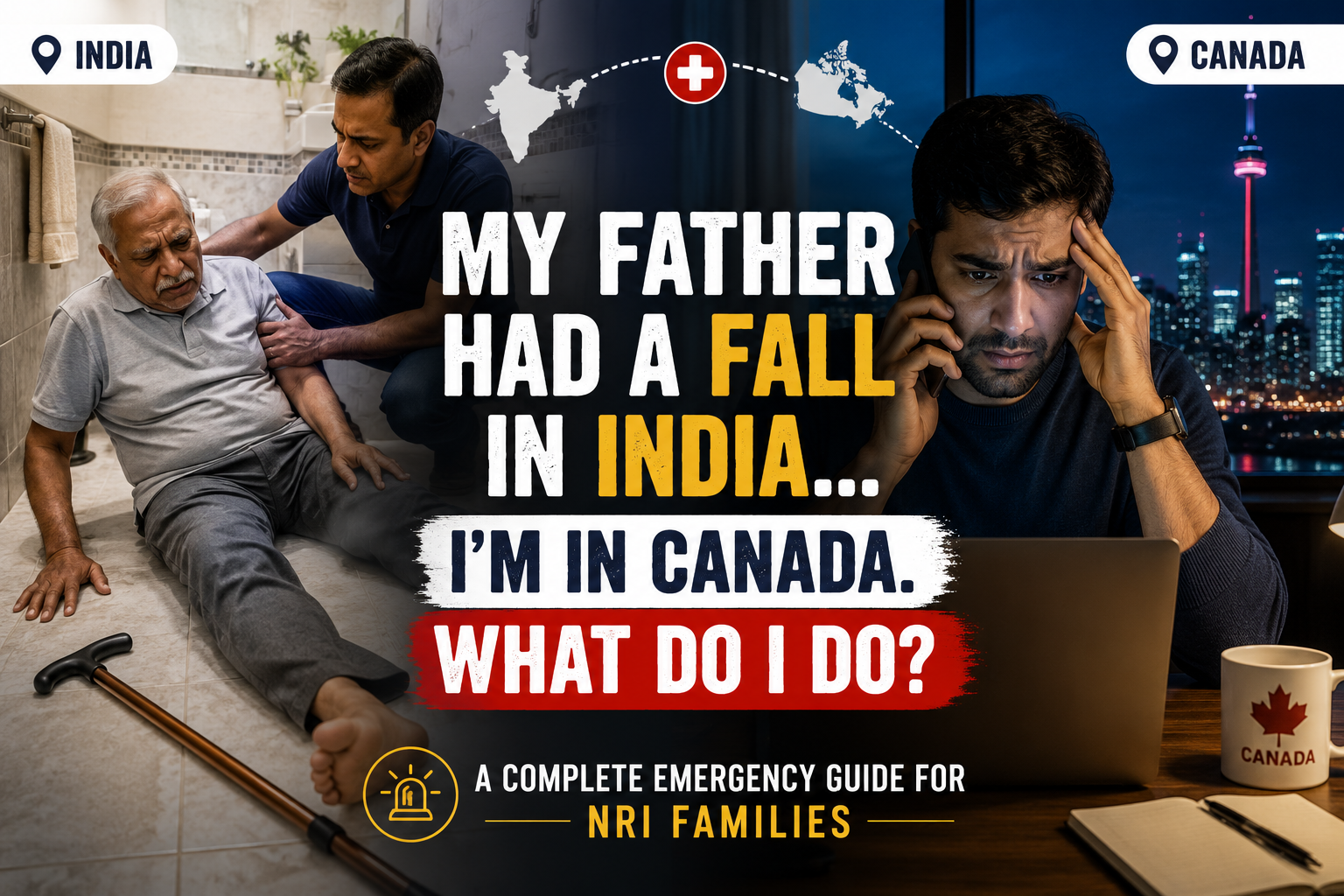
It’s 2:13 AM in Toronto.
Your phone rings.
You reach for it half-asleep, squinting at the screen. It’s a number from India — a neighbour you’ve spoken to maybe twice. Your stomach drops before you even answer.
“Uncle has fallen in the bathroom. He is conscious but he cannot get up.”
In that moment, 11,000 kilometres collapse into a single, suffocating thought: I’m not there.
The panic is immediate. So is the guilt. You’re scanning your mind for what to do while simultaneously wondering how long your father, mother, or elderly parent has been on that floor, whether anyone is with them, whether they’re in pain. You feel utterly helpless — because you are far away, because it’s the middle of the night, and because no one ever told you what to do when this moment came.
Emergency Checklist for NRI Families (Save this now — you may not have time to search for it later)
🚨 Emergency Checklist for NRI Families
- ✓ Call your parent immediately to assess their condition
- ✓ Contact a neighbour, building security, or local friend to reach them physically
- ✓ Assess consciousness, speech, and ability to move
- ✓ Call 112 if serious symptoms are present
- ✓ Arrange hospital transport if needed
- ✓ Inform siblings and other family members
- ✓ Keep medical records and insurance documents accessible
- ✓ Ensure someone stays with your parent at all times
This guide exists for exactly that moment. Whether you’re in Canada, the UK, the USA, or Australia — read this carefully, share it with your siblings, and bookmark it. Because falls are one of the most common emergencies elderly parents in India face, and the difference between a manageable crisis and a life-altering one is almost always how quickly the right response begins.
Why Falls Are Dangerous for Seniors in India
Falls are not a minor inconvenience for elderly adults — they are a serious medical event with potentially life-changing consequences.
According to the World Health Organization, falls are the second leading cause of unintentional injury deaths worldwide, with adults over 60 at the highest risk. In India, this risk is compounded by home environments that were rarely designed with senior safety in mind — and by the reality that many elderly parents now live alone while their children are abroad.
For seniors living alone, the danger multiplies significantly because there is no one to respond immediately. A person who falls and cannot get up may lie on the floor for hours. In that time, conditions that were initially manageable — a hairline fracture, a mild concussion, internal bruising — can deteriorate into life-threatening emergencies.
Common fall-related injuries in elderly adults include
- Hip fractures — often requiring surgery and long recovery periods
- Head injuries — ranging from minor concussions to serious brain bleeds
- Internal bleeding — which may show no external symptoms initially
- Wrist and shoulder fractures — from instinctive attempts to break the fall
- Loss of mobility — which can be permanent if treatment is delayed
For NRI families whose parents live independently in India, the absence of immediate on-ground support is what turns a fall from an emergency into a crisis.
What To Do Immediately: Stay Calm and Assess
The moment you receive that call, your instinct will be to panic. Resist it — because your parent needs you to think clearly right now.
Before you do anything else, gather information. Ask the person who called, or if you can reach your father, mother, or elderly parent directly, ask them:
- 🧠 Are they conscious and responsive?
- 💬 Are they speaking normally, or is their speech slurred?
- 🦵 Can they move their arms and legs?
- 🩸 Is there any visible bleeding?
- 📍 Where exactly is the pain?
- 🤕 Did they hit their head?
- 👥 Is anyone with them right now?
These answers will determine every step that follows. Do not skip this assessment. What looks like a minor fall can sometimes be something far more serious — and what sounds frightening over the phone is sometimes manageable with the right response.
Step-by-Step Emergency Response
Step 1: Get Someone to Them Immediately
This is your most urgent task. Your father, mother, or elderly parent should not be alone on that floor.
Call anyone who can physically reach them in the next 10 to 15 minutes:
- 🏠 A neighbour — even a casual one
- 🛡️ Building security or a watchman
- 🧹 A domestic helper or cook
- 👨👩👧 A nearby relative or family friend
- 🏢 The Resident Welfare Association of their apartment complex
Do not wait until you have a complete plan before making this call. Physical presence matters above everything else at this stage. Someone needs to be with your parent — to reassure them, to assess the situation in person, and to prevent them from attempting to stand on their own.
Step 2: Determine Whether Emergency Medical Care Is Needed
Once someone is with your parent, you need to make a critical judgement: do they need an ambulance right now?
See the next section for the full ambulance guide.
Step 3: Notify Siblings and Family Members
As the situation becomes clearer, loop in other family members — siblings, relatives in India, anyone who can coordinate on the ground. Divide responsibilities: one person manages the local response, one manages communication with the hospital, one manages insurance and paperwork.
When To Call An Ambulance
Call 112 immediately if your parent shows any of the following:
- 🚑 Loss of consciousness at any point, even briefly
- ⚠️ Severe or worsening pain anywhere
- 🤕 Any impact to the head
- 🦴 A suspected fracture — severe localised pain, swelling, or visible deformity
- 🫁 Difficulty breathing
- ❤️ Chest pain or pressure
- 🧠 Slurred speech, confusion, or drooping on one side of the face
- 🦵 Inability to move a limb
Emergency numbers in India:
- 📞 112 — The national emergency number that works across all states in India.
- 🚑 Local Ambulance Services — Availability varies by city; ask neighbours, building security, or the nearest hospital directly.
If the situation appears less acute — your parent is conscious, communicating clearly, in mild pain, and there was no head impact — you may have a few minutes to assess further. But when in doubt, call the ambulance. Medical professionals can evaluate; you cannot do that remotely.
Common Mistakes To Avoid
In the rush of an emergency, well-meaning responses can make things worse. Be aware of these critical errors:
Do not tell them to stand up immediately. This is the most common mistake. If there is a fracture — particularly in the hip, pelvis, or spine — attempting to stand can cause serious additional injury. Even if your parent feels they can manage, insist they wait for a medical assessment.
Do not assume they’re fine because they say so. Many elderly people instinctively minimise their symptoms, especially in front of their children. “I’m okay, don’t worry” is one of the most dangerous phrases in this situation.
Do not wait until morning to act. If the fall happens at night, the temptation may be to let them rest and see how they feel in daylight. Resist this completely. Conditions like internal bleeding, undetected fractures, and concussions worsen rapidly without treatment.
6. Hospitalisation Challenges for NRI Families
If your parent does need to go to a hospital, a new layer of challenges emerges — and for NRI families, this is where things become genuinely difficult to manage remotely.
Consider everything that needs to happen simultaneously:
- 🚑 Someone must accompany them in the ambulance
- 📋 Admission paperwork must be completed
- 👨⚕️ A doctor must be communicated with directly
- 💊 Medical history and current medications must be provided
- 📄 Insurance documents must be located and submitted
- 🛏️ A hospital attendant may need to be arranged for overnight care
- ✍️ Consent decisions may need to be made quickly
From Toronto or Vancouver, managing all of this through a phone screen — across time zones, with incomplete information — is an exercise in controlled desperation. It’s not impossible, but it is exhausting, and important things fall through the gaps.
For guidance on arranging hospital support for elderly parents in India, see our [Hospital Assistance for NRI Families] page.
The Biggest Challenge: No Trusted Person on the Ground
This is the heart of it.
Even the most attentive, most devoted NRI child cannot close a 15-hour time zone gap. You cannot be in two places at once. And even if you book the next flight out of Toronto the moment you put down the phone, you will not set foot in India for at least 20 to 30 hours — assuming no delays, no connections, no complications.
A great deal can happen in 30 hours.
What NRI families need — and what most don’t have arranged until after something goes wrong — is a trusted person on the ground. Someone who can reach your father, mother, or elderly parent within the hour. Someone who knows their medical history, knows which hospital you’d prefer, and can speak to the doctor on your behalf while keeping you updated in real time.
Need immediate support for a parent in India? IndiaRoots can coordinate emergency response, hospital admissions, and real-time family updates 24/7 — so you’re never managing a crisis alone from thousands of kilometres away. [Talk to IndiaRoots Today]
Warning Signs the Fall Is More Serious Than It Appears
Sometimes a fall looks minor but conceals something significant. Watch for these warning signs, and treat each one as a reason to seek immediate medical evaluation:
| Symptom | Why It Matters |
|---|---|
| 🤕 Impact to the head | Risk of brain bleed or concussion |
| 🧠 Confusion or disorientation | Possible concussion or stroke |
| 🦴 Severe pain in the hip or pelvis | Possible fracture requiring surgery |
| 🚶 Inability to bear weight or stand | Major structural injury |
| 💫 Persistent dizziness | Underlying cardiac or neurological issue |
| ❤️ Chest pain or pressure | Possible cardiac emergency |
| 🚑 Slurred speech or facial drooping | Possible stroke — call an ambulance immediately |
Why Falls Happen at Home
Understanding why falls happen helps you prevent the next one. The most common causes among elderly adults in India include:
Environmental hazards:
- 🚿 Wet or slippery bathroom floors
- 💡 Poor or insufficient lighting, especially at night
- 🧶 Loose rugs or mats
- 🪜 Staircases without handrails
- 📦 Cluttered walkways
Health-related causes:
- 💊 Medication side effects, particularly dizziness or low blood pressure
- 🏃 Muscle weakness from inactivity
- 👓 Vision problems
- 👂 Inner ear conditions affecting balance
- 📉 Postural hypotension — a sudden drop in blood pressure on standing
For a detailed guide on making your parent’s home safer, see our [Home Safety for Senior Citizens in India] article.
Preventing Future Falls
Once the immediate crisis is resolved, the next conversation with your family must be about prevention.
Home safety improvements that make a real difference:
- 🚿 Install grab bars in bathrooms — beside the toilet and inside the shower
- 🦶 Use anti-slip mats in all wet areas
- 💡 Improve lighting throughout the home, particularly in hallways and the path to the bathroom at night
- 🪜 Add handrails on both sides of any staircase
- 📦 Remove loose rugs, low furniture, and anything that creates trip hazards
Health monitoring measures:
- 🩺 Regular medical check-ups with attention to balance, muscle strength, and blood pressure
- 👓 Annual vision testing
- 💊 A thorough medication review — ask the doctor if any current medications increase fall risk
- 🏃 Physiotherapy to strengthen legs and improve balance and coordination
These are not one-time fixes. They require follow-up, accountability, and often a professional who can check in regularly. See our [Elder Care Plans for NRI Families] for how IndiaRoots supports ongoing health monitoring.
How IndiaRoots Helps NRI Families in Emergencies
For NRI families, the real value of a professional elder care service is not what happens during a routine week — it’s what happens at 2 AM when your father, mother, or elderly parent is on the bathroom floor.
Immediate on-ground response
A trained care coordinator can reach your parent within a short window, assess the situation directly, make clear decisions about next steps, coordinate ambulance services, assist with hospital admission, and stay with them so they are never alone.
Real-time family communication
You receive updates via WhatsApp as the situation unfolds. Doctor conversations are relayed. Medical reports are shared. You are not sitting in Toronto wondering what is happening — you are informed, included, and able to make decisions.
Post-hospital recovery support
The crisis doesn’t end at discharge. Recovery from a fall — especially if surgery or extended treatment was involved — requires medication management, follow-up appointments, home visits to assess safety, and ongoing health monitoring. IndiaRoots carries this forward so the burden doesn’t fall entirely on already-stretched family members abroad.
Learn more about our [Emergency Support Services] and [NRI Parent Care Guides].
Why NRI families trust IndiaRoots:
- 🚨 24/7 emergency response — because emergencies don’t observe business hours
- 🤝 On-ground coordinators with real local knowledge and medical contacts
- 🏥 Hospital admission support including paperwork, attendants, and doctor communication
- 📱 Real-time WhatsApp updates so you are never left wondering
- 📍 Presence across 30+ cities including Chandigarh, Delhi, Haryana, Punjab, and Bangalore
- 🌍 Dedicated NRI family support — we understand the specific pressures and communication gaps you face
When you can’t be there, IndiaRoots is.
Emergency Preparedness Checklist
The families who manage these crises best are almost always the ones who prepared before the crisis arrived. Complete this today:
- ✓ A trusted local emergency contact who can reach your parent within 20 minutes
- ✓ An updated list of all current medications with dosages
- ✓ A documented medical history including diagnoses, allergies, and surgeries
- ✓ Insurance information — policy numbers, hospital network, and emergency contact details
- ✓ Clearly noted hospital preferences
- ✓ A spare key accessible to a trusted person
- ✓ A professional emergency response service already arranged and briefed
That last item is the one most families delay. It feels unnecessary until the moment it becomes absolutely necessary.
Frequently Asked Questions
What should I do first if my elderly father, mother, or parent falls at home in India?
Stay calm and immediately call someone who can physically reach them — a neighbour, building security, a family friend. Then assess their symptoms remotely: are they conscious, can they speak clearly, was there any head impact or severe pain? Based on those answers, decide whether to call an ambulance.
Should I tell them to try to stand up?
No. Do not encourage your parent to stand until a medical professional has assessed them or ruled out a fracture. Hidden fractures — particularly in the hip — are common in elderly adults and can be worsened significantly by attempting to stand prematurely.
When is it an emergency requiring an ambulance?
If they lost consciousness at any point, hit their head, have severe pain, cannot move a limb, are showing stroke symptoms (slurred speech, facial drooping, confusion), or are experiencing chest pain — call 112 immediately.
What if I’m outside India and have no local contacts?
This is exactly the gap a professional elder care service addresses. IndiaRoots provides an on-ground coordinator who responds immediately, accompanies your parent to the hospital, and keeps you updated throughout.
Can someone stay with my parent in the hospital overnight?
Yes. Arranging a trained hospital attendant is part of the support IndiaRoots provides for NRI families during medical emergencies.
How can I prevent this from happening again?
Address home hazards — grab bars, anti-slip mats, better lighting, clear walkways. Ensure your parent has regular health check-ups including vision testing and a medication review. Consider enrolling in a professional care programme that includes regular home visits and health monitoring.
The Best Time to Prepare Is Before the Next Fall
Falls happen without warning. They don’t wait for a convenient time, for you to be in the same city, or for you to have a plan in place.
The difference between a fall that becomes a manageable medical event and one that becomes a prolonged, traumatic family crisis is almost always this: how quickly trusted help arrived on the ground.
If your father, mother, or elderly parent lives alone in India — whether you’re in Canada, the UK, the USA, Australia, or anywhere abroad — the most important thing you can do today is not read another article about fall prevention. It’s to make sure someone trustworthy is already arranged, already briefed, and already one phone call away from their front door.
Because when that call comes at 2:13 AM, you won’t have time to start searching.
Need Emergency Elder Care Support?
IndiaRoots is available 24 hours a day, 7 days a week, for NRI families across India. Reach out today to discuss a care plan for your parents — before the emergency, not after it.
📞 +91-93508 98003 📧 info@indiaroots.org
Available 24/7 for NRI families across 30+ cities in India.
IndiaRoots — Trusted Elder Care for NRI Families Across India