If your parents are alone in India during Diwali, the festival can bring more anxiety than celebration. You are thousands of miles away, watching the countdown to one of the most family-centred days of the Indian calendar, and the question that sits quietly at the back of everything is: are they okay?
Diwali used to mean home. It meant lights strung across every window, the smell of ghee and marigolds, your mother’s hands shaping besan laddoos in the kitchen, your father lighting the first diya at the doorstep while everyone gathered around. It meant noise, laughter, cousins, neighbours, and the kind of warmth that has nothing to do with weather.
But when you live abroad, Diwali can arrive with something heavier too — guilt. A quiet, persistent guilt that follows you through office Diwali parties and WhatsApp forwards and “Happy Diwali” messages sent across time zones. Because somewhere in India, your parents are spending the festival of lights in a house that feels a little too quiet, a little too empty.
Are they lonely? Are they celebrating at all? Do they miss us more during festivals than any other day of the year?
If you are an NRI asking these questions right now, you are not alone. And more importantly — there are real, meaningful things you can do.
Why Parents Alone in India During Diwali Struggle Emotionally
Festivals are designed for togetherness. They are built on the assumption that family will gather, that the house will be full, that there will be someone to share the sweets with. When that assumption no longer holds, festivals don’t just feel different — they can feel like a reminder of everything that has changed.
For elderly parents living alone in India, Diwali can quietly amplify loneliness in ways they may never fully express to you.
Social circles shrink with age. Friends move away, fall ill, or pass on. Neighbours change. The community your parents once belonged to looks different now. Festivals that once meant a house full of visitors may now pass with very few.
Physical limitations can restrict celebration. Climbing ladders to hang lights, staying up late for crackers, navigating crowded markets for sweets and gifts — these things become harder with age, and without family present, they often simply don’t happen.
The emotional weight of missing children and grandchildren intensifies during festivals. Your NRI parents in India may carry this quietly all year. But on Diwali, when every television advertisement and every neighbour’s house is full of family, that weight becomes harder to set aside.
Research consistently links loneliness among elderly adults to higher risks of depression, cognitive decline, and poor physical health. Studies suggest chronic loneliness in senior citizens can increase health risks comparable to smoking multiple cigarettes a day. Diwali, ironically, is often when this loneliness peaks most sharply.
When One Parent Is Living Alone After Losing a Spouse
For parents who have lost a partner, festive days carry a particular kind of grief that is difficult to describe and even harder to watch from a distance.
Your parent is not just celebrating without their children. They are celebrating without the person they shared every previous Diwali with. The rituals, the preparations, even the small habits — who lights the first diya, who arranges the puja thali, who makes the first cup of tea that morning — all of these carry the shape of someone who is no longer there.
Loneliness in senior citizens in India is at its most acute in the months and years following bereavement, and festivals are when it surfaces most visibly. If your parent is widowed and living alone in India, Diwali is not just emotionally difficult. It can feel genuinely unbearable without meaningful support. This is one of the most important things for NRI families to understand — and to plan around.
Signs Your Parents May Be Struggling During Festivals
Parents rarely say “I am lonely” outright. They have spent decades putting family first, and they are not going to burden you with their sadness when they know you have a life to live. So you have to learn to read between the lines.
Watch for these signs in the weeks around Diwali:
- “We’re not celebrating this year” — said casually, as though it’s a practical decision, not an emotional one
- Shorter phone calls — less to talk about, less energy to pretend everything is fine
- No mention of preparations — no shopping, no cleaning, no festive planning
- Reduced enthusiasm — their voice sounds flat, their responses are brief
- Avoiding social gatherings — temple events, society programmes, neighbours’ invitations all turned down
- Low mood or appetite — sometimes loneliness expresses itself physically
If you notice two or three of these together, take it seriously. Your parents are telling you something, even if they are not using words.
7 Things NRIs Can Do If Parents Are Alone During Diwali
You cannot always be there in person. But distance does not make you powerless. Here is what you can actually do.
1. Schedule a Longer Family Call — Not Just a Quick Check-In
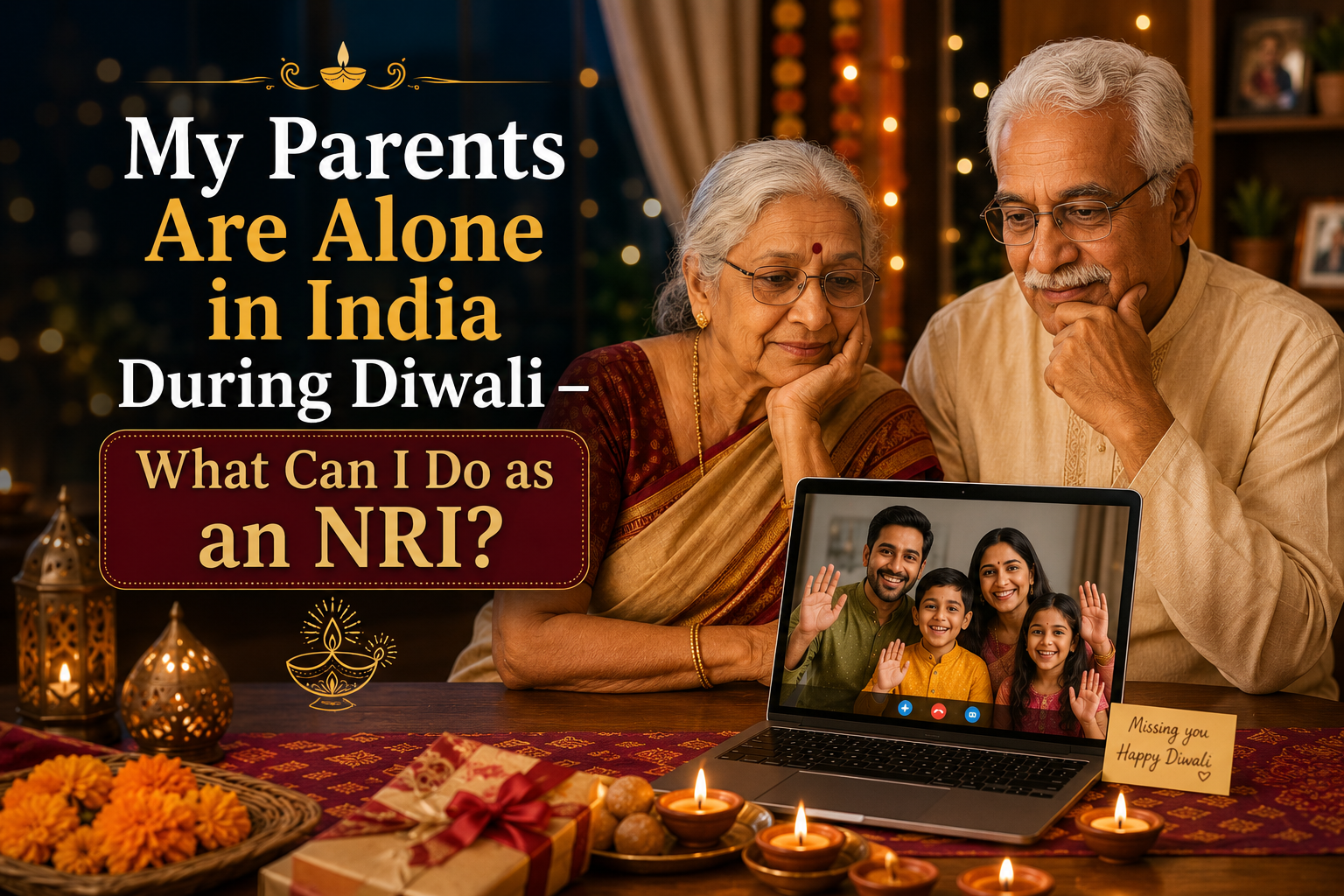
There is a difference between a five-minute “Happy Diwali, how are you, okay take care” call and a genuine, unhurried conversation. This Diwali, block out time. Do a video call instead of a voice call. Include your children — their grandparents’ faces light up in a way nothing else can replicate. Eat dinner together on video if the time zones allow. Watch them light a diya. Ask them to show you the house. Make the call feel like a visit, not an obligation.
2. Arrange a Local Celebration in Advance
You don’t have to be in India to organise a Diwali celebration there. Order diyas, flowers, sweets, and puja items online and have them delivered. Coordinate with a local helper or domestic staff to decorate the house. Hire a priest for a home puja if your parents are religious. The effort of planning this from abroad — and letting your parents know you planned it — carries enormous emotional weight for parents living alone in India.
3. Send a Personalised Gift That Means Something
Skip the generic gift hamper. Send something personal. A framed photo collage of the family. A memory album of old Diwali photographs. A handwritten letter — actual paper, actual handwriting — telling them what they mean to you. These are the things elderly parents keep. These are the things that matter long after the sweets are eaten and the crackers have gone quiet.
4. Coordinate With Relatives, Friends, or Neighbours
Think about who lives near your parents. A cousin, a family friend, a trusted neighbour. Reach out to them directly. Not to ask a favour, but to be honest: “My parents are alone this Diwali and it would mean the world to them if someone stopped by.” Most people are glad to help when asked sincerely. This one phone call from you can change your parents’ entire day.
5. Plan a Small Surprise
Think about what makes your parents feel celebrated. Maybe it’s their favourite mithai from a specific shop. Maybe it’s a flower arrangement. Maybe it’s having someone come by to do a proper Lakshmi puja with them in the evening. Plan something they are not expecting. The element of surprise — knowing that their child thought of them, planned something, made it happen from thousands of miles away — is deeply moving.
6. Encourage Social Engagement
Gently encourage your parents to step out. Temple celebrations, housing society events, cultural programmes in the neighbourhood — these exist and they matter. Sometimes elderly parents withdraw from social life gradually, and a nudge from a child they love and trust is all it takes to re-engage. You can even help them find local senior citizen groups or community clubs that organise festive programmes for Diwali for senior citizens.
7. Consider Companionship and Emotional Support Services
Sometimes what your parents need most isn’t another gift or another phone call. It is someone physically present — someone to sit beside them during the evening aarti, to help light the diyas, to share a plate of sweets with, to make an elderly parent alone in India feel genuinely seen and celebrated.
Companionship care for elderly parents in India is specifically designed for moments like these. A trained, compassionate companion who visits your parents during Diwali can provide the kind of emotional support for elderly parents that no video call can replicate. For elder care for NRI families navigating this from abroad, professional festive care for senior citizens is worth exploring seriously.
Why Festivals Matter More as Parents Get Older
When we are young, festivals feel like events. When we are old, they feel like anchors.
For elderly parents, Diwali is not just about lights and sweets. It is about feeling that they still belong to something. That the rituals they have observed for decades still mean something. That their life, with all its changes and losses, is still worth celebrating.
When parents spend Diwali alone, they are not just missing a party. They are missing a sense of belonging. And for NRI families, understanding this is the first and most important step toward making it better.
How Some NRI Families Make Diwali Special From Abroad
The family in New Jersey booked a local catering service to deliver a full festive meal to their parents in Pune on Diwali evening. They arranged for a cousin to be present and set up a laptop so the entire family could have dinner together on video. Their mother later said it was the best Diwali she’d had in years.
The couple in London coordinated with their parents’ neighbour in Chennai to decorate the house with flowers and kolam the morning of Diwali. They sent a gift box three weeks in advance with strict instructions not to open it until the evening. Inside was a photo book of thirty years of family Diwalis. Their father cried.
The family in Melbourne arranged companionship care for their 78-year-old widowed mother in Delhi, who had been living alone since their father passed. The companion did the puja with her, sat through the evening, and helped her call each of her children one by one. She told her son it was the first Diwali in two years that she hadn’t cried alone.
These are not extraordinary stories. They are what happens when NRI families decide to do something instead of feeling helpless.
When a Phone Call Isn’t Enough
A phone call matters. Never underestimate it. Your voice, your face on a screen, your children wishing their grandparents — these things carry real love across real distances.
But a phone call cannot hold your mother’s hand while she lights the first diya of the evening. It cannot sit beside your father during the puja and make sure he isn’t doing it alone. It cannot share a plate of sweets with someone who has been eating meals alone for months.
There is no shame in acknowledging that. Long-distance caregiving has real limits, and those limits are not a failure of love — they are simply the geography of the life you have built.
What matters is that you don’t mistake the limitation for helplessness. Emotional support for elderly parents through professional companionship care means there are people in India who can be physically present with your parents when you cannot. Whether your parents need daily living assistance, health monitoring, or simply a warm and trusted presence during the festive season, elder care for NRI families has never been more thoughtfully designed than it is today.
Your parents deserve not just to survive Diwali. They deserve to celebrate it.
Final Thoughts — Your Parents Don’t Have to Spend Diwali Alone
If your elderly parents are alone in India during Diwali, small actions can make a meaningful difference. Whether it is planning a local celebration, arranging a surprise, reaching out to neighbours, or ensuring they have companionship during the festive season — helping your parents feel connected matters more than any gift you could send.
The guilt you feel is a sign of love. But guilt by itself doesn’t light a single diya. Action does.
You cannot undo the distance. But you can make sure your parents feel that the distance does not equal indifference. Call earlier than you think you need to. Plan further in advance than feels necessary. And if your parents are truly alone — if their social world has grown small, if they are struggling more than they let on, if one parent is navigating bereavement alone — consider getting them real, consistent, and compassionate support from someone who can actually be there.
Diwali is the festival of light over darkness. This year, make sure that light reaches your parents too.
Frequently Asked Questions
Can elderly parents feel lonely during Diwali? Yes. Festivals often increase loneliness among senior citizens, especially when children live abroad. The collective celebration around them can make their own quiet feel even sharper.
How can NRIs help parents in India during Diwali? NRIs can schedule longer video calls, arrange local celebrations in advance, coordinate with trusted neighbours or relatives, send personalised gifts, and organise companionship or emotional support services for their parents during the festive season.
What should I do if my parents are alone in India during festivals? Plan ahead rather than reacting on the day. Create social engagement opportunities, reach out to local contacts, arrange festive care, and consider professional companionship services if your parents lack nearby family support.
How can elderly parents celebrate Diwali safely? Avoid crowded areas and open-flame crackers, use safer electric diyas, keep emergency contacts accessible, ensure medications are stocked, and celebrate with a trusted companion or caregiver present.
Is loneliness during festivals a serious concern for senior citizens in India? Yes. Research links loneliness in senior citizens to significantly higher risks of depression, cognitive decline, and deteriorating physical health. Festivals, when spent alone, can intensify these effects considerably.
Are companionship services helpful for elderly parents in India? Absolutely — especially for parents living alone or coping with loneliness after losing a spouse. Companionship care for elderly parents provides consistent emotional support, meaningful social presence, and the kind of in-person connection that long-distance calls cannot replace.
How can I make my parents feel loved during Diwali from abroad? Beyond calls and gifts, think about presence — arranged locally on your behalf. A planned puja, a decorated home, a trusted companion, a surprise delivery, a neighbour asked to visit. Love expressed through effort and planning carries as much weight as love expressed in person.